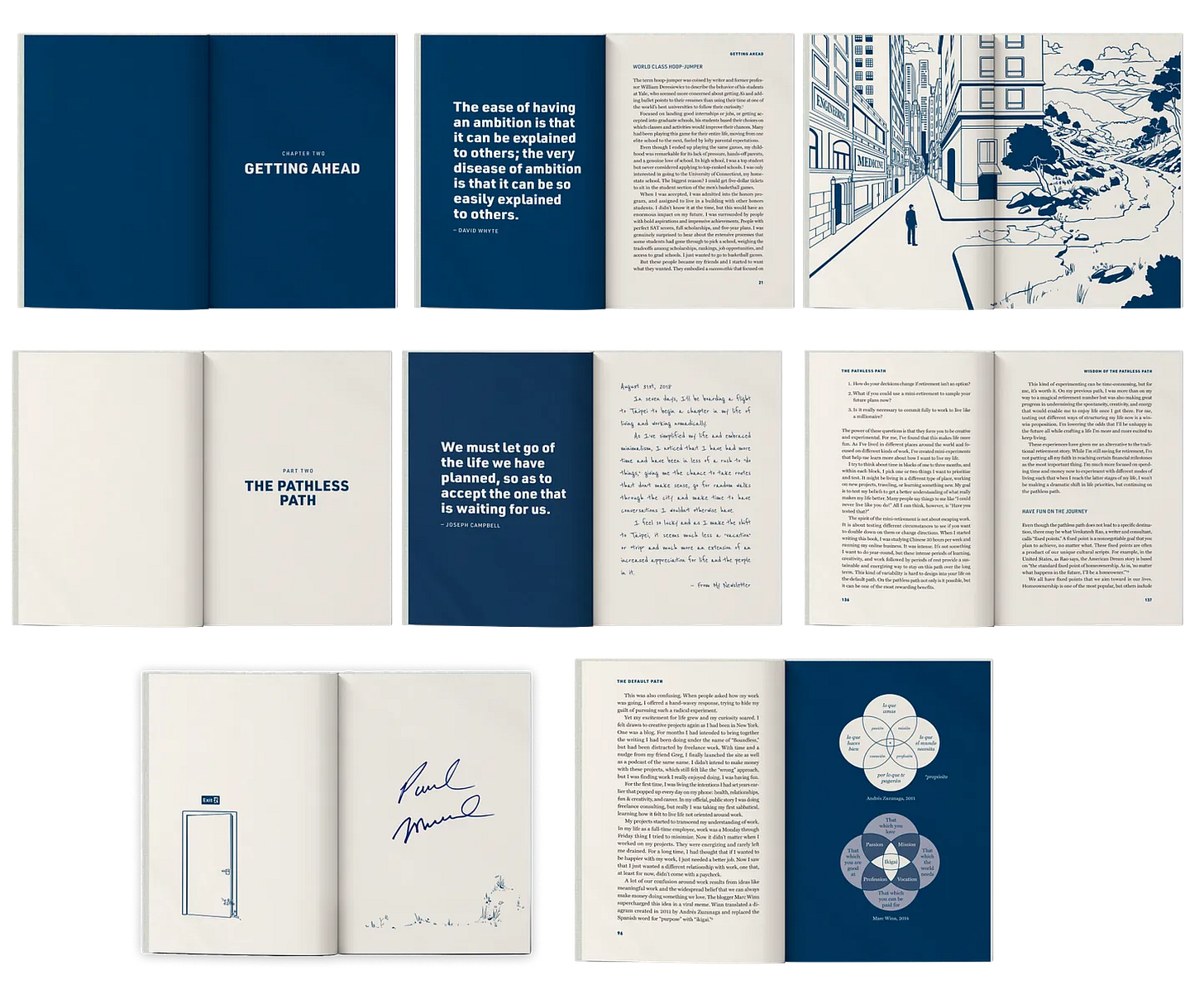
30 Ideas From The Pathless Path
The Pathless Path is a big idea about embracing uncertainty and moving through life without a plan.
In my favorite passage from the book, I wrote:
The Pathless Path is an alternative to the default path. It is an embrace of uncertainty and discomfort. It’s a call to adventure in a world that tells us to conform. It’s also a gentle reminder to laugh when things feel out of control and trusting that an uncertain future is not a problem to be solved.
The phrase has become a meme embraced by many people on weird paths in the world. To others, who haven’t read the book, they often want me to define it more clearly. Unfortunately, it can’t be defined that well . The best I can do is share a collection of ideas that for me, all contribute to a way of life I refer to as Pathless Path:
1. The Default Path
The Default Path is a narrative that people judge their lives against, based on cultural and familial norms. It is often centered around achieving four to five positive life events before one turns forty. Even if a person’s life does not follow this specific path, they may still anchor their self-worth to it and judge themselves against its standards.
2. The Pathless Path
The Pathless Path is an alternative to the default path. It is less of a rigid script and more about learning to trust that uncertainty is not a problem to be solved. It also serves as an “off-ramp” from the dominant energy of the default path, which doesn’t offer many clear alternatives.
3. “Hoop Jumping”
This is an idea from William Deresiewicz’s book, Excellent Sheep, which describes how young people often aim their lives at doing things not for personal fulfillment, but simply to check items off a list. This is done in the hope that it will enable them to compete for other things, such as jobs, scholarships, or admission to graduate schools.
4. The Inner Ring
This idea comes from C.S. Lewis, who suggested that at some point in our lives, we will inevitably be drawn toward an “inner ring.” The problem with the inner ring, in Lewis’s telling, is that once you are actually inside, the entire pressure shifts to simply avoiding being kicked out.
5. Accidental Meaning
Much of the meaning that previous generations derived from orienting their lives around full-time corporate jobs was actually a result of other circumstances. These factors included strong and growing economies, the prevalence of two-income households, and more affordable housing.
6. Work Was Not Always Central
In people’s minds, work wasn’t always seen as the primary aim of life, or at least that’s what historical writers tell us. In ancient Greece, the word for “work” literally translated to “not-at-leisure,” which placed more importance on leisure and active contemplation.
7. Leisure Is Active
If we travel back in time again, we find that leisure before the 19th century did not typically include passive activities like entertainment or watching television. It was an active state, one that had more to do with how connected you were to your actions rather than simply not-working.
8. Modern Protestant Ethic
The Protestant Work Ethic and its concept of a “calling” still have a strong influence on our current relationship with work. Common statements like “work is life” and “use your gifts” are clear derivatives of the teachings of John Calvin and Martin Luther.
9. The Meaningful Work Trap
Meaningful work is a promise made to potential employees by almost every company these days. Yet, reaching this imagined, blissful state of meaning through what companies are offering is often unrealistic. However, that doesn’t stop companies from trying to sell the idea.
10. Aspiration
I’ve found the philosopher Agnes Callard’s concept of “aspiration” to be a great companion to the idea of the pathless path. She argues that we cannot know which values we will acquire before we embark on an aspirational journey. This is in sharp contrast to the default path, where goals like money and positions are already defined for us.
11. Spirit of the Fool
One thing that holds people back from trying new things is the fear of feeling like a fool, causing them to retreat to the safe comfort of their existing competence. George Leonard argues this “spirit of the fool” is an unavoidable part of the process, and I believe it’s impossible to fast-track your way through it on a creative path.
12. Prototyping Life Shifts
People falsely view life changes as all-or-nothing leaps. This is because this is how the stories are often told, and we tend to seek evidence that confirms this narrative. We listen for what we want to hear. Yet, if you dig deeper, you’ll find that most people prototype major changes in subtle and slow ways.
13. Non-Work Experiments
My biggest moments of growth and my greatest “aha” moments have aligned with periods of extended non-work. Whether it is a week off from “worker mode” or a one-month sabbatical, this is how I reconnect with who I truly am. These experiments also have a nearly 100% approval rate from those who try them.
14. Wonder Tips the Scales
People often hate change because of the discomfort that comes with uncertainty. As a result, they will stay on paths with high levels of certain discomfort for a long time. The one thing that reliably breaks this pattern is developing a sense of wonder—an excitement about the future and its possibilities.
15. Rethinking Retirement
Retirement is a default destination and reward on the default path. It frames life as a financial calculation that needs to be solved, but in doing so, it undermines the search for things you actually enjoy doing. It’s better to take “mini-retirements” now to find what you truly like doing in the present.
16. Money & Life Energy
A useful way to reframe money is to think about the “life energy” you are trading for it. If it feels like a fair trade, then go for it. This trade-off is also easier to assess when your income goes down because you are forced to make choices, and you may uncover things about your spending that you were deluded about.
17. Having Enough
The default path always defaults to wanting MORE. Unless you’ve defined your own personal definition of “enough,” you will likely accept that having more money, more stuff, and more of everything is the natural way of being.
18. Having Faith
You can’t solve uncertainty; you can only learn to live with it. Having faith that things will be okay is vital. Many people think that unconventional paths are risky, but often, taking them exposes people to the fact that they never really had a relationship with uncertainty at all.
19. Positive Freedom
The psychoanalyst Erich Fromm argued that leaning into “positive freedom”—the freedom to self-actualize—was a relatively new concept from the 1900s onward. He noted that since it was so overwhelming, most people just wanted an easy way out, opting instead for conformity and political movements. Embracing it is still very hard today.
20. The Second Chapter of Success
Many of the happiest people don’t completely avoid the default path; instead, they graduate to a different set of metrics and aims in life. I call this the “second chapter of success,” and it involves making deep commitments to things you want to continue doing over the long term.
21. Find the Others
The internet makes it possible to “find the others”—people who do things like you and care about the same things you do. The reason to do this is not to fall into the “you are the average of your five closest friends” nonsense, but simply to make your life better by being around people you genuinely like.
22. Define Your Own Prestige
Prestige is simply what we, as a collective, pay attention to and care about. With the internet, we can find new forms of prestige beyond money, status, positions, or fame. For example, we can gain prestige for sharing ideas. The more varieties of prestige there are, the better.
23. Generosity as a Practice
I’ve learned accidentally that generosity is extremely uncomfortable, but it is a skill that can be learned. Simply giving to charities is not practicing generosity; it’s just fitting into the norms of society. True gifts are often uncomfortable because they create bonds between people.
24. Who Do You Serve?
If you think my ideas are dumb, great! I’m not writing for you. You should focus on the people who care about what you have to offer. People who get grumpy about what you are offering suck. Go find the people that give a damn and focus on them.
25. Overcoming Cynicism
It’s easy to be cynical in today’s world, and I still fall into that trap myself. But the person who ultimately pays the price for this cynicism is you. If you are trying to do something that requires creativity, cynicism is kryptonite. You must aim for optimism and never give up.
26. Hustle Traps
Instead of figuring out what you truly want, you might end up aiming for what other people are doing or following a script you think you should follow. For example, you might still work five days a week even though you work for yourself. Why not six, or four?
27. The Real Work of Your Life
We have a very narrow definition of work, seeing it as something that can be paid for and that typically exists in the form of a job. The real work of your life is to find the things that are worth committing to. Once you do, the only “job” you have left is to design your life so you can continue to do those things.
28. Escaping Work Is (Usually) a Trap
Most people don’t actually want to escape work; they just want a break from being in “worker mode.” The idea of being “financially independent” is a delusion in today’s world because it just means you are relying on the labor of other workers. Because of this, “Coast FIRE” is probably the most realistic form of the FIRE movement.
29. We Want to Be Useful
Most people have an innate desire to contribute. Even in digital nomad hubs, where people could easily stop working forever, I find that most people still choose to do things to help others or create something new. Realizing this can help you understand how important it is to search for your “real work.”
30. You Don’t Have to “Buy the Culture”
In the book Tuesdays with Morrie, Morrie says that you don’t have to buy into the culture; you can create your own. Your life is what you make of it. The default path is one way that can work, but for many, it also carries a high risk of leading to numbness and cynicism.