Hannah Frankman On Why Homeschooling Matters & Why It Helped Her Skip College
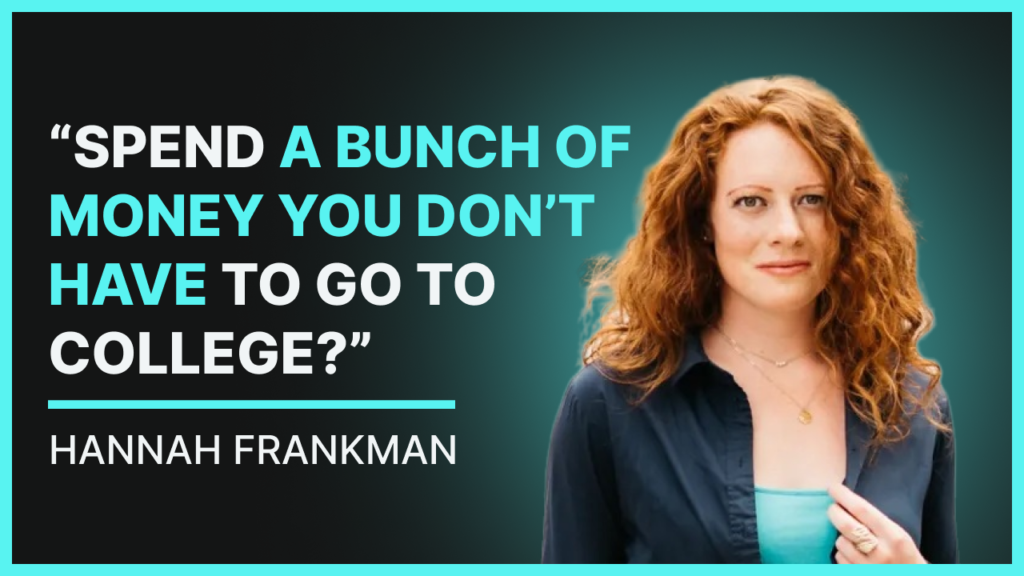
Apple Podcasts · Spotify · YouTube Hannah is awesome and you should listen to this podcast. She grew up homeschooled, is an endlessly curious person, has a deep sense of agency, and is a pro at carving her own path. She’s done a ton of things including writing, coaching, and working at startups and has created jobs for herself, negotiated working remotely (before it was cool), and has done a ton of other things. She recently founded Rebel Educator which is a media brand that aims to share more about homeschooling and alternative education with a broader audience online.
Follow Hannah:
Links Mentioned:
- 3 Reasons Homeschoolers Often Become Entrepreneurs - Foundation for Economic Education (fee.org)
- No, You Don’t Need to be “Qualified” to Homeschool Your Children - Foundation for Economic Education (fee.org)
Watch & Listen
- 0:00 – Preview of episode
- 0:43 – Intro to Hannah
- 1:46 – Growing up homeschooled
- 7:23 – The “guinea pig child”
- 12:19 – Learning a sense of agency
- 13:48 – Realizing she’s on a different path than the others
- 15:58 – What does it mean to love school?
- 18:00 – Unschooling
- 24:54 – Skipping college
- 31:28 – The four-year experiment and the hard first year
- 39:16 – Looking back - what would Hannah change?
- 41:11 – Working remotely
- 48:57 – Taking an 8-month sabbatical
- 55:25 – Learning to trust your gut
- 1:04:16 – New project: rebelEducator
- 1:09:16 – What motivates Hannah?
- 1:12:30 – Rapid fire questions with Hannah
Transcript
Follow Hannah: Links Mentioned:
Read the full transcript
Paul: Welcome to The Pathless Path. I'm Paul Millerd, and in this podcast, we examine the invisible scripts that run our lives and dare to imagine new stories for work and life. Uh, yeah, so welcome to The Pathless Path, Hannah. Uh, excited to dive in. Uh, we've gotten to know each other living in Austin, uh, meeting so many cool people in Austin. I've really, uh, loved living here.
Um, we're going to talk about a lot today. So you have a fascinating background, you have so many interesting ideas. Right now you're involved in building an education brand called Rebel Educator. Love everything you're doing. You used to work at an education startup, Praxis, which you described as your dream company, I think.
Hannah Frankman: Yes.
Paul: It's an alternative education system for university education or higher education. You grew up being homeschooled. You're a big advocate of it. You enjoyed the experience. Excited to dive into your story. Welcome, Hannah.
Hannah Frankman: Thank you so much, Paul. I'm so excited to be here. I feel like the minute I heard about the project you were— like the projects you do and like your brand was called Pathless Path. The Path, I knew for certain we were going to be friends. So yeah, I'm really excited to be on the podcast. Thanks for having me.
Paul: Awesome. So, so much I want to talk about today. Um, would love to start with just growing up. Your parents decided to homeschool you. Um, you've written about how, like, you didn't, you didn't realize, like, when you're doing this, like, when you were a kid, you didn't realize this was, like, a different thing, right? So what, what was it like, um, growing up as Hannah?
Hannah Frankman: It was awesome. If I'm being honest, I thank my parents at least once a month over the phone for, or over text or both, for homeschooling me. Because in retrospect, I realize what a phenomenal experience it actually was. For me, it was just fun at the time. Like I was doing school at home. My family is actually really weird cuz my, My dad worked from home, um, like 20 years ago before working from home was a normal thing to do.
And my mom was a stay-at-home mom homeschooling my sister and I. So we were just all home all the time. And it wasn't until I hit like high school when I realized that normal families don't, like they see each other for dinner every night. And I thought that was so weird. Um, yeah, growing up homeschooled was. Was great.
It was one of the best things that ever happened to me.
Paul: Yeah. So you sort of had this, okay, this is what— these are things people can do. You've written about this. Like, just— I love that phrase. Like, this is things people can do, but you realize things people can do that were not normal for like broader groups of people, but you just grew up around, right? So at 12, you're— you've written that your mom called you an entrepreneur and you're like, oh, that's pretty cool.
But like, what, what was that like? Like, Tell me a little bit more about that and the background around that.
Hannah Frankman: Yeah, so I always had an entrepreneurial streak in retrospect. I just was a really creative kid. I loved making things. And then I realized pretty early on that adults thought it was cute slash impressive at, at like 8 or 9. I thought they thought it was impressive in retrospect. I'm like, wow, they must've thought that was adorable.
Paul: Um, but.
Hannah Frankman: Adults would think what I was working on was cool and they'd want to support me. So I started like all these little, like I was just the kind of kid that wanted to try everything I'd see. Like I'd read a magazine and I'd be like, this is cool. I want to try making a magazine. And I'd see people starting businesses and I'd be like, that's cool. I want to try starting businesses.
So I had all these little projects I was working on all the way through elementary school. I think the first thing I actually paid, I think I sold, I think it made a dollar off of it. I made these tiny little magazines. They were like literally this big.
Paul: Wow.
Hannah Frankman: They were like, I don't know, like gnome magazines and doll magazines. And I sold one. I sold a subscription to my grandma's friend for a dollar. And I thought that was really cool. But when I was 12, I started making these hand-knitted dolls for my sister. And I just thought it was really fun.
I liked being crafty. I liked knitting. I thought coming up with knitting patterns was cool. So I made these dolls and my sister loved them and she took them to our homeschool co-op and some of the moms there thought they were really cool and they wanted them for their daughters. So they asked me if they could commission me. I learned a big word there, commission, commission me to make these dolls.
And so I was like, yes, absolutely. And I went all in and I made like a whole hand-drawn catalog and I came up with prices and I made these like outfit setups and I had like a little color swatch of all the different yarn colors that I'd bring in and they could like choose the yarn colors they wanted. And my mom was like, you're an entrepreneur. And that was another big word. I had no idea what that meant, but like, that sounds cool. Uh, let's, let's go with that.
Um, so yeah, it was just like, really, I was just playing as a kid, but then I realized really quickly that it was quite fun to do that and like actually make money doing it. And that was a thing, like I could use my yarn and go make like knit dolls and then use the money to go buy more yarn and make more dolls and go buy other things. And I became pretty hooked on the entrepreneurship thing pretty quickly.
Paul: How did your parents talk to you about doing those things? Were they encouraging you or they just like didn't question what you were doing? How did like you think about doing stuff when you were a kid?
Hannah Frankman: A little bit of both. My parents, in retrospect, my parents did a fantastic job giving my sister and I, just like equipping us with an environment that was full of things to go explore. There were books everywhere. There were crafting supplies everywhere. There were like art supplies. And like my dad was always out in his shop building things and we were always welcome to, you know, like come out and see what was going on if we wanted to.
So there was ample opportunity to go try stuff. And then when my sister or I would have a big crazy idea, like I'm going to start a doll business, my parents would just kind of be like, okay, like here's, I remember my mom suggesting that I like find a pretty notebook and learn how to bookkeep. She's like, you should learn how to keep track of the money that you're making. So I learned bookkeeping when I was 12, like very basic bookkeeping, but I learned bookkeeping. Um, so like they'd come along with little nudges like that, but for the most part, they just, let my sister and I free to go play for hours every day. And that's where most of these schemes got concocted.
And we'd come running in, mom, mom, I have this idea. And we'd tell them about it and they'd be like, that's cool. And so we're given a lot of freedom.
Paul: Is there a normal day for homeschooling? Like, I mean, I know with homeschooling, I've talked to many people who have done it. There's a wide range, right? It's not just like one thing. There's like, sort of free range, like let your kids do whatever they want. And then there's more of like, okay, let's like structure this and create some structure.
So what was your experience like?
Hannah Frankman: Yeah, it kind of varied based on the year. So I was my parents' oldest kid. So I was 100% the guinea pig child. And so there was a lot of trial and error really early on. Cause I went to a private preschool and kindergarten, like a very Montessori-inspired kindergarten. And then like I was involved in the decision in kindergarten that we were going to try homeschooling in first grade.
And at first it was a little more schooly where, you know, like my parents were kind of breaking out of the traditional school mindset too of needing to have specific curricula that you're following and specific standards that you're meeting. And so early on it was a little more schooly where like we'd sit down every morning, we'd be like, okay, this is what we're learning about today. And then as I got older, it became like, it just kind of organically evolved to match my learning style and also the things my parents were learning. So in elementary—
Paul: I wanna pause you there.
Hannah Frankman: Yeah.
Paul: Kindergarten, you said your parents, you were involved in the decision making. I feel like we need to cover that. Like talk to me through like you're 5 or 6 years old. What are you like, how are you like involved in that meeting?
Hannah Frankman: That is such a great question. Yeah. Um, so I was, I was 6, I was born in October, so I was like on the older end of the grade spectrum, which makes a little bit of a difference.
Paul: 6-year-old Hannah Frankman's at the table and they're like, all right, Hannah, what do you think? Should we homeschool? Like, how are you thinking about your education? Like, what was that? Do you remember this?
Hannah Frankman: I do. I remember this vividly. Oh wow. My parents were really open with me about the process. It was my dad's idea first to homeschool me. And then my mom was fairly quick to get on board too.
And we were just weighing a lot of options. So we went and visited a bunch of different schools my kindergarten year. We went and visited the local elementary school, like the public school. And we visited a couple different private schools. And we visited, I remember we went to, like, I remember visiting all these different schools 'cause I thought they were all really cool. And in retrospect, it was actually like laying the foundation for the next 20 years of my life and probably the rest of my life, honestly, 'cause I keep ending up back in education.
But I remember we visited a school that was, it was like a kind of a part, like a half school kind of thing where like you'd go in a couple days a week and then the rest of the time you'd spend at home. We visited this like really nature-inspired school. We visited a couple Waldorf schools. And so I remember going on all these tours and then my parents would just like allow me to be present while they were having conversations about all of the different things. And I kind of, you know, had an idea that the Waldorf school was a really long drive. It was like an hour each way and it was expensive.
So like we weren't sure about that one. And I remember like I was involved in the conversation where we went to visit the local elementary school. They were doing their end of year math test and I'd already learned everything that was on the math test in kindergarten. So my parents, like, I was there for the conversation where my parents were like, yeah, we can't really send you there because you're going to be really bored. Um, and then I remember my parents took this big piece of paper and they taped it up on the wall by the stairs and they wrote pros on one side and cons on the other. And they explained how a pros and cons list worked.
And then they left markers there and we could all write stuff on the pros and cons list. And I'm sure mine were very phonetically spelled, but my big contribution was on the cons list was I couldn't ride the school bus. I thought that was gonna be a real bummer if I didn't go to real school. But like, I got to see them adding things to the list. So it was like really an educational experience where I was really involved. Like, I don't think if I'd been like, mom, I decided I wanna go to the Waldorf school, I don't think they would've been like, okay, we're gonna drive an hour each way twice a day.
Like, cool. It wasn't like I was, I could just do whatever I wanted, but I was really allowed to be part of the process. And they definitely had my buy-in when they decided to homeschool. It was very much, it felt like this mutual, we're all gonna experiment with this and we're gonna see how this works. And my sister is 6 years younger than me, so she was just a baby at the time. And that was part of everybody's incentive too, was like my mom really wanted me to be there with my sister.
She wanted us to have a relationship. And in retrospect, I'm so grateful for that. So like I was bought into that part too. I was like, yeah, I want to watch like my little baby sister learn how to talk. I want to be home for that. So I was super on board.
Paul: Did your parents have the sense of— so I think you're somebody with like a lot of agency, like compared to a lot of people I meet like your age. I think like you, you have a high degree of agency, the sense that like you can do so many things. And like, was that something your parents were thinking about? Like we need to give this person power to make decisions or is it kind of a natural byproduct of homeschooling and the environment you grew up with?
Hannah Frankman: I think it's both. I think it kind of becomes a virtual cycle where it keeps begetting itself. I know that for my dad, he was really aware of the fact that I was a really creative kid and he didn't want school to stifle that. Like, he wanted me to be free to go do art all day or go, like, play make-believe and come up with, like, a whole fantasy world and make up a story and not have school crush that. And I think the agency went along with that where I was a pretty precocious little thing. I was a very precocious little thing.
Um, I wish I'd held onto more of that, honestly. Like I was a real go-getter when I was like 5. Um, and I think my parents were really aware of wanting to nurture that, which I, that part I wasn't aware of at all. I didn't have that kind of self-awareness when I was 5, but I think I had some of that innately. My parents wanted me to be in an environment that allowed that to continue. And then, and then the environment and the encouragement just like allowed that to blossom, which I think a lot of kids have it and it just gets stifled by all the have-to-dos of school.
So I think it's a little bit of both.
Paul: When did you get the sense that you might be on a life path that was different than other kids?
Hannah Frankman: Um, that is such a good question. Uh, when I was like 18, maybe. I don't, I don't know. I feel like there were such gaps in my awareness. So when I was, cause I was around other homeschoolers and so homeschooling was a much more normal thing to me than it is to your average person. Cause I was around other people who were doing it.
And then when I was, I was on like a pretty academic track too in school, like in elementary school, it was kind of, there was a lot of free time and free play. And then starting in middle school and then definitely in high school, I had a really heavy academic focus because I loved school.
Paul: Yeah.
Hannah Frankman: I got so sad my senior year because I was like, oh, I have to go do other things besides school now. This is really terrible. It's tragic. But when I was in high school, I was structuring my education for a long time around just assuming I was going to college because I had this whole picture in my head of just this dream world that I thought college was going to be. And it wasn't until I started doing a ton of research into different schools and talking to people that I realized that college is really just high school 2.0. And I was really disappointed when I found that out because I thought I was going towards this like dream of being an academic or something.
But I thought I was on a normal path at that point. It's like, I know I'm doing something separate.
Paul: Yeah.
Hannah Frankman: But I think I'm still kind of going to the same place. And it wasn't until after high school that I really realized what a starkly different path I had been on this whole time and what a different direction that was sending me in than the average person. Like, I feel like sometimes still I'm gaining awareness on this where I'm like, I really am pretty different for a 25-year-old, aren't I? Like, I just hang out with people who are like me. So I kind of forget just how weird I might seem to like the, yeah, the average person who isn't around homeschoolers.
Paul: Well, I think one thing I notice, so for me, I worked 10 years in the corporate world and like very, like, I, I liked school too and was like following the traditional path. But after leaving the past 5 years of self-employment, it took me like a few years to unlearn the fact that like I didn't need to find a manager's permission. I didn't need to get access to a company to do the thing and like really like develop the muscle of agency and autonomy. It was really hard.
Hannah Frankman: Yeah.
Paul: And then I see someone like you and it's like, oh, that person just like totally has already internalized these things, has nothing to unlearn. So it's really incredible to see. I'm curious, when you say like, I loved school, like what does that mean? Like, 'cause I actually did like school. Like I think people are too harsh on school sometimes. Yeah.
I loved learning new things and when I was challenged and like doing hard things and having the accomplishment of like getting good grades, that was rewarding. But like mostly it was like I also just loved the social life of school and I liked being around my friends most days and I was getting good grades. So like I didn't have a lot of the negative consequences that some people face. But for you, what does that mean? Like I love school. Was it like really the topics you were involved in?
Was it some of the projects you were involved in. What does that mean?
Hannah Frankman: Yeah, I think like in the purest sense, it just meant that I loved to learn.
Paul: Yeah.
Hannah Frankman: With a passion. And I never was in a context that killed that for me. And I say that with a caveat that like I actually got the other side of the coin because I hated math when I was in elementary school. I just thought it was really boring. And I think that if my parents had taken more of an unschooly approach, like if they just, you know, we'd run into this problem farther down the road when they knew more. I think if we'd taken an unschooling approach, I eventually would have come to love math because I would have come into it in my own terms.
Paul: But what does unschooling mean? Just for people that don't know, like what unschooling means.
Hannah Frankman: Yeah. Unschooling is a much more quote unquote radical approach to homeschooling when you're looking at it from like the traditional school lens. Basically, it just means that you're giving your kid a lot of freedom. You're not following like a traditional school curriculum and rules. Like a lot of unschoolers, there's, there's a whole bunch of different ways to do it, but a lot of unschoolers, they'll like let their kids do whatever they want all day and they'll let the kids' curiosity lead them to learn, like the curiosity is the compass and then kids learn to the curiosity. So a kid might innately hate math worksheets and not really care about numbers, which was 100% me.
I was like, I just wanna read a book all day. I don't wanna, I don't wanna do math problems. But then you give them a context like running a business and all of a sudden they wanna calculate profits because that's really exciting. And then all of a sudden they can't get enough of arithmetic because it's useful to them. And then when they see it through that lens, they're like, oh, these numbers are telling a story about how much money I'm making. I wonder what other stories I can go decipher through numbers.
And then all of a sudden you're totally bought in. So it's not taking like the schooly approach of, okay, you need to sit down and work on your math worksheet because it's 11:15 and that's math time, so let's go. It's kind of the polar opposite of that where the kids just get to drive the approach. So I think if my parents had taken that approach with math, I would have actually come to love it. Like I actually think I would've been really good at math. I just hated it so badly that I never gave it a chance.
And so I got to see, like my parents had more of a schooled approach with math where they're like, hey, you have this workbook that you need to work through this year. So you need to, you know, sit and do your math sheet for the day. And my mom would be like, come on, it's like 20 problems. Like, just do the arithmetic. It'll take you 15 minutes so you can go play. And I'd sit there for like 2 hours and I'd draw all over the page until you couldn't even see the math problems anymore.
Like, anything to get out of it. So I got to see that other side of it that I think is how most kids see all of education.
Paul: Were there specific topics at like 17, 18 that you were just like, nobody could stop you from just doing more and more and learning?
Hannah Frankman: Yeah, so in high school, when I say I love school, In high school, I was doing, I was using a couple programs called the Great Courses or the Teaching Company. I don't know if you're familiar. And then another one that's very similar called Modern Scholar. So basically for anybody who's not familiar, it's basically just college professors lecturing on whatever their topic of specialty is. And then this production company makes these video recordings of it and then they're marketed to like continuous adult learners. So basically you have this library of the best lectures from the best experts on all these topics that you can imagine.
And you can go get this world-class education on all of these topics. It's very similar to like a college course. Right. You just don't get the like the live engagement. So.
Paul: Well, you're getting a better professor. Like I was getting TAs in large lecture halls.
Hannah Frankman: Exactly.
Paul: Teaching me statistics, but you're getting the best professor in the world or like most engaging.
Hannah Frankman: Exactly. So that was, that was the letdown for college for me. I thought that that's what college was going to be like. And I was so excited. I was like, I want to go to college forever. I want to take all the courses.
And then I started to realize that I could pick one of these professors that I was listening to through the Great Courses and I could go to their college. And then I was stuck with like whoever else was on faculty. And I wasn't like, I realized it was going to be a downgrade. And that's what really started to kill the college dream for me. But anyway, to answer your actual question about subjects, I was such a nerd in high school. I took like all your kind of standard requirements and then I added on as much as I could possibly fit in every year.
So I did like, I'd usually double up on science and I did like oceanography one year and I did anatomy and physiology and I found this YouTube series where you could watch cadaver dissections.
Paul: So I watched a whole bunch of cadaver dissections for like pre-med in high school.
Hannah Frankman: Yeah. And then it was so cool. And I did like, I was really interested in strength and conditioning. So I watched a bunch of like workshops on like understanding your fascia and how to stretch your fascia and stuff like that. And then I did, I really loved history and literature too. So I did, I think it was my sophomore year, I did medieval literature and I read a bunch of old medieval works.
And then in my senior year, I thought it would be really cool to do the great books for English. So I did a lecture series. Huge lecture series on the Western canon. And I just tried to read as much of it as I possibly could. And it was so incredibly cool.
Paul: Wow. So you're like doing like the St. John's curriculum. Exactly.
Hannah Frankman: I wanted to go to St. John's.
Paul: But then you had already done everything.
Hannah Frankman: Well, not really. I had friends who'd gone to St. John's and it was actually a really cool experience. I just couldn't justify the cost. I was like, I don't need this degree for anything. So why on earth would I go spend a bunch of money to go read these books with a bunch of other nerds when I can, like, you know, I can do it myself.
Paul: Yeah. So fascinating because I mean, I was like an honor student in high school and like very good at school, but like none of me and my peers were like going home and doing more stuff. It was like, get the grade. With as little effort as possible. And like, that was the game. And I look back now and it's such a shame because I had so much free time and now I'm such a curious person.
Like, I wish I had explored more just on my own. Um, but when you're getting good grades, like every adult is like, good job. Like nobody's like pushing you further.
Hannah Frankman: Yeah. I, I think that's true for a lot of really smart kids is, I mean, and that is it. The system's self-perpetuating, right? Because it is the game you're preparing yourself for as you go out into the corporate world where it's kind of the same thing. It's like, do enough to impress your boss and then you can go like have fun. So like most people, the curiosity gets crushed early on and then it's never given an environment to blossom again.
Paul: Yeah. And I mean, I was lucky. I mean, I think the positive side of like traditional education is there are some heroic teachers that do find you and do support you, but The sad thing is they're the exception and not the rule. But like, I think a series of those definitely, like, believing in me along the way, like, kept that spirit alive.
Hannah Frankman: Yeah.
Paul: So not going to college, like, was there a moment you decided, like, okay, I'm definitely not going? Was it sticker price or is it like, when did you decide? And then, like, if you're not going to college, what is— how do you conceive of your next step given that, like, society is telling you you can't just Homeschool yourself until you're 80.
Hannah Frankman: Yeah, this was a really formative period for me because I think it really, it was hard. It was really hard.
Paul: I bet.
Hannah Frankman: And it really set the stage and the tone for a lot of how I was going to go about a lot of the other choices that I made. It was like a real prelude to a lot of the other really sort of counter-norm things that I've done since. that I probably wouldn't have been brave enough to do if I hadn't done this first. So the first nail in the coffin for college came— it was actually my freshman year of high school. My mom and I went to this college planning night at our, my local high school. And we, we had like, we went to this workshop on paying for college.
And I remember hearing the numbers and hearing the payment plans. And I remember coming home. And I think in retrospect, I think this says a lot about my headspace when I was in high school. I remember saying to my mom, this sounds like such a stupid way to start your adult life is to go and spend— like, the first thing you do is you go and spend a bunch of money that you don't have. Like, I was really confused about it. And that was the first moment where I was like, OK, if I can't get a really big scholarship, I'm definitely not going into debt for this.
Paul: Yeah.
Hannah Frankman: Like, I know I can learn all this stuff on my own. That's just sort of like my first principles baseline assumption for education. So this seems dumb, but I still really wanted to go to college because I loved academics and I thought like I really craved a peer group of people who were as curious as I was. Most of the homeschoolers I knew weren't interested in the same things as me. So like in my mind, I just had to make it to college and then I'd have professors who could guide me and I could have these late night philosophical conversations and I have friends that were interested in these things. I was like, I just have to make it there and then like we'll all figure it out.
And actually, this is actually an important piece of the story. Let me backtrack for a second because when I was in elementary school, I had a really great homeschool peer group and then in middle school, it completely fell apart. Like there was some mom drama in our homeschool group and it schismed into like 3 different parts. There was Group A and then there was Group B and Groups A and B hated each other. And then there was a Group C in the middle, which like wasn't invited into either group. And my family was invited into like all 3.
And we just kind of like, my mom was like, we're not hanging out with Group A or Group B. Like this is just no. Um, but Group C had like 6 kids in it or something. So it was like not a very big homeschool community anymore. And middle school is a really terrible time for that to happen. Like you're ready to start branching out and having more more peers and friends.
So I was like, I just gotta make it to high school and then I'll be able to meet cool people. And I almost went to public high school because I was so lonely and I wanted friends.
Paul: That's a good inflection point for homeschool people, right? That's— yeah, a lot of times people do go to public or private schools because of the socialization needs when you're like 13.
Hannah Frankman: Yeah, it's, it's a really big thing. So for me, I just bumped it out. I was like, okay, I gotta make it to college and then I'll find my people. But then I started to realize, I think it was like sophomore, junior year, I started to realize that college wasn't going to be this dream that I was imagining where I was going to go to this campus and it was going to be just like The Teaching Company, but in real life and full of all the other people who also get super nerdy excited about The Teaching Company. I realized it wasn't going to be like that. And I was kind of going through the process of choosing schools.
And that was really hard too, because it just became more and more clear to me that I could do all the academic stuff. Myself and the benefits of an actual college education. Like, I started learning about gen ed requirements, and I started learning about party culture at school, which wasn't really what I was going for. And I was like, I don't know about this. But everybody told me that I had to go to school or I was going to completely ruin my life.
Paul: It's like one of the most strongest memes in America.
Hannah Frankman: Everybody told me, like, I was I was working on this vegetable farm and orchard my senior year of high school. And all the people I was working with were all college graduates. And they were like, you're gonna ruin your life if you don't go to college. And I was like, I'm sorry, I'm working the exact same job as you. Like, this doesn't make sense. But they all told me I had to go.
And so the thing that really gave me the courage to not go to college actually was Praxis, which I, it, it was founded the year I was a senior in high school. And they had just launched their blog and a couple different people independently sent it to me and said, hey, I think you'd really like this. And I was like, ew, business apprenticeships. Like, I don't wanna go work in business. Haha, plot twist, I'm now obsessed with business, but I didn't know that was going to be my trajectory at the time. But the people who were writing for the blog were talking about dropping out of college and how to be successful without college.
And I was like, oh, like this was all I needed was somebody else saying the same thing. And through all of this, my parents were super supportive.
Paul: That's so cool.
Hannah Frankman: My parents were so supportive. They were just like, do what you want to do. Like, you know, they were there to have the conversations with me. They were there to explore it with me. They never told me I should or shouldn't do one thing or the other. Like I'd come to my mom and I'd be talking about the financial side of things and she'd just like walk through it with me.
And I really felt like they had the same skepticism of the system that I did. And if I hadn't had that, I'm not sure I would've been able to have the courage to opt out. But because my parents were with me, and then I found this blog from this company called Praxis that was talking about being successful without school, I felt like, I felt like I had enough where I thought I was going to be okay. And if I wasn't, worst case scenario, I could swallow the shame of being like a couple years older than everybody else in my college class, which in my head sounded awful, but I was like, I can totally handle that. So I decided to do a 4-year experiment where—
Paul: So did you design it like that at the beginning? You're like a 4-year experiment?
Hannah Frankman: No, not really. It was just like, let me see how far I can get in 4 years.
Paul: Okay.
Hannah Frankman: Like I think I can. I think I can, like, it wasn't even the specific, like, I think I can launch a career or I think I can get the equivalent of a college education. It was more just like, I think I can find my way in 4 years. And if at the end of 4 years I'm not doing something that I'm impressed by, I can always go back to school. And I really made the decision. It wasn't until the college application deadline came and passed and I hadn't applied for anything where I was like, all right, I guess we're doing this now.
Paul: Yeah. So what was that first year like? What did you, how did you spend your time? Probably some like missteps and stuff, but what was that year like?
Hannah Frankman: This is the real like shadow, valley of shadows of the hero's journey. I was very lost my first year. I went back and worked at the farm where I'd been working. I did another season there. And that first winter out of high school. So like I did that right after I graduated and then that winter.
I started teaching writing classes to my old homeschool group, which is where that transition back into education, like that pattern started where I just keep accidentally ending up in education. Like I didn't really set out to work in education. It just sort of happened. But I started, I started doing that. And then by the end of that first year, I was really pretty lost. I was like, I don't really know what I want to do.
I don't know. I don't know what I want. I don't know where to go from here. I know I'm really hungry for more, but I have no idea what that is.
Paul: And that's normal.
Hannah Frankman: Yeah.
Paul: Like I think I realized looking back, nobody, even like at this age, like nobody really knows like what they want. I think almost better is like figuring out what you don't want. By making a choice to not go to college, you sort of made a strong decision towards some space.
Hannah Frankman: Yeah.
Paul: You sort of decided not that, therefore I am taking a stand in terms of certain way of orienting my life or taking ownership. So when did you kind of find your way?
Hannah Frankman: So, I mean, it's definitely a process. I'm still finding my way.
Paul: Yeah, we all are.
Hannah Frankman: Yeah. But I think It started to become clear. So it was like April of my first year out of high school. So I was on month like 10 of being a real adult. And I really built that up in my head. I was like, I'm a real adult now.
Paul: Real adult. I don't know if I'm a real adult now.
Hannah Frankman: Are you a real adult? I'm not sure. I was such a baby then too. But in my head, I was like, okay, we're adults now. We got to like figure this out. Figure this out.
Paul: Um, but college is not like that, by the way. It is like delayed adolescence.
Hannah Frankman: Yeah, in retrospect, I know that. I didn't know that then. Um, but yeah, I decided— so I was on month 10, and I decided that like I needed to start doing some exploration. So I went— I was still following Praxis, and I went and did like a deep dive into their blog again, and I saw that Isaac Morehouse, the founder, was offering like a public speaking, a public speaking course. And I thought, oh, that would be a cool way to like dip my toes in the water and kind of get a feel for what this Praxis thing is. Like, I still don't think I want to go do some business apprenticeship, but this sounds like it might be fun to try.
So I reached out to Isaac and he and I had an email exchange back and forth and I kind of explained my background and he got really excited and he, he thought One, he was homeschooled, but two, he was like, oh, she'd be a good candidate for Praxis.
Paul: Yeah.
Hannah Frankman: So he handed me off to other people on the team and they started this multi-month sales process where they tried so hard to convince me to do the program. And I like did multiple calls with everybody and I was getting a feel for the program and I was like, these people are amazing. Like these are my people. I have to be a part of this. But I also don't wanna go through the program and pay them a bunch of money to go do an apprenticeship at a startup because I don't think I wanna work for a startup.
Paul: Yeah.
Hannah Frankman: So I was really lost for a few months and I just kept following them and I just had this really deep gut sense where I was like, this is the thing, but also doing the program is not the thing. So we need to figure this out. And then their COO posted that he was hiring an intern and I saw it like 20 minutes after he posted it and I sent him a message immediately and I was just like, I'm your girl. Like, what do you need? And he's like, cool. Like, here's—
Paul: slow down. So The email was literally like, I'm your girl. Like maybe you didn't say girl.
Hannah Frankman: It was a Facebook message. I could probably go pull it up right now if you wanted me to. I don't remember exactly what I said.
Paul: But like it was like direct, like you're like definitely.
Hannah Frankman: It was super direct. It was like, I want to be your intern. How do I apply? Was basically the message. And he got back to me.
Paul: How old were you at this point?
Hannah Frankman: I was 19.
Paul: Okay.
Hannah Frankman: Yeah. Still a little baby. Yeah.
Paul: So that's amazing. Yeah. So it seems like you sort of had this idea, like, I don't wanna pay for school.
Hannah Frankman: Yeah. Very much so.
Paul: And that was sort of forcing you like this constraint that's like, all right, I need to make it work. I like these practice people. How do I like get involved without paying them? So like, you're like, all right, maybe they can pay me.
Hannah Frankman: Yeah. This was definitely another inflection point in the story where a pattern was set where I was when I'd find something that I thought was really interesting, I was going to figure out how to get somebody to pay me to go learn about it instead of paying them to do the program, which is something that's kind of been a recurring theme ever since for me. Um, but yeah, I just wanted to be involved though. It wasn't that— it wasn't that calculated at the time.
Paul: I was just like— you would have probably worked for free.
Hannah Frankman: Oh yeah, totally. Yeah, totally. And they didn't pay me very much either. It was a tiny little stipend, like the really what I was getting was the experience.
Paul: So they, he ended up hiring you?
Hannah Frankman: He did. Yeah. I'm pretty sure I screamed with excitement when I got the email. Um, yeah, he hired me for a 4-month internship with him helping on their application review team. And they embarked on a 4-month process of trying to sell me on doing the program. Like they were treating this like a recruitment funnel and I embarked on a 4-month process of convincing them to give me a job.
And it was sort of this like head-to-head battle the whole time where he'd bring up like, hey, you know, I really think Praxis would be a great fit for you. And I'd be like, hey, I love working for you. I want to keep working for you. I don't ever want to leave. Give me more work, please.
Paul: Yeah.
Hannah Frankman: And eventually I won because they extended my internship and they kept giving me more work. And I ended up, in retrospect, they called me a contractor, but I thought I was just the intern for 15 months. Months. Like I just would not leave. And then eventually, like even went through a couple rounds of interviewing for positions that they ended up hiring somebody else for. And then on month 15, so they hired me as an intern over Labor Day of 2016 and they hired me full-time at Thanksgiving of 2017.
After 15 months, they finally gave me that job that I'd been asking for for a whole while. So I won at the end of the story.
Paul: That's amazing. It seems like you've learned a ton from that experience. Like you've been involved in coaching through them, like learning how to write, like learning how to run a virtual business, doing many different things. Looking back, like, would you have done anything different or?
Hannah Frankman: I mean, I really love where I've ended up, so I'm not mad about any of it. Yeah, I think I would've been a lot less stressed about the whole process. Like I spent those whole 15 months terrified that they were gonna email me one day and be like, hey, you've been an intern for long enough. We think it's time for you to go do something else. And in retrospect, like now that I have the perspective that I do and I've been on the other side of the table where I've been hiring people, I realize that Like if you're doing a good job, people want you to stay.
Paul: They don't want to get rid of that as soon as you're doing it.
Hannah Frankman: They don't want to get rid of that. So in retrospect, I would feel a lot more relaxed about the whole thing. I wouldn't, I would just not waste so much time being anxious about it. But you don't know until you make it through how things are going to unfold. So. Like if I could go back and talk to 19-year-old Hannah, that's what I would tell her.
I'm not sure she would even believe me, but that's what I would tell her. But like it all worked out in the end.
Paul: So you ended up working for them for several years. One thing I found really interesting is like this reading your story, this is where the autonomy jumps off the page again. In 2019, you negotiate to work remotely.
Hannah Frankman: Yeah.
Paul: So like, I love that. Like this is like, I was, I decided I would only work remotely in 2018. So like now the world has joined us as like, this is a normal thing to do, but it wasn't then. Like, so, so talk to me about like how, where you were in your work at that point and how you decided you were just going to be a nomad and still work for this company.
Hannah Frankman: I mean, at the end of the day, I just kind of told them I was doing it, but Um, but it wasn't actually like, it's not as cool as that sounds. It was like a process. Um, so 2019 was a really weird year for Praxis because we actually schismed into two different companies. We like had started building a second product and then our teams just split and made them two different things. So there was a lot of change happening in Praxis where a bunch of our original team had gone to work on this second project and there was a bunch of turnover on our team and I just took advantage of that to. To really expand my role prior to that.
Like my first year full-time at Praxis, I was just a coach doing, and like kind of like a community manager type person. And then that second year of Praxis, I just started taking on, I kept seeing projects that needed to get done that nobody had the bandwidth for, so I just kept taking them on. So I ended up doing a bunch of curriculum development for us and taking on like a more expansive coaching role and like more of a leadership role on our coaching team. And that's like really what set the stage for me to be the program manager eventually, which is what I was doing for like a year before I left. And in that process, I just became more and more valuable. And I also just became bolder about realizing that you could go ask for what you want and take it.
And so I had been, so we were living in Char— I was living in Charleston. Our office was in Charleston. We were actually a remote team when they hired me, and then like a month after I got hired full-time, they announced that they wanted everybody to move to Charleston, which I was really salty about because I wanted to be a nomad. Um, although Charleston, if you have to live somewhere, Charleston's a really good weather. It's a really great place. It was like 10 minutes from the beach.
It was amazing. Um, but anyway, I, when I moved there, I signed a year-long lease and then with, with another coworker, and then she ended up leaving the company. So I was left with this lease by myself, and my landlord was great about it. He's like, you know, I'm selling the property, you can just break the lease. I was like, awesome, thank you. And then I just started like sublet hopping because I didn't— I just had this feeling like I don't really want to commit to a whole year here.
I don't really want to be stuck here. And so I was kind of poised to be ready to make a quick exit anyway. And then after the company had split into two, two separate entities and one of our teams moved to San Francisco for a while, it just didn't make sense for us to have an office space in Charleston, cuz not everybody was there. So they were starting to make moves to move the team remotely and, and let out the office. And at that point I was just like, well, my sublet's almost up, so I'm leaving now. And at that point, Like it was a series of conversations and I definitely like, I was, you know, I made sure that everybody was bought in before I announced that I was doing it, but it was also like, I, I had been making it clear for months that I wanted to get out and their timeline kind of kept changing.
I was like, if I'm here for another year, I don't wanna be stuck in Charleston anymore. And then when they started talking about maybe getting rid of the office, I was like, well, I'm not staying until the office is closed. I'm just. I'm gonna, I don't have a home here anymore. I'm going. And at that point things were in flux enough that they were, they were okay with it.
Paul: So you start working remotely. Um, you eventually end up leaving, um, Praxis.
Hannah Frankman: Yeah.
Paul: You still speak very highly of it and it seems like you loved your experience there.
Hannah Frankman: Yeah.
Paul: Um, why, why did you decide to leave? I know you ended up taking a sabbatical. Like something I've written and talked to a lot of people about, and I definitely wanna explore that. But why did you decide to end up leaving and talk to, talk me through that decision?
Hannah Frankman: Yeah, so I left right at the beginning of 2021. So it was like maybe 15, 16 months after I went remote and I'd kind of known that this was coming for almost a year before I actually left. And there were a few things. Really, they all come down to the root of I was just running out of room to grow and my ambitions and interests just weren't mapping with where Praxis could support me anymore. And it was a really hard decision because I loved Praxis and it was, it was my first love. It was my first real startup job.
And that's a really hard thing to walk away from. I feel like if I was in the same position now, I would leave a lot sooner than I had because I just, you know, it's like you see all the red flags, but you're really in love, so you're like really gonna try to make it work. Um, so that's kind of the position I was in, and I just hit a point where I just, I knew I wasn't going to grow anymore. We were starting, like, I made pretty clear all through 2020 what my ambitions were and where I wanted to grow into in the company. And for a while I could see a path, but then as the company's kind of goals evolved, it made— it was just obvious that the things I wanted to do, there was no need for that type of position. And so 2018 to 2019 was a huge jump in responsibility.
I went from just being the like boot camp coach to managing pretty large swaths of the program experience. And then from 2019 to 2020, I took over pretty much the whole education department. So I was like managing our coaching team. I was like the version of the curriculum they're still running. I built, um, I was doing a bunch of curriculum development. I was like managing all these different moving pieces of the program.
And that felt like a really big jump. And there just wasn't, there wasn't another jump like that to be had. And I'd realized that I really liked these exponential leaps. So I wasn't going to be happy if I couldn't have that. So it was like, I definitely cried when I made the call. Um, but I knew that it was time and in retrospect, like I had no idea how important it was for me to shed that skin.
Like I kind of felt it, but I really had no clue. But it was so important for me to shed that skin so I could go do other bigger things so I could keep evolving and growing.
Paul: Yeah. Did you realize that? Did you plan to take a sabbatical, like time off, or did it just sort of, I didn't find anything else to do?
Hannah Frankman: Yeah, it was, it took a little bit of time. I thought before I quit that I needed to find, like I wasn't gonna leave until I had the next thing lined up. And then like we were just doing our 2021 planning and it became really clear to me that if I postponed for like 3 or 4 months, they were just gonna have to restructure everything again, and that wasn't fair. So I just decided to, to call it. Um, and I had no idea what I wanted to do next. So I was like, I'll give it like a couple weeks, maybe a month or two to figure it out.
And then I realized really quickly that I had been so excited about Praxis and it had been so clear to me that it was the thing for me to be doing, and I didn't wanna I didn't want to go jump into something unless I felt that way again. So I was willing to wait for the right thing and I had the freedom to be able to do that. So I decided I was going to take a break, unwind, because I was pretty burnt out too. Um, and that I was not going to work again until I found something that was so incredibly clear that it was the right thing. Or I ran out of money and I had to go get a job.
Paul: Yeah. So how long did you intend to take at the beginning?
Hannah Frankman: I thought it was just going to be like a couple months at first, but I had no idea.
Paul: How long did it end up being?
Hannah Frankman: It was 8 months.
Paul: 8 months. Okay. Yeah. So a big thing that I notice people experience is like there's sort of like this 1 to 3 month period when you sort of just are like, uh, and you're like, just like, unleashing a lot of the like built-up tension and just like, I mean, even if you like your job, there's a certain amount of like just staying in worker mode and busy mode all the time. And then like people sort of like soften into like their sabbaticals and like this is when people's like their everything just starts like exploding. Like it's like these possibilities start seeping in.
It's like, oh my gosh, I used to like this when I was growing up. Like Did you experience this?
Hannah Frankman: Yeah, actually less than I thought I was going to.
Paul: Interesting.
Hannah Frankman: I thought I was going to, like, I was like, by month 3, I will have like written a novel and I'll be like reading 10 books a day. Well, that's common too.
Paul: People have these ideas that like they're going to accomplish a lot of stuff during their sabbaticals. And from what I've seen, they actually end up accomplishing way less than they expect.
Hannah Frankman: Which is important.
Paul: Yeah. Why do you think that's important?
Hannah Frankman: Because, well, for me it was, and I can only speak to my experience. I'm actually really curious how your experience maps over this, but for me, like the most important thing from the sabbatical was just unlearning all of the stuff that I'd learned when I was working. And some of that was this hyper-bias towards creativity or productivity. Yeah. So for me, like that's part of why I didn't set a time limit on my sabbatical was because I didn't want any constraints. I didn't want a goal.
I didn't want to be constantly like watching the clock and checking how my progress was mapping over what I thought I was supposed to be doing because I'd spent years doing that and I didn't think it was actually healthy for me. Like I wasn't happy when I was doing that. So like I, I very specifically set the intention that I was not going to have an end date. Because I thought that would ruin the whole thing. So for me, I thought that unwinding process was really important, but I'm curious about your thoughts on this too.
Paul: I think for me, I experienced this sort of deeper connection to myself and this waking up to just a sense of awareness of who I am, how I'm showing up in the world, and like all these scripts I had in my head. Like when you've been doing stuff nonstop, like you sort of convince yourself that like that's what you have to be. And then I think I took like multiple breaks in my first 2 years of self-employment, some structured, some less structured and accidental. But like when I moved to Taiwan, I had less stuff to do and I just had— I was like walking around and I noticed Oh, I feel like I should be doing something, but that's just like the manager in my head. And I was like, well, like, there's nothing inherently wrong with me just sitting in a park and like contemplating and like learning to be okay with that and realizing like that might be one of the most important things in life.
Um, in a way that like we just have a lot of shame and like built up ideas of like what we're supposed to be doing that are tied to that. So that was probably the most powerful reflection for me. And this is why I kind of build these chunks into my life now as a way to constantly remind myself, okay, it's not about the doing, it's about the non-doing.
Hannah Frankman: Yeah, I think the way you talked about reconnecting with yourself definitely really resonates with my experience too. And that was one of the things that surprised me was I thought like my whole intention for the first couple months was to just wake up in the morning and do whatever on earth I felt like. And see where I naturally gravitated towards it. It kind of was like, there was some mornings where I'd be like, I just want to go binge watch Netflix. And I'd feel this real resistance. I'd be like, no, we're going to go binge watch Netflix because that's what you want to do.
But. A lot of it, like I was just, you know, whatever I'm curious about, I'm just gonna go do. And I found myself watching tons of podcasts and reading a bunch of articles online. I thought I was gonna read a lot of books and I ended up going down rabbit holes of different thinkers on Twitter and like Substack and stuff instead, which really surprised me. But it was also really important because when I left Praxis, I thought I was going to go land another startup job. Like I went and joined Y Combinator's jobs board and I started watching early stage startups.
I thought. That some early stage high growth startup was going to be the place for me, either that or like something in the VC world. Like I had, what I had done for careers with Praxis, like I'm gonna go work for the company that teaches people how to build careers and I'm gonna go learn from everybody. I decided I was gonna do the same thing for startups. And then after a couple months, I realized that I had done absolutely nothing towards that end. And I really, like, I kept reading about things and getting bored.
Like I just didn't care. About some generic tech company. Like I know other people are super excited about it, but it wasn't my thing. Um, and really it was all of this, like this intellectual world that I kept dropping back into. And it makes so much sense now a year later where like, that's what I'm doing for work and that's what I want to be. And I just had to give myself the space to let that part of me naturally bloom to realize that that was like my compass was pointing in that direction so intensely it was like almost painful.
It was like, we have to, we have to go do that. We have to go chase this. So it took me the full 8 months to become aware of that and to like really feel into the nuance of like which pieces of that felt right and which pieces of it didn't. And then to admit to myself that that's what I wanted. And then just like have enough of the pieces fall into place where when things started to cross my radar, like work started to cross my radar, projects and stuff, it was really clear to me what was a yes. Like I needed all that space to do that.
Paul: Yeah. And I think this is one of the most powerful things of like taking time away from work, like that ability to pay attention. When you start to shift back into this more ambitious mode, you're able to like clearly see. Opportunities or like the people you're supposed to meet or the ideas you're being pulled towards so much more clearly and powerfully. So like, it just like, it saves you so much time because like when you see something, you're like, oh yeah, I'm gonna like go all in. And like, like you were messaging the Praxis guy to be his intern.
It's like, oh, I know exactly what, and then you can go all in on stuff. So how have you been thinking about that in the last year and like How have you started to activate some of this next step in the journey?
Hannah Frankman: Yeah, this, that's such a great question. I haven't talked about this a lot online yet, so I actually don't know how this is going to land. I don't know if this is gonna sound super weird or if there's gonna be like, yeah, okay, that makes sense to people.
Paul: This is The Pathless Path podcast. It's very like, that's true, poetic and we like weird.
Hannah Frankman: That's true. If people didn't come here expecting this, then that's their own problem. So one of the things that I really noticed in my last couple years at Praxis was that I had become really dissociated from my intuition. Like, I'd been really in tune with it when I started at Praxis. Like, I just— like, the level of intensity and certainty with which I knew this is the thing. It's like when people tell you they meet their significant other and they're just like, this is the one.
Like, the conviction that they say that, I had that same amount of conviction about praxis, I just knew for sure that this was it. And I'd really let my intuition drive me for a lot of that process. And then I'd slowly detached myself from it where I was just so in my head focused on the next step that, that like gut feeling that I'd been really in tune with for a long time just sort of started to dull out.
Paul: Yeah. And there's a script, right? It's like, go work at a growth stage startup. Like that is a path that can easily be implanted in your mind is like, I should do that.
Hannah Frankman: Exactly. But it was all shoulds. Like, there, there are things about early-stage startups that are innately interesting to me. Like, I want to be friends with people who work at them and hear all about it at dinner, but I don't want to wake up in the morning and go do that for 10 hours. So the intuition started to like really come back the last few months before I left Praxis, and it was really strong. It felt like somebody was like knocking on the door that I'd shut, being like, hello, I'm going to make you listen to me.
It was like eerie, the level to which I could kind of feel all the things falling into place that led up to it being clear that like, okay, this is time for me to leave. Um, like I just knew with such certainty. So I really tried to tap back into that when, like, when I started working again. And that's what, like, I really made it a point. And there have been a couple times over the journey over the past year where I've lost it, where I've kind of gotten stuck in either the head, or I've been like, well, I want to do this thing, and I know you're telling me that it's not going to work out, so I'm just gonna, like, not listen to you for a couple months, and we're gonna go try this, and then and we'll come, like, we'll reconvene and we'll talk about how it went and we'll kind of debrief and go from there.
But like, that's made such a difference for me this past year is like, it really truly is a gut feeling. Like when I really drop in, it's like I feel the yes and I feel the no. And it's made it really easy to follow this path honestly, because it's just so abundantly clear to me what's a yes and what's a no. To the point that sometimes I'll just be like, this is a no, and on paper it looks like it absolutely should be a yes. And if somebody asked me to explain it, I might not even be able to, but like, I know it's a no, so we're just gonna trust that. And that's— I feel like the more I tap into that intuition, the easier it becomes to accelerate on the path.
Like, things just happen faster when you're listening to those initial yeses and nos, and that's made such a difference.
Paul: There is a certain magic that can just never be explained that I've experienced when I'm doing things that are in alignment. There's so many, like, woo-woo ways to describe this, but it's, like, very real and powerful. And, like, so this podcast, like, I just— I've been doing it on and off for, like, 3 years. I just published a book, and, like, I actually started making more money doing, like, consulting stuff for corporate. That's what I was doing this morning. Mm-hmm.
Um, and it's going really well and I actually like that stuff, but like something about like the ideas in my book, the people I'm talking to, this podcast, it's like, it's like I have to, like I have to do this. And it's like, there's, it's so clear that it's like I have to do this. I don't know why it may not turn into anything and may not be involved in making me money, but like that stuff doesn't matter. There's like a deep essence of like, this is right.
Hannah Frankman: Yeah.
Paul: Um, and learning to trust that is so vital, I think, on like my path because I'm self-employed and like you realize the longer you're in these modes, like you basically just need the energy to keep going, to stay in the game. Um, making money is like a short-term game, but then once you figure out how to like make enough, you really just need the energy to keep going.
Hannah Frankman: Yeah. Yeah. I think the way I describe it, like, I think there are ways to describe it that this magic that's tangible enough that you can get people's buy-in. Like if I'm talking to somebody really analytical, I'll just explain like, okay, so there's a lot of data that your mind is processing, like intaking all of the time. And just because you haven't distilled it enough to articulate it verbally, doesn't mean that like you're not, you can't bypass that part and kind of like jump to the conclusions about what the data your mind's intaking. I have more of like a metaphysical understanding of it where like, I don't think it's quite that, like I don't think about it that analytically, but I feel like I can explain it enough to people who are analytical where I'm like, this is why I made this decision.
You don't have to like it, but like, here's the logic. But I don't even, I'm at a point where I don't even need the rationale behind why. I just trust so much that the intuition is right that I just follow it. And the more, I feel like the more you get in line with that, like the more your creativity flows too, the more everything flows. Like really it's all just a game of getting super aligned with your intuition and your creativity and your desires and the compass and the path that feels right to you. And then once you have all those pieces in place, like you have your whole navigation system calibrated, Then it's just like, let's hit the accelerator and see how fast we can go.
Paul: Yeah. So it seems like for you, homeschooling was a great way of like giving you the practice of high agency decision-making and like trusting your intuition. And then even after starting to work, you started to lose that a little. So even you had to like kind of remember, okay, I need to reconnect with this. Mode, like remember, and a lot of life I feel like is just remembering what we used to be and like trying to continue to reconnect with that youthful spirit.
Hannah Frankman: That's such a funny phrasing because one of my favorite quotes about writing, and I had this hanging over my desk when I was in high school, so I used to write a lot. I wrote all through high school and I've always wanted to be a writer. It's a Joan Didion quote and she says, to remember what it was to be me That's the point. And that's like her summarizing the purpose of writing is to remember like who you were at each stage. And I think in a lot of ways that's all like, it's echoed throughout all pieces of life, not just writing where like there are so many of these things that you were at one point in time that were true and that were important and that kind of sort of like set the foundation, was a prelude to where you are now.
And it really is important to, like, that's why conversations like this are so cool because like you can kind of see the continuity threads that you don't necessarily, you're not necessarily aware of in day-to-day life, but that are really important to be able to trace back and be like, oh yeah, that is, that is why this happened. That is how I got here. So I like the way that you phrased that very much.
Paul: Rebel Educator. This is the name of your brand you're starting. You're doing a lot of experiments, aren't quite sure where it's headed, but I think you have the intuition and energy aligned behind it. So I'm excited for what emerges from it. What are you thinking about? What are you getting involved in over the next year with that?
Hannah Frankman: Yeah, so Rebel Educator has been a really cool project and I think it's pretty apparent within the first 5 minutes of talking to you, but I care a lot about education. And I feel really strongly like when my parents were starting to homeschool me, it was all of the— there were so many people who are talking about their homeschool experiences that helped my parents have the, the validation that this path was going to work. And I feel really strongly that I want to add to that canon of people talking about successful educational alternatives. As a viable path to, it's like, hey, I turned out relatively okay. Like I'm not the, a fair judge of that, but like I am 100% certain that nobody could deny that I'm at least mostly all right. Like I'm, I'm doing okay.
I'm not a total mess up. So like this path worked and I want to talk about that. And that's why I've been writing about homeschooling for years is because like, Man, if I could even set a handful of other kids free, if I could be the thing that gives a handful of parents the courage to go homeschool their kids, like what an incredible gift that I could give somebody. And like, that's really inspiring to me. So I wanna, I wanna talk about this stuff, but Rebel Educator, um, we're building in alternative media, alternative education media brand. And like there is no real hub resource right now for everything that's happening in the alternative education world.
And there are a lot of questions from people, especially post-COVID about what's possible and what's out there. There's a lot of, a lot of disgruntled parents who really aren't happy with the public school system anymore. And it's really hard to go find options if you're not already tapped into the, the communities of people who are doing this. So like we're trying to build the resource that when somebody brings up at a dinner party, my kids aren't happy at school, somebody says, oh, you have to go read Rebel Educator. That's, that's where you start. Like that's what we want to be.
And it's a project that I'm incredibly excited about. I was working as a, like when I started working again after my sabbatical, I was doing a bunch of freelancing and I was just taking on all the projects that felt like big guesses. To go back to our conversation about intuition. And a lot of them did end up being in the education space because that's, that's kind of where my background was already. And I'd been building a network in that space for years. So people started coming to me with education-related projects.
Um, and I was, I started to realize that a lot of what I wanted to do was be an advocate for education. And I was also like, ever since I started watching all these podcasts on like week 1 of my sabbatical, and I realized that I really love this intellectual world of people who are talking about ideas and sharing ideas and being advocates for them. I was like, I kind of want to be one of those. That really, that really like made it clear to me that this was the type of work that I wanted to be doing. So when this project crossed my radar, it was, It was the yes that was as big as Praxis had been. And I was like, oh, I found it.
So it's something that I'm really, really excited about. Like we're focusing right now on the spaces where like you really wanna establish yourself to be a thought leader. So Substack and Twitter, and we're building a website and we're establishing a team of writers who are gonna be writing for us. We're gonna build this huge content library. Of all of the different resources that are out there for people, both the theory and the philosophy and also the data, because there's a lot of research that's been done over the last 50 years and how to actually effectively educate kids. So these aren't just theoretical hypothetical ideas.
They have backing. And then—
Paul: Data point of you, you're killing it.
Hannah Frankman: Like I said, I haven't at least like totally failed. So I'm doing okay.
Paul: Working on things, living on their own.
Hannah Frankman: I'm not in jail. I'm not dead. I'm supporting myself financially. So, hey, I'm doing at least okay.
Paul: Where does this come from? Like, what— I sense this deep desire for you to, like, show other people, like, this possibility that you've kind of tapped into in your own life. Is that a big driver for you? Like, what else really motivates you here? Because I sense it's very genuine and very powerful.
Hannah Frankman: Yeah, I was thinking about this this week, actually. I was trying to, to clarify the roots of this because I think there are a couple. Um, I remember I always loved to read. I loved to read ever since I was a little kid. And to go back to high school where I was like reading a ton and I was reading the great books and I was reading all of these other works too. I always was just really drawn to the people who were able to really clearly communicate ideas and who were advocates for different ideas.
Like those were the people that I admired the most. And I've always been the type of person when, where when I admire something in someone, I kind of wanna know what it's like to be that too. So like being somebody who is an effective communicator of ideas, I've just always naturally been really drawn to that and really wanted to be that. Like, it's, it's, I'm just fascinated by it. And there's also, you know, like I'm, this journey that I'm on has been wonderful. And of course it's had its hard parts and its rough seasons and its hiccups and the days where I just like cry and it's like, I'm like, it's a human experience.
It has its, its rough parts too. But the good parts have been—
Paul: Sounds like a normal self-employed path to me.
Hannah Frankman: Yeah, but the good parts have been really good. And I feel like I got really lucky that I was exposed to the right things that helped me realize there even was a possible path here. And so I feel really strongly like I want to give that back. I want to be that for other people too. Like what, I'm so excited about this stuff, how for one, I just like, How could I shut up about it? But then also, like, it feels like such an important thing to share that with other people so that they can have it too.
And so that's, that's really what drives me. Like, I want to free as many kids as I possibly can to go have an amazing education. And I want to share my journey with as many adults as I can who, like, you know, the whole reason I'm here is because I went and read and listened to a whole bunch of people who talked about different ideas that I thought were cool, and I went and stole them and tried them on and made them fit me. And so it feels like the least I could do is offer my own contribution back into this pool of experiences that we all draw from as we're forging our own.
Paul: Beautiful. I am definitely rooting for it. Like, I'm somebody that's considering homeschooling in the future, so hopefully everything will be like ready ready to go.
Hannah Frankman: I hope so.
Paul: Future kids show up.
Hannah Frankman: Plus you have the bonus of knowing me, so like I will always get on a call to talk about this stuff. You're gonna have a harder time shutting me up than anything.
Paul: I'm just gonna move to like where you are.
Hannah Frankman: I mean, honestly, let's just all hang out in Austin indefinitely because it's kind of nice here.
Paul: Um, want to do some rapid-fire questions.
Hannah Frankman: Okay.
Paul: Um, who, who's a path, uh, role model you have? Somebody's path you admire?
Hannah Frankman: I know this is supposed to be rapid fire, but that's, that's tough.
Paul: Um, it can be slow fire, slow contemplative sabbatical energy.
Hannah Frankman: Honestly, lately it's been all the people who've built really great online brands. So people like, uh, Lex Fridman and Zooby and Chris Williamson and these people who've like, they've put themselves in a position where they just get to talk to cool people all day and share ideas. Um, lately they've been the ones that I've been thinking about quite a bit as like a kind of an inspiration board for what's possible.
Paul: Awesome. Yeah. All, all people that are hyper curious. I love that. Um, what's a book that really like rocked your world?
Hannah Frankman: The Fountainhead by Ayn Rand.
Paul: When did you read that?
Hannah Frankman: I was 19.
Paul: Okay. So that's like a typical age when that book is like. But how did that resonate with somebody with like your experience homeschooling? Was it just like, oh, you can take ownership of your life? That kind of—
Hannah Frankman: Yeah, it was a real validation of trusting the yeses and trusting like the innate creative process. Like it really is a book about going and finding your own path. And I feel like it really liberated me to like really trust that inner compass. And stop caring about what the world thought was I should or shouldn't do.
Paul: Best on-ramp, could be a book, could be a podcast, could be a group or program, best on-ramp for homeschooling?
Hannah Frankman: Follow me on Twitter.
Paul: Rebel Educator on Twitter. Hannah Frankman on Twitter.
Hannah Frankman: Follow me on Rebel Educator.
Paul: But, um, I know there's like famous books, um, that a lot of people start with. Like if you were giving someone like a homework assignment, like what would you give them as like, here's the one week studying you should do before you figure out if this is something you want to do?
Hannah Frankman: Yeah. So for somebody who isn't sold on homeschooling yet, they should absolutely read Dumbing Us Down by John Taylor Gatto, which is, it's not about homeschooling, but it's a really strong case for what's wrong in the education system as we know it. And I think that's a really great starting point for people who aren't convinced about the homeschooling thing yet. If you, if you're already interested in homeschooling, I write as a fellow at fee.org, the Foundation for Economic Education, and they have a really great library of content on homeschooling. And they have a lot of like current events stuff too. So that's a really great starting point.
And then honestly, like, we are building a library of resources at Rebel Educator to answer this exact question. So also go check out our Twitter and our website. I don't know when this podcast is being launched, but our website's being launched next week. So we'll have stuff there too.
Paul: So it should be up. Um, cool. Your website should be up now.
Hannah Frankman: The website is live. It's rebeleducator.co, uh, not rebeleducator.com. Somebody already stole that, but rebeleducator.co.
Paul: Jumping to the future publish date. But yeah.
Hannah Frankman: Love it.
Paul: Awesome. I will link up to that. I'll also link up to your articles. You wrote some just really thoughtful, reflective articles. Anything else you want to send or direct people to? Final thoughts?
Hannah Frankman: No, I think that's it, honestly.