Jacqueline Jensen on sabbaticals, rethinking work and building a "calm company"
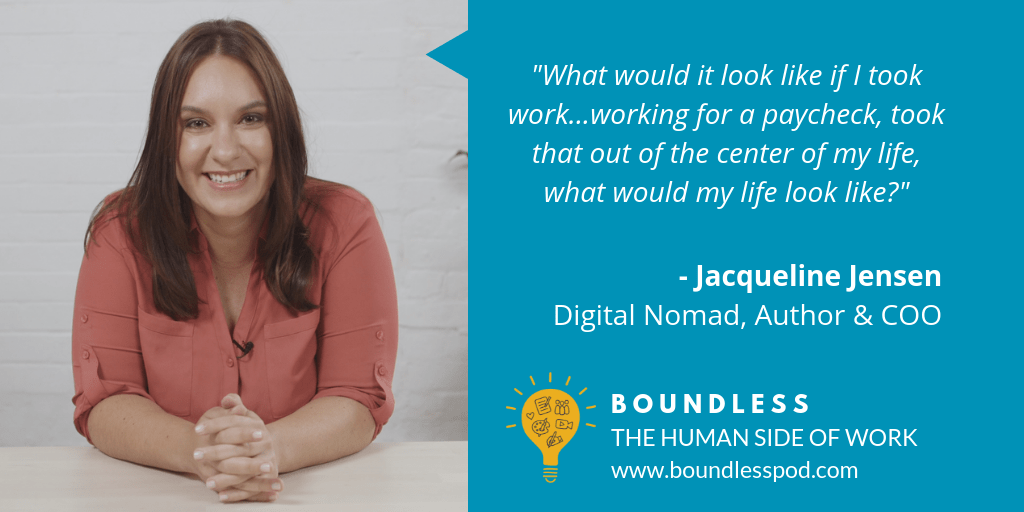
Jacqueline Jensen has been a digital nomad for 3.5 years, living and working globally. It might surprise you to find out then, that she’s written a book called “Travel Isn’t The Answer.” While counterintuitive, she argues for a return to awe and wonder with what is already around us. She talks about different moments of wonder she has experienced (including a breathtaking view in Montenegro) and different techniques for how people can “Live With a Sense of Curiosity, Passion, and Awe Anywhere and Everywhere” (the subtitle of the book).
Apple Podcasts · Spotify · Overcast
Last year, in a planned sabbatical she came face-to-face with the fact that work was the center of her world. While she almost “quit” the sabbatical, she pushed herself to redefine her day and time to claim back some of herself from a sole focus on work. She provides many actionable tips and perspectives that can help people question the role of work in their lives, take steps to increase the amount of awe in their lives and connect with people that matter to them.
More About Jacqueline:
- TedX Talk
- Twitter: @JackieMJensen & LinkedIn: Jacqueline Jensen
- Book: Travel Isn’t The Answer (Amazon)
Recommendation on getting outside of your comfort zone:
- Check out local music: sofarsounds.com
- Go to an art museum
- Travel-as-a-service recommendations discussed: Hacker Paradise, Recess Labs, Roam, Outsite
- App for re-aligning your day: Today
Transcript
Jacqueline Jensen has been a digital nomad for 3.5 years, living and working globally. It might surprise you to find out then, that she's written a book called " Travel Isn't The Answer.
Read the full transcript
Paul: Welcome to The Pathless Path, exploring the human side of work. I'm your host, Paul Millerd, and I'm fascinated with how we can imagine past the default path to do things that matter. I have conversations with entrepreneurs, freelancers, and thinkers who are questioning the role of work in our lives who are thinking about how we can unlock creative potential in ourselves and organizations and are carving new paths in the world to create a more human future of work. If you want to support the podcast, check out the Patreon link in the show notes. And for more information, go to BoundlessPod.com. Today I'm talking with Jacqueline Jensen.
Who is a COO, digital nomad, former venture-backed startup founder, speaker, and recognized community builder. Welcome to the podcast, Jacqueline.
Jacqueline Jensen: Thanks for having me.
Paul: So, I am really excited about this conversation today. We're going to be talking about a number of things including structured sabbaticals, building a calm company, how travel as a service is popping up all over the place, and why travel is well is not always the answer. So, we'll be digging into that and a lot more. I'd love to start with the idea of the structured sabbatical. So, I was just reading a book by Alex Pang called Rest, and he was digging into some of the research around like why people should take sabbaticals. And to me, it just makes so much sense, right?
We need breaks in life to kind of recover and reset. But Maybe you could just talk a little bit about how that idea of taking a structured sabbatical came about and a little bit more about it.
Jacqueline Jensen: Yeah, sure. So, it's interesting that you say it makes sense to take a break. To me.
Paul: To me.
Jacqueline Jensen: Yeah, for me. For me, it never did. Oh, wow. It never made sense. No, no, no. I love to work.
I find a lot of value from my work. I really enjoy being someone who has work as the center, you know, and I never really thought of it that way, but it definitely had always been this kind of the center of my life. So I left a job and I was looking for the next thing I wanted to do, and I had, I had travel booked in Europe, and I thought, gosh, it's gonna be really hard to look for another job while I have all this travel booked. What if I can't be working remotely anymore? What if I— what if it's better just to stay in one spot as I interview. And the more I kind of thought about what to do next, the more these, these really weird moments of like hints that I should be taking a sabbatical kept coming up.
So, so one of them was I was visiting a friend in New York City and he started a program called Recess Labs where people take structured sabbaticals away from their tech career and they work on a a passion project and they just, they take time away and they meet every week and they're onsite in New York and they're kind of supporting each other through that sabbatical. And I thought, well, that's a really interesting idea. Of course, not for me. Like I would never take a break like that, but it's kind of interesting that, you know, this person left Facebook and is working on writing a novel or this person left this job and now they're working on some side project that they've always wanted to work on. Seems a little fanciful, seems a little lazy, seems a little like something I wouldn't do, but interesting nonetheless. And then I really started thinking about it and thought, why not?
Right? I've got savings. I am employable. I can get a job when I decide to end the sabbatical. And I've got all this travel booked already. It's paid for.
And what if I just thought about different passion projects? So I'd always wanted to learn to code. So I ended up doing a 4-month, like, intro to programming course online. I had thought about writing a book but had always thought I don't have time to do something like that. And this was a great time to do it. And then I just really wanted to focus on my mental and physical health.
Like, what would it look like if that was playing more of a center role in my life? Yeah. So, so really What would it look like if I took work, and I define work as I do something and I get a paycheck. Of course, writing a book is work and learning to code is work, but for me, the idea of working for a paycheck, what if I took that out of the center of my life? What would my life look like?
Paul: Did the structured sabbatical really force you, or at least put you in a different mindset to question some of those ideas around work?
Jacqueline Jensen: It definitely did. So it was pretty surprising. It took about 2.5, 3 months into the 4-month sabbatical before I really felt comfortable waking up, not having work be the center of my life, not feeling bad about it, not getting stressed out and just kind of enjoying the time. So I think it was really, really eye-opening for me to try and live life without work as the center and get adjusted to that and really look, like you said it, Why, why has work been playing this role and what could it look like if it wasn't? And yeah, it was super eye-opening. It was hard.
It was definitely not like a 4-month vacation. It was a lot of work to kind of untangle myself from the things that we all get from work, you know, validation and adrenaline and excitement. It was interesting.
Paul: And what advice would you give to someone who maybe they say, I can't take 4 months off right now. I have to pay the bills. Like, what are some small things you did that helped you as part of that?
Jacqueline Jensen: Yeah, so I wrote about this a bit in the book that I wrote during the sabbatical because you're right, you know, it's not, not everyone can take time off, but how often are we unplugging on the weekends? How often are we taking nights unplugged from our computers, and especially those of us who work in tech. We're able to really easily check our phone for emails. We're able to work from anywhere a lot of the times. It's really easy for that addiction to work and what it provides to creep into our lives. And so just basically, what are your hobbies outside of working?
Would you consider work to be the center of your life? And have you ever explored taking that out of the center and just seeing what it feels like, right? And for me, it was 2.5, 3 months of not feeling good about it. I felt guilty. I felt, like I said before, I felt lazy. I felt insecure that I wasn't getting validation from someone and pat on the back.
It was really, really fascinating to take it out of the center.
Paul: I know, I think we discovered each other, we were both looking at some of Andrew Taggart's writing. I mean, that's been a big influence on me and just of understanding where some of these ideas come from. And they're, they're not, um, some of them you can question. I think I, I was raised at least taking a lot of these things for granted. Just you kind of show up and you work and you just kind of do that. But, uh, it's, it hasn't always evolved in a direct line around that.
Jacqueline Jensen: Yeah, yeah. And Andrew talks about, um, human beings being defined by work and their lives revolving around work. Our alarm goes off in the morning and so we can get on our way to our commute to the office. We go to sleep when work is done for the night. All those kinds of things. It's interesting how much we don't even notice that work is the center of a lot of our lives.
Paul: Right. I'd love to shift gears to the book you mentioned. I believe it's called Travel Is Not the Answer.
Jacqueline Jensen: Yep.
Paul: And talks about how you can cultivate curiosity and wonder even when you're not traveling. And I love this. I mean, I find myself walking around Boston where I am now, where I've spent a lot of time, and I've been trying to put myself in that mode to just realize like how amazing things really are. But you— it's so easy to get stuck in the same place and need that travel as a way to open your mind. And there's definite benefits to travel, but I'd love to hear more of how you landed on that direction for the book.
Jacqueline Jensen: Yeah, yeah, thanks for asking about that. So the full title is Travel Isn't the Answer: Live with a Sense of Curiosity, Passion, and Awe Anywhere and Everywhere. And it was interesting, I had been approached about writing a book a couple years ago, and I said, "No, I don't have time to do that. It sounds interesting, but I just don't have time for something like that." And then when the sabbatical came about, I thought, I just could be really fun to work on a book and make the time for it. And so then I was thinking about what I wanted to write about. And the obvious answer, right, being a digital nomad for the last 3 and a half years, and digital nomad meaning I work from my computer and I literally travel full-time.
I don't have a home. I sold everything 3 and a half years ago. So the obvious thing would be to write about that, right? Like how to become a digital nomad, maybe best practices for working remotely, maybe how to explore a city. But I kind of found those boring because not everyone can travel like I travel, right? There's people who have kids or they have pets or they just bought a house or they really enjoy the one city they live in and having a shakeup of a routine that often would be difficult for them.
So I started kind of thinking to the conversations I'd had with people all around the world and A common thing people would say is, oh, you're living my dream because you travel. And I remember I was thinking, oh gosh, if they knew, they knew what yesterday looked like, or if they knew when my internet cut out and I was so stressed out, or if they knew, you know, that someone was rude to me because I couldn't speak the local language or right. There's all these moments that actually aren't amazing while you're traveling, just like in normal life, if you're in one spot, right? And so then it got me thinking, what is it that makes us curious and live in awe and have passions? Because what if we stopped glorifying travel? What would that look like?
Because travel is a new thing, right? In the '50s, most people had never been on an airplane. So this is a really, really new phenomenon that you can literally work on your laptop from anywhere in the world. Yeah, it wasn't an option, right? Things like Airbnb and Uber, right? These allow digital nomads to live the life we live.
And so what if we just kind of took the glorification out of it? So that was the idea behind the book is what if you lived the life you wanted wherever you were, whether you're traveling or not? So it's definitely not telling people not to travel. I love traveling. I'll continue traveling until I get sick of it. But is travel the answer?
Is money the answer? Is fame the answer? Is being in perfect health the answer? Is a relationship the answer? I don't think so.
Paul: I think there's two things you touched on. I think one is— I mean, I get this a bit too. I don't think people realize how in many cases it can actually be cheaper to travel longer terms than especially living in some of the cities in the US. And then two is a lot of people just say, "Well, I can't really do that." And you're kind of taking away that excuse and saying, "Well, maybe let's invigorate some wonder in your day-to-day life now." Yeah.
Jacqueline Jensen: I mean, think of how many people around the world have on their dream wish list to visit Boston. You get to wake up there and walk around. They'd kill for that. It's really interesting. Many, most places I've been to, someone wants to go there. You know, someone in the world has, has had a dream to be there.
And so, yeah, it became interesting as I was traveling that, that, that wonder of landing in a new spot or being in a new neighborhood or a new city or a new continent started to wear off. And it, that was an interesting experience, but it's like, Oh, there is day-to-day life. There's still struggles. There's still all kinds of things that happen. And really, we all just need to choose the life we live, whether we're traveling or we're in our hometown.
Paul: Do you have any exercises or actions that you recommend people take to shift that perspective?
Jacqueline Jensen: Yeah, so I write about a bunch of them. I'll tell you a few of my favorites. So one is, getting involved in your local music scene, wherever you are, right? So one thing that I love, it's called Sofar Sounds, it's S-O-F-A-R and then S-O-U-N-D-S.com. And there are these really cool locally organized concerts that happen all around the world. It's the movement kind of started in London with these guys really just being sick of going to live music shows at bars and people are talking and drinks are clanking and no one's listening to the music.
And they thought, wouldn't it be cool to have these bands play in a quiet area where everyone's just watching and paying attention and it's small and intimate? So they started hosting these events in their living room and they'd invite their friends and everyone was quiet during the performances and the artists really liked it. And so then that moved on to different cities. And so it's songs from a room and you don't know where the room's gonna be when you sign up on SoFursounds.com. Yeah, have you been to a show?
Paul: No, it sounds amazing.
Jacqueline Jensen: I definitely want to check it out. Yeah, I'm sure there are shows in Boston, but wherever I go, I sign up. You don't know where it's going to be. You don't know who's going to play, but you do know the date. So you sign up and then the day before they contact you via email to let you know whether you're in or not, and then they tell you the address. So I've gone to shows in old denim factories.
I've gone to shows in bakeries that have shut down for the night. Gosh, like nightclub offices in the upstairs of a nightclub before the nightclub opens, and all kinds of different bands, and you just never know who's going to play. And so that's fun, right? And it's just fun to support like live musicians. And whatever city you're in, there might be a festival happening, there might be a showcase, you know, at the restaurant down the street every Friday of local artists. So that, that's a fun thing to do.
And kind of along those same lines, I also like going to art museums wherever I am. I never was big into art museums until I started traveling. And now it's wherever I am, I want to go to at least one museum and just, just look at art, think about things in a different way, kind of get, get in the shoes of the artist, you know, whether it's a modern artist that's new or something really old, right, in Europe. And it's just fascinating to put yourself in the shoes of someone else who created something beautiful.
Paul: Yeah, those are amazing. One thing I often tell people to do is try to change your mode of travel.
Jacqueline Jensen: Yeah, that's cool.
Paul: Like instead of riding the train, start riding your bike around the city. I know when you ride a bike around even like Boston, it's basically a different city because you take different routes, you're seeing different little stands, you're seeing different little food places, different views and It's pretty amazing what you are in awe of. I mean, I was riding around yesterday in an area I'd never been. I was like, "Oh my God! 8 of the last 10 years here and I'm seeing new things.
Jacqueline Jensen: This is so amazing." That's so cool! Yeah. Another thing on this subject would be getting into nature. Even most cities will have something that's like a central park type of a thing or maybe a half an hour drive outside the city, you're in the mountains or by some water. That is really interesting too. Like, it's interesting.
Like, I'm from Utah, right? And sometimes I'll talk to people who've lived in Utah their whole life, but they've never been skiing, you know? And it's like, God, people travel from all over the world to come skiing, you know? So how often are you getting into nature and experiencing awe? So like Jason Silva, he's a futurist that I follow. He describes awe as an experience of such perpetual perceptual vastness that you literally have to reconfigure your mental model of the world in order to assimilate what you just saw.
So how often is that happening in your life, right? Where you're seeing something that is so, so much bigger than you and so beautiful and so vast that, that you have to, you have to shift what, what's going on in your brain to just make room for it. And oftentimes that happens in nature. So I'd say that's another thing is, is get out. Into nature.
Paul: So when is the last time you had one of those moments?
Jacqueline Jensen: Uh, one that I really remember during the sabbatical. So the sabbatical was, oh my gosh, almost a year ago. I can't even believe it. But, um, so it was in the fall of 2007. I was in Montenegro, which is in Eastern Europe in the Balkans. And it's kind of a difficult thing to explain, so we'll see if I can convey this correctly, but you go from the airport and then you're driving and you go over a mountain.
And then as you're coming down, the Adriatic Sea is right there. And it was so blue and so huge and vast and just gorgeous that it took me a minute to realize that it was water. Super hard to explain because then in the distance, there's a mountain range, but it's also that same color of blue. It's really weird. And so when I was looking at it, I was thinking, I was like, what is that? And then I realized it's water and it's mountains in the distance and they're like kind of the same color of this beautiful blue.
And I said to the driver, that's one of the most beautiful things I've ever seen. And he just smiled and he said, I know, I'm just so grateful to see it every day. Everyone does this when they see this, it's just so beautiful. So yeah, that's one that I remember.
Paul: That's pretty amazing.
Jacqueline Jensen: Yeah, yeah.
Paul: You are pretty knowledgeable about travel. You've been traveling around for 3.5 years. I've seen this over the past few years, what you've deemed travel as a service. What's happening here? How is this turning into its own little industry?
Jacqueline Jensen: I thought of that idea when it came to me, travel as a service, because as you know in tech, there's software as a service. You build a product. And then people are subscribing to it and they're using the software as a service, right? And they use it every month. And it was interesting, the more and more I was seeing of these travel as a service where you're buying in and you're getting the things that you need in order to be a digital nomad, in order to travel. So it would be things like signing up for a program and they provide your accommodation, they provide your coworking space, maybe they provide travel to the next city, and you pay them a monthly fee.
And, um, you know, you always have someone to call if something goes wrong. Maybe you're with a group of other people, and so you kind of have a built-in social network. Um, so it's really just taking the, um, the obstacles out of it is, is the premise, right? So rather than you navigating where you're going to stay in Buenos Aires We'll find an apartment for you. And rather than you navigating the flight to Buenos Aires, we'll do that. And so you don't get lonely, we'll get other people who are like-minded and build a community.
So that's the idea of travel as a service. And yes, it's been really interesting to talk to different people. There's some people that love it and it really works for them. It helps them make that leap to travel. And for those people, I think they should do it, right? I think if it gets you, you know, if it helps you feel comfortable traveling, you should do it.
And then for other people, it's just not quite a fit, right? Or maybe that particular program's not a fit, but there's other programs that are. It's been interesting to watch the space grow and talk to different people in it. Another, another thing kind of in that same realm would be networks of co-living and co-working spaces. So things like Roam.co would be an example, or Outsite.co. And those are really interesting too, right?
So you can kind of pop in and stay with other people and be in a home of people who are traveling and working and then kind of pop out.
Paul: Yeah, I actually stayed with the Roam in Bali. Oh, how was it? It was actually pretty incredible. The interesting thing is, I'm sure you saw there are a couple articles written about the place.
Jacqueline Jensen: Yeah.
Paul: And I almost think like the types of articles that get written about digital nomads are always just like spun negatively or dystopian. And then so I had the experience of going there kind of expecting this this dystopian experience and I just met wonderful people and like real community and kindness and just like a good place to be. And it was pretty incredible. I think, I think they've done a really good job. I've met a couple of people that have worked with them of really just focusing on the human connection part of it. So I haven't seen the other ones, but I think there's definitely real real potential.
Jacqueline Jensen: Yeah, I mean, I do too. And the thing is, is the community— you nailed it. I mean, that's— if you can get the community right, then you've got something on your hands. If you're just trying to sell a program and kind of fill spaces, it's going to be tough if you're with those people for a year, right? Or you're with— there's no shakeup, right? Like, you've really got to get community right if you're traveling with people for that long.
But I For me, I'm really liking the idea of using travel as a service programs and then traveling solo. And then maybe popping in for a little bit and then traveling solo. So something like Roam in Bali, maybe stay for a week or two, but then also kind of go back out on my own.
Paul: Right. Yeah, how have you balanced that over the last 3.5 years of just your own independent spirit with the sense of— I think we all need to be part of something at times in our life. How have you balanced that?
Jacqueline Jensen: Well, I, I'm naturally someone who networks a lot, so, and I never really need someone to like invite me to a meetup or like, I know where to look online. I know who to tweet to get in contact with the right person. I know how to pitch myself to speak. You're like, I have a good sense of that kind of stuff. And so a lot of times wherever I am, I just, I pop into the local startup community. And see what's going on.
Right. So that could be like a 2-hour coding course that someone's putting on at like a coworking space. It could be listening to a fireside chat. It could be giving a presentation at a meetup. So I kind of do that naturally on my own. The idea with travel as a service programs, I thought, gosh, this might make it easier.
Right. I can kind of just plug in and maybe all the work will be done for me. But it just goes back to community. So sometimes those have worked out and sometimes they haven't. I really enjoyed Hacker Paradise. I was with them for 3 weeks in Bali in the spring of 2016, I believe, 2015, one of those.
But yeah, and that was super fun, right? Like I met really cool people. A lot of them I keep in touch with. So, so I think I'm, I'm interested in trying things out, right? And keeping an eye on this kind of travel as a service space and seeing what new things are popping up. But I also, I don't rely on it solely.
Like, if they all went away, I would still just keep doing what I do and meeting people on my own.
Paul: Right. Yeah. How do we use Twitter? I know you're a bit of an expert at this. I mean, we literally met through Twitter. So how should one go about using Twitter to connect with meaningful connections.
Jacqueline Jensen: Yeah, so I gave a TEDx talk about this a while ago. Gosh, it's almost 6 years ago.
Paul: I think it's still relevant.
Jacqueline Jensen: I'll definitely link it up. You think so?
Paul: Okay. I mean, I'll definitely link it up. I just think people's mindsets around Twitter are not to like, I think all the whole news media has kind of made Twitter a different thing, but it's still so useful for meeting great people.
Jacqueline Jensen: I think so too. I mean, yeah, so what I talked about in that talk, and I still talk about with different entrepreneurs, um, is it's really— Twitter is just a total hack to get to know people that you wouldn't be able to meet. Um, like, it's really great. And so I look at, um, I look at co-working spaces in cities that I'll visit and see who they're tweeting at, right? I'll look and see who's organizing meetups, like on their event calendar, to see if I can connect with the organizers on Twitter. I do it less than I used to.
I used to do it every single city I go to. Now I kind of, I stay busy and kind of on my own projects, and so I don't do it as often. But for any, especially digital nomad who's looking to connect with people, I'm like, are you active on Twitter? You know, like, gotta start with that. And yeah, and just kind of seeing who's who in the city that you're visiting. It doesn't take a ton of time, but you start to get to know the people who are active and they're organizing startup weekends or they're a community manager at a coworking space, things like that.
Paul: So how do you build a calm company?
Jacqueline Jensen: Yeah, wow, that's a challenge, yeah. I believe it was Jason from Basecamp who first started talking about a calm company. Oh, I love that word.
Paul: Do you know? Yeah, I love that word.
Jacqueline Jensen: By chance? Yeah. So I don't read a ton of his stuff, but I talk to a lot of people that read a lot of their stuff. So it's kind of one of those things that it kind of gets mashed in my head. So I think it's Jason at Basecamp who first kind of coined that term. But yeah, coming off of the sabbatical, is where that idea really started.
And I wanted to slowly reintroduce work back in, in a way that it looked completely different than it did before the sabbatical. So I wanted to limit the number of hours I worked. I wanted to have other things going on besides work, like it just, and kind of the centerpiece of that was I just wanted calm. Ness in my life when it came, especially when it came to work. Like I didn't want to be hectic. I didn't want to have fake emergencies.
I didn't want, I didn't want tension. I wanted to work with great people who do great work and also have awesome things that they're doing outside of work. Like I just wanted to work with really well-rounded people. So I started working with Carl Richards, who's a New York Times columnist. He's an author and a speaker. And I've been a big fan of his work for years.
And Carl really buys into this philosophy too, of a calm company. And so it was really fun to be working with someone who's aligned with that vision naturally. Like, I don't need to sell him on the idea of a calm company. He uses that term as well. So yeah, it's been, it's been really fun. So, so how do you do it?
You get people who have lives outside of work. And I think a lot of entrepreneurs are taught the opposite. Especially ones that raise money. There's a lot of pressure to always be working and to always be on and to buy into the hustle and to wear busy as a badge of honor and all of that. And so, yeah, it's tough to undo that.
Paul: I think David Graeber was using the phrase performing busyness. Oh, perfect. Which I thought was like a perfect summing up of what so many— what is happening in so many businesses.
Jacqueline Jensen: Yeah, it is. And it's, and it's, um, it's, you know, if you can out-busy the person next to you, you're a harder worker, you're more of an asset to the company, you're going to move up faster. And it really is It's just a life. Like, it's just more fun to work with calm people and people who have a life outside of work. And it's a challenge for me. I mean, I, I fall back into it where I'm working over, you know, the number of hours I want to work each day, or I'm not unplugging at night, or, you know, and I have to— it's, it's a constant work in progress for me.
But it's nice to be surrounded by people who believe the same thing. So Hopefully that answers your question, how do you do it? I think you do it by really believing it yourself. It's not a productivity tool, it's not a methodology that some guru spelled out. You really need to believe it at your core that you enjoy working in calm environments.
Paul: I know at Basecamp they have a max hours you can work. And then the other thing they do is divide up the projects in a very discrete sprint. So it's, things are not stretching over a year. It's a 6-week project and then it's either done and it didn't work or it's done and you go to the next version of it. Have you talked about like what some of those principles might be for what you're building?
Jacqueline Jensen: We work in sprints, so that's nice to hear that Basecamp is doing a similar thing. We've started working in 30-day sprints and 60-day sprints depending on the contractor. It's a team of contractors, so it's Carl's business, I'm his COO, and then we have a bunch of contractors. So yeah, depending on the projects, we'll design different sprints for different people. Yeah, I mean, it's really hard to explain and we're actually working on creating something called the code. And so we outline everything about how to do different projects, right?
So we have a code for how we handle email. And one of the principles for how we handle email is that we always assume best intent. We assume the other person, has good intention.
Paul: That's such a good principle, right?
Jacqueline Jensen: Yeah. So like, that's pretty basic.
Paul: Okay.
Jacqueline Jensen: Like, this isn't like, this isn't crazy stuff that Carl's inventing over here, but like, it, yeah. Like if, if it was part of your code at your company, that, that, that's what you do. That changes things quite a bit, right? It takes off a lot of the frustration. It takes off a lot of the stress, you know, and it, and everyone's just operating in a calm environment. So I guess that would be examples is creating the code has been really awesome and just, and really like solidifying those principles that sometimes Karl and I forget that people don't know, you know, like that actually needs to be stated.
Paul: Right.
Jacqueline Jensen: Yeah.
Paul: I have a suggestion for you guys. I think maybe you should rename the 30-day sprint to a 30-day jog.
Jacqueline Jensen: Ooh, I like it. Yeah, I do like that. Yeah, I mean, here's the thing is, I mean, I was working building, you know, tech products before this. And so I was like, you know, this needs to get out, this needs to get out, this is something people are asking for. And we are lucky to not have that urgency. We're working on really fun projects.
And so it's like, you know, we have check-ins and everything, but it's not like the company's going to shut down if we don't get this sprint right, you know, or this jog. So it's, you know, it's more of a way to just like frame the work less than like, you know, like you're going to get fired if the deadline's not met or something like that.
Paul: Well, I think it's just amazing that you're even having this conversation with Carl. I think 10 years ago there wouldn't even be an awareness that you should have this type of conversation. There was just so much taken for granted. This is how you do things and totally we're just not going to question it. So I've definitely seen an uptick in more companies talking about things, whether it's because of people working remote and more flexibly, I'm not sure, but it's definitely a good trend.
Jacqueline Jensen: Yeah, I think so too. And I think, you know, if someone's looking for, you know, maybe switching from an environment that's more hectic to a more calm one, it'd be great to look at who the leaders are in the company and what their lifestyle is like. So Carl, for example, moved his family to New Zealand a few years ago. He's American and they moved to New Zealand and it's because they like to be outdoors and it's just gorgeous there. It's not unusual for Carl to get off a call and go kayaking or take a walking meeting on his phone because he is training for something. There's a lot in his example of this is the kind of lifestyle I want to live and the business allows me to live that lifestyle.
It's kind of not the other way around where you're living to work. So I think, you know, taking a look at what people's lives are like and if it— you know, you've probably heard this, Paul, where people say that the boss should be the last to leave the office every day or whatever, right? It's like, no, I want the guy that takes lunch breaks and takes a few weeks off every year and is encouraging of other people to do the same. and is calm. So I think that's, it's a good indicator, right?
Paul: I was always very good at taking the lunch breaks and vacations, but I would just pretend like I was working more, which is its own sad point in itself.
Jacqueline Jensen: Totally. Yeah. Yeah. Yeah. That is sad.
Paul: So talk to me a little bit about your routine. You said during your structured sabbatical, you got more into a routine and started thinking more around how you kind of format your time. How did you go about that and what enabled you to make and keep the shift?
Jacqueline Jensen: Yeah, so like I said before, I mean, the idea of not waking up and doing work and getting praise from doing that work was really, really, really difficult for me. Like, um, like I almost stopped this sabbatical because I was like, this, this is it. Like, I can't handle this. Yeah. And in the beginning, I remember I was like, um, I was interviewing for jobs still and I was telling them, well, I'm on a sabbatical, um, but I'm probably going to stop it in a few months. Right.
Like, I just like, I couldn't wrap my— oh, I know. And people were like, um, you're on a sabbatical, so that means you're taking a break. I mean, it was like crazy. Like, I It's embarrassing how intense it was. So the routine really came out of that I needed to do something besides worry about not working or check job boards or like network and be kind of crazy without work as a senator. So what I decided to do is sit down and think about what my ideal day would look like if it could be any anything, right?
Like, the day is free. What does it look like? So I jotted down a bunch of things and I decided, gosh, what if every day of the sabbatical could look like this? What if that was the sabbatical, right? And just practicing, like thinking of the routine as a practice. So I called those micro-actions.
So I had an app, I still have it on my phone, and I check into these micro-actions each day. So it's It's less like a checklist and more like a map, right? Like if I started to get worried that I wasn't working and crazy thoughts running through my head about I'll never get a job or I'm gonna really lose my place, you know, if I'm not actively seeking out work. When those thoughts started, I'd look at the list and say, oh, that's right. I wanted to meditate for 20 minutes every day in my perfect day. So I'm gonna meditate.
Or, oh, I really wanted to go on a 30-minute walk. Around the neighborhood to explore the city I'm in every day. So I'm going to do that instead. So, so yeah, it was, it was really life-changing for me. And so I now have that checklist all the time now. And whenever, whenever I feel lost, you know, and I don't know if others ever feel this way in their day-to-day life, but there's times where, you know, worry takes over or anxiety takes over.
And it's really nice to be able to look at a list and remind myself of the things I like to do.
Paul: And what's that app called?
Jacqueline Jensen: It is called— let me look. It's called Today. And it's a green icon. I think it's only iOS. It's a green icon with two white arrows. And it's the best.
I love it. So I'm able to just look at it. I think the trick for people though who have tried this and kind of reported back their experiences is to really make sure you don't think of it as a checklist. Because then it's stressful, right? But if it's a map and things can be replaced, right? If you notice you haven't quote unquote checked in to let's say your morning journaling micro-action, maybe you should do night journaling instead or maybe something's off with that or maybe you want to replace it out with something new.
Paul: That's amazing. So I have recently shifted the the name of my podcast to the title Boundless: The Human Side of Work. I'm wondering, when you hear the human side of work, what does that mean to you?
Jacqueline Jensen: Well, that's calm company. That's the first thing that comes to mind is running a calm company. Yeah, just being, being aware that there, the The people on the team are more than their deliverables, right? That you guys are working on. I mean, as cheesy as it sounds, you're working on having a beautiful experience. You're not working on just solely creating products to put out into the world because there's just only so much fulfillment you can have from that.
But when you're, when you're creative and you're discovering new things and you're seeing people grow, I mean, that, that's where it's really at.