Martha Balaile on creating inspiring art filled with magic
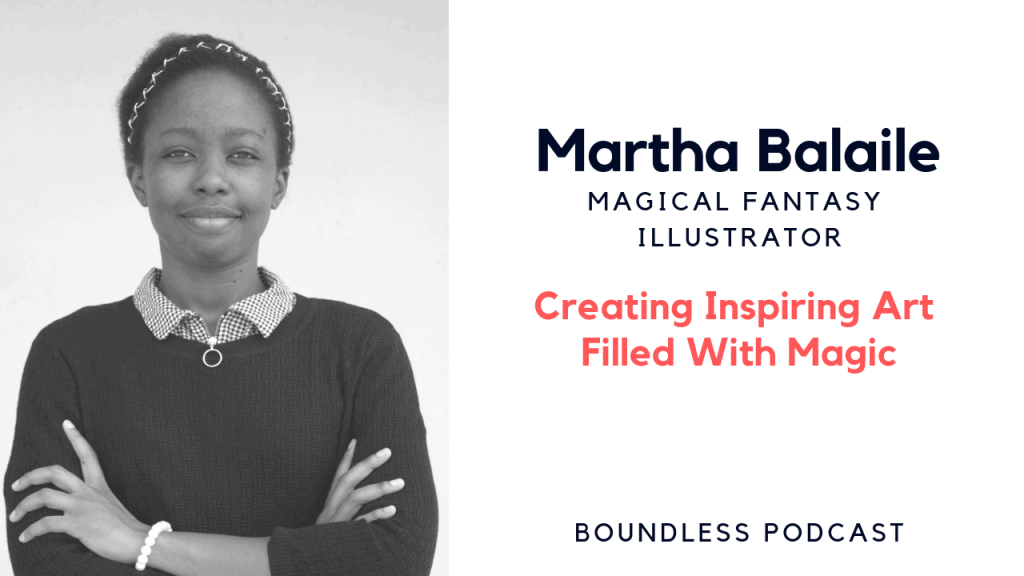
Martha Balaile is a fantasy illustrator living in Cape Town, South Africa originally from Tanzania. Her mission is to figure out how magic, mythology and fantasy can have an impact on real life. She’s also the wonderful creator of the new cover art for this podcast.
Martha aspired to create “art that is filled with subtle lessons on living a magical and adventurous life.” Two of the lessons she has found:
- Go with the flow
- Be aware of fear
We explore these a bit and she shares some examples from fantasy that have inspired her. Check out the show!
We talk about:
- What drove her to pursue an art career after growing up in Tanzania
- What she wishes she learned in art school
- What she looked from working with clients
- How she switched from magic “standard” art to art she cared about
- How she decided to take the leap to freelancing “early” in her career.
- How she structures her day around her work
Her Top 3 Magic Podcasts:
Mythology Studios: Work With Martha
Transcript
Martha Balaile is a fantasy illustrator living in Cape Town, South Africa originally from Tanzania. Her mission is to figure out how magic, mythology and fantasy can have an impact on real life.
Read the full transcript
Paul: Today I'm talking to Martha Balila. She is a fantasy illustrator living in Cape Town, South Africa, whose goal is to figure out how magic, mythology, and fantasy can have an impact on real life. I'm excited to dig into this, but also just want to note that Martha helped design the new cover for the podcast, now Reimagine Work, after she inspired me with some of the work she's done. So we'll talk about that. We'll talk about some of these themes. Welcome to the podcast, Martha.
Martha Balaile: Oh, thank you very much.
Paul: So I discovered your artwork after you reached out to me from one of my newsletters, you said you had the motivation to get started on a project after I had talked about trying to overcome perfectionism. And perhaps we'll dive into those, but I think what inspired me about your illustrations was, I think a word you talk about a lot, which was that they came off as pretty magical. I didn't really have a word to describe them. Uh, but you talk about this as a central theme of your work. When did you first start thinking about magic?
Martha Balaile: Um, well, I've always been interested in the idea of magic and like magical comics, magical TV shows, even growing up as a child. But I think it was only last year that I actually started really focusing my work on the theme of magic. And I think it really happened when I was looking into things like tarot cards and and just more magical real-world items that are considered magical.
Paul: You said you're trying to figure out how these things can inspire people in real life. How are you thinking about that, or when did you decide that's something that drives you?
Martha Balaile: Well, I looked at myself as an example. I read comic books, and immediately I was inspired to become an artist. But the thing is that the comics that I was looking at are very magical. And also they just, you know, the feeling that you get like when you read, I don't know if you've ever read the Harry Potter books, but you've read like a Harry Potter book and you just feel so inspired to go out and do something. And I was really curious about that feeling like, okay, how does reading this fantasy book kind of translate into that, like, I want to go and do something out in the real world. And so I really would love to explore that.
Paul: So what have you found so far, or what have you found that you reflected on from J.K. Rowling that you've learned from her?
Martha Balaile: Well, the thing that I found from her and just in general from other, like, books and stories is that there's a lot of are real life experiences that are integrated in there, and it's a lot easier to understand and to reflect on when it doesn't feel as intimidating as real life. So it's like easier to see an evil wizard and understand— yeah, and understand his characteristics as someone, you know, you have that you're facing in real life. Like, someone you have to work with or a friend or something and reflect on like, oh, okay, so maybe this is what's going on in their head.
Paul: That's fascinating. It's— I'm thinking back to my work experience and working with a couple evil wizards and just thinking about, thinking about that kind of makes me laugh a little, but it also just makes me realize that it can kind of help you distance yourself from the situation and look at it as a story and something that's kind of common to how we all experience life. So you went to art school. When did you know that would be the path you would follow?
Martha Balaile: So art school was not always an option for me because I am actually Tanzanian and I grew up in Tanzania, and art is not really a career, right? No, it's not really an option. So I, like, as going through school, I thought I was gonna be something else, like a academic or something like that. But then as I grew up and as I discovered more and more that, oh, you can go to art school, then I thought, oh, actually, maybe let me go to art school and see what I can do with it afterwards. And that was the thinking behind that.
Paul: So where did that initial kind of vision for what you could possibly do in academic or something like that come from? Did you— do your parents are following those paths?
Martha Balaile: Yeah, my, my father is an aircraft mechanic and my mother is a lawyer. So very—
Paul: that's, that's quite the range.
Martha Balaile: Yeah. Yeah. So it's very different from what I'm doing right now. And so that's, that's why that I always saw myself going in a more traditional career path at a younger age. But then when I— as soon as I discovered that, oh wait, I can actually do art professionally, and I became like immediately interested in that, and there was no other option for me.
Paul: When did you come to that realization that it was something you could do or make a living or at least support yourself through it?
Martha Balaile: For me, it wasn't immediately obvious that I could make a living from it. I was just In high school, I discovered that you can actually, there are university degrees that are focused on art. So then I thought I would take them, 'cause there must be something there, but I wasn't immediately aware that it's a full-blown career. So as I went through it, and then I went to university, and I discovered more about what I could do with it, and then I'm still learning even now as to what I can do with it, the different ways that an artist can make money, or like the different career paths as an artist. Um, the information is not always so straightforward.
Paul: Yeah. So when you graduated from art school, what were you expecting as you kind of made that transition? And what do you think was different from how you were experiencing school?
Martha Balaile: I think in school it's more about the skill and it's more about like, um, it was more about getting the skills to make good art, to make professional art. But then the one thing I had to learn quickly when I graduated is it's more about what you can produce. And there are other things that come into play, like you need to be able to do work on time and you need people skills because you need to deal with other people in the workspace and the people who you're producing art for. I actually started working for an advertising company at first, which was quite interesting because that's what I thought, like, you know, you become an artist and then you get employed by someone like a big company and then you work your way to freelancing.
Paul: So it sounds like that you discovered something else. What, what did you actually discover?
Martha Balaile: Okay, so the funny thing is, as I was working full-time, I would get requests here and there. To do some artwork for other people. Then I discovered, wow, there are actually a lot of other people out there that also need artwork. So I don't just have to maybe work for advertising to be able to do art. And then that's how I started freelancing.
Paul: So how many people did you start freelancing for on the side before you started to think, okay, maybe it's time to take my own leap or carve my own path?
Martha Balaile: I think I did maybe 4 or 5, but the thing that really got to me that made me realize that this was something viable was that they were businesses that were coming to me. So it was more than just— because initially I thought, okay, yeah, there is work out there, but maybe it's just going to be like making birthday cards and that kind of thing, which is fine, but it's not constant. And then I kind of discovered that there were actual business owners who were looking for artwork for their things like logos and menus and podcast covers. Yeah, so that sort of thing.
Paul: That's amazing. And when did you finally make the decision to leave the advertising world behind?
Martha Balaile: Honestly, I didn't stay that long. It was about, um, so I didn't, I didn't graduate that long ago actually. Um, I graduated in 2016. I worked for about 6 months and then I was like, oh, I wanna try and see if I can do it on my own. And I've been doing it on my own ever since.
Paul: Had, did you experience a kind of massive learning curve as you started on your own?
Martha Balaile: Yeah, definitely it was, it was a big learning curve, but I feel like even when I was, uh, the 6 months that I did work for corporate, um, it, it was, it was also a big learning curve because it, there was so much to do, but then I, I actually really liked that. So that's how I figured that it might be okay if I, if I try and do it by myself. Because I really enjoyed the learning experience, but there was so much. There was taxes and you need to figure out how to, how do you find clients and things like that, which you can't learn on the job.
Paul: We talked a bit earlier and you said in art school you had wished you had learned some of these softer skills to navigate working on your own. What are some of the things you wish you had been taught in art school or had known about?
Martha Balaile: A few things. Like, I wish I knew more about the client side of things. So we learned a lot about making your art look good, how do you present it professionally and things like that. But we didn't learn as much about the initial side of it. So, and the reason I think is because a lot of art schools expect you to be employed afterwards, so you don't have to worry about that. But things like how do you put your work in front of an audience of not just a portfolio for applying for a job, but how do you get your work in front of an audience of people if you're freelancing?
And how do you get from that point of people see your work to actually getting clients? And how do you handle your taxes? I keep bringing that up, but That was like such a pain because it's not very clear, especially if you're freelancing.
Paul: Don't worry, it's the same thing in the US. I still have no idea whether or not I got everything right in my taxes. So I know being on the client side, a big challenge with working with designers, illustrators, creators I've worked with in the past is that I honestly have no idea how to give feedback to somebody that's actually creating? I'm sure you've experienced this, but I think I was in a situation where we were designing a logo with somebody and our feedback would basically just be like, not this. What are some of the things you've learned to help people kind of make decisions for and guide the work you're doing to get you valuable feedback? Because I find that a big challenge with anyone that's working with creators is just kind of, it's changing the language of what you're trying to get to, to communicate to somebody that has those more technical skills.
Martha Balaile: Yeah, that's, that's definitely can be a challenge. So the nice thing is that I've actually spent a bit of time on both sides as well, like, so I can understand what you mean that it's really hard to, to kind of explain. And I think Maybe some of the things me as an artist that I do is I try to get people to explain maybe the mood because it's really hard for someone who doesn't have the language to explain the visuals, but everybody has emotions and feelings. And they— so explaining what kind of mood you want to feel when you're looking at the artwork at the end of when it's done. And trying to use that language instead, or sometimes it even really helps to get someone to share visuals, even if it's not— the end result is not going to look anything like the picture that was shared.
But it really helps me as an artist because I can interpret the visuals in terms of to understand, like, okay, I like the clouds, then I can take the idea of the clouds and maybe interpret it as maybe a feeling of lightness, and then I can take that and create something from it. So I try and as much as possible bridge the language gap by trying to use feelings.
Paul: Yeah, I like that. I mean, from working with you, I thought your process was pretty cool in terms of showing the moods, the colors, the different types of images with the quick sketches worked pretty well.
Martha Balaile: Oh, thank you. Yeah, yeah, the sketches really help a lot as well. Um, so I try not to just start working on the artwork immediately. Um, and the sketches also give me an— because, um, it's a really nice step. It gives me an idea what the client is leaning more towards. So I do one sketch that's almost exactly what we talked about, one that's a bit different, and one that's something in the middle.
And it gives me like a temperature gauge.
Paul: How do you design your day in terms of working? Do you prefer working at certain hours? Do you, how do you structure and manage so many different projects that you might be working on?
Martha Balaile: Um, so I'm, I'm a morning person, so I, I put my most, uh, demanding projects in the morning. And I try and do that. I start with actual drawing in the morning, and I don't start looking at like emails and, and that kind of thing up until the afternoon if I can. If I can. And the reason is just because in the morning I feel like I have that energy and I don't want to waste it on doing all these other things. And then the afternoons are more like a mix of like work that I find fun or personal projects.
And that kind of thing.
Paul: How many projects are you typically working on at a time? Like when you say you put some of the most demanding projects first, what does that mean? Is it most demanding clients? Is it kind of the things you're furthest away from in terms of figuring out where you're headed with the inspiration? Or how would you describe that?
Martha Balaile: It's either For me, the most demanding projects are either the newest tasks. So for me, it's hard. The concept part is quite tricky. So if I don't have a concept, then it takes a lot of thinking and a lot of sketching. So I put that first. Also, if I'm stuck, if I was working on something and then I get to a point that, okay, I'm not sure how to continue from here, then I'll put that in the morning as well.
A lot of the times I don't really— I don't necessarily figure it out right away, but just working on it helps me get through it.
Paul: Yeah. What are the tools you use? Are they pretty standard tools that someone like you might use?
Martha Balaile: I think the standard tools that most people use is Photoshop, but I use Procreate and I draw on my iPad. I've got an iPad Pro and an Apple Pencil. And it's really nice because I can move around with it and I can sit somewhere different and draw for a while and then change my scenery, which is really nice.
Paul: You say you take inspiration from self-development, wellness podcasts to epic legends. That's quite the diversity of inspiration, but what have been some of the biggest influences?
Martha Balaile: Okay, so I really like Norse mythology and Greek mythology, and I really like working with a lot of the stories that they have. In terms of podcasts, I tend to listen to more esoteric podcasts, just generally anything magical. So there are like magical podcasts, and I like to listen to them because they set the mood for when I'm drawing.
Paul: That's awesome. Maybe you can send those later and we'll link them up in the show notes.
Martha Balaile: Yeah, sure.
Paul: I'm always looking for like a wider range of interesting podcasts, so it'd be cool to explore some of those. You also say you're creating art that's filled with subtle lessons on living a magical and adventurous life. So what are the lessons? Do you have any lessons for us that we can take away on living a magical and adventurous life?
Martha Balaile: Yeah, so one of the— one of my favorite ones that I'm really interested in recently is just going with the flow, because I've been reading quite a bit of adventure stories, and it's really amazing how the heroes of the stories just go and wait to see what adventures happen to them. But in our daily lives, we're always like planning, and everything is so strict, and Sometimes I feel like that's something that I like to try and just say, okay, let's see what happens here.
Paul: I love that one. Any other lessons come to mind?
Martha Balaile: The concept of fear and how in mythology, fear is always presented as this evil mythical creature like a dragon or like a hydra or something like that. I think that's so interesting in how Reading stories about how heroes face their fears by like battling them and staring them straight on, it kind of brings a new perspective to fear in real life. So I found that really interesting.
Paul: So can you tell us what an oracle deck is?
Martha Balaile: Yeah, so about a few months ago I got into tarot decks and The tarot deck, most people know what that is, but most people don't know what the oracle deck is. The oracle deck is nearly the same thing. The only difference is it doesn't have the same structure as a tarot deck. A tarot deck needs to have 70, I think 78 cards, and it's got a very like specific— each card means a very specific thing. With oracle decks, it's more fun because, uh, you can make it as many or as little cards and The cards can have a variety of different meanings, and usually people use them for inspiration to kind of meditate further on a subject.
Paul: So you're trying to create one of these, right?
Martha Balaile: Yes, I am.
Paul: And what's your, uh, inspiration or goal with that?
Martha Balaile: So I'm really inspired by the tarot, but then a lot of And there are so many decks out there these days, but I really like what some of the newer tarot decks are doing by interpreting that into modern, uh, because the tarot deck is old, so they are interpreting it into modern day life and making the lessons more relevant today, which is really nice. But then I thought, some of it's still the same structure. How, how fun would it be to create a more modern deck with that meets more modern needs, and the structure is just completely different.
Paul: So how does one, uh, use an oracle deck? Is it just something you have sitting around, you kind of draw cards for inspiration, or do you have to sit down with somebody to help you navigate those stories?
Martha Balaile: Um, with the oracle deck that I'm going to make, it's going to be very casual, so you could just sit down and draw a deck by yourself and kind of use it for inspiration. You can use it for creativity if you want, like writing or painting or something like that. Or you could just use it to kind of just meditate and reflect and think about the deeper meanings about that word in your life, for example.
Paul: So another thing I want to ask you is, I thought you do a pretty good job of sharing your brand image, kind of your vision, what drives you and inspires you on the web. What have you learned just about communicating and connecting with people on the web and selling some of your services or products out there across the world?
Martha Balaile: Thank you so much. The funny thing is I still find it a bit challenging, but the lessons that I've learned, I think, is just kind of, sort of speaking to people like I would in real life. I try to do that as much as I possibly can because it feels really unnatural to me when I try to kind of come up with like a brand, like a brand message or something like that. So I just try and share my inspirations and things that I was thinking of when I create an art piece and I've had to do a lot of thinking about the brand as well and what it means to me. And I just share that. And I find that a lot of people seem to connect with it when I do, when I do it that way.
Paul: When you look around at people designing things on the web, logos, images, illustrations, what do you wish people took away more of in terms of kind of dreaming bigger, thinking differently about how they could create stuff? Stuff. I see so much on the web that kind of everything— I mean, with the podcast covers, I saw everything just kind of looked the same. And seeing some of your work, it actually inspired me to think in a different way about it. So is there anything you wish people might kind of dream a little bigger about or reimagine about the way they're thinking about graphic design?
Martha Balaile: Yeah, I think, I think a lot of it has to do with personal personal interest and personal reflection. I think that for some reason a lot of creatives tend to think that you need to make things to kind of make other people happy all the time, or things that are trending or things like that. And, um, I did that for a bit and then I got bored, and so I started looking for what makes me happy, what makes me inspired, which I find that when you do that, you find other people who also have the same interests and people get really excited about the same things that you get excited about. So that's what I would, I would say is that when you create work that you are definitely excited about, other people are more likely to also feel the same way.
Paul: What helped you make that shift? It seemed like you might have gotten a little burned out from kind of just doing what might be generally acceptable or something like that?
Martha Balaile: Yeah, yeah. So I was doing a lot of things and just posting it and putting it out there and just not getting any response, and I didn't like it too. So then I thought, well, if I'm not getting a response and like I'm not liking it, then there's no point in it. At least if there's no response but I love it, then I'll, you know, it's got a payoff. So I started making work that I actually like and people responded and I was like, this is cool.
Paul: Simple but powerful lesson. So is there anything you want people to check out or any other kind of lessons or insights you'd love to share or places to point people we could leave people with?
Martha Balaile: Um, my Instagram. That's where I post my latest work and that's where I like to connect to people just because it's really fun and easy to, to to chat to people on there. Um, it's mythology.studio.