The Top 10 Career Myths We Should Stop Believing
The modern working world has its own language and culture. A language and culture that is rooted in many myths. Myths that worked for many years but are increasingly out of touch with reality or at best, limit people’s options and imagination for what they might do with their lives.
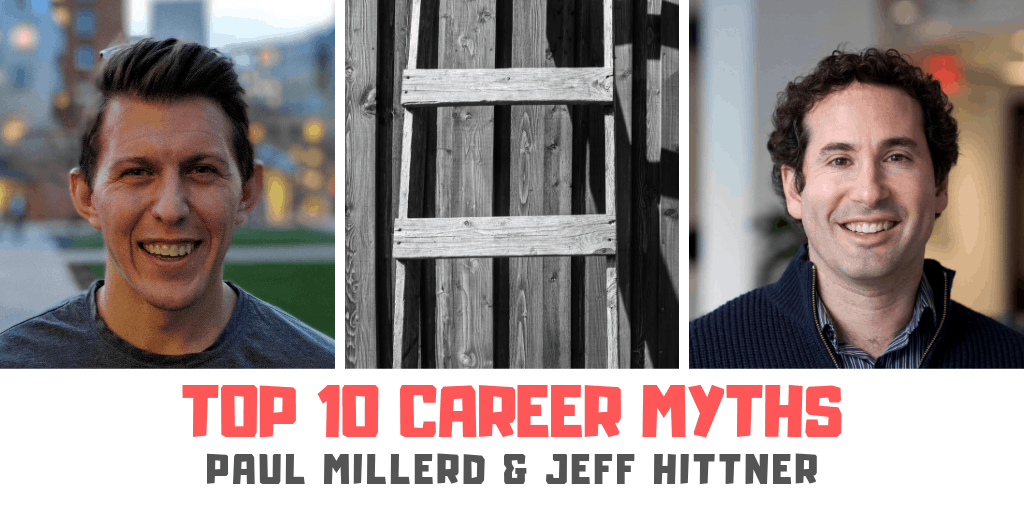
I explored these myths with Jeff Hittner, the founder of Your Project X, a social venture with a mission to help 1 million people find more purposeful work. The conversation focused on the biggest myths around, money and expectations around money, the status quo and what we tend to believe is the best way to do things, misconceptions of purpose and passion, and fear and making transitions.
Career Myth #1: “Once I land my dream job / make $X a year, I’ll be happy”

Early in my career, I was restless. My first job was a two-year leadership development program. I left after ten months. I moved jobs five times before I realized I should experiment with a different way of working and stop chasing the impossible goal of the “dream job.”
Early in one’s career, when a clear “path” seems to be available for the taking, it is easy to believe that there is a certain point one reaches in which you’d finally be happy. “Wow, I finally make $100,000, isn’t this incredible?”
But this is rarely what happens to most people. You adjust. You and your friends all make a little more so no one questions it when our friend orders the $60 bottle of wine at dinner to split evenly. Suddenly $250,000 seems like the right number. Then I’ll finally have enough.
Research shows that we compare up. We look to the people that have more than us. A better job, more stuff or more money. This makes us feel crappy and gives us the sense that we never have enough.
This is not a game you can win.
While most people would accept that these are not the best goals, it is hard to shift past these. When thinking about a career, it is much easier to target a specific type of Vice President role than to specify a vague role centered around learning, mission and discomfort.
Re-Frame: Finding a “dream job” or targeting a certain salary is the wrong question. Instead, think about asking “which one of these opportunities is going to help me be the type of person I want to be?”
Learn more: Self-determination theory from Professors Deci and Ryan says that extrinsic factors such as money and status are not very predictive of a high level of satisfaction or motivation. Instead, people are intrinsically motivated and are driven by three elements:
- Competence: Are you challenged beyond your current level of competence?
- Autonomy: Do you have ownership over the work you are doing?
- Relatedness: Are you able to help other people or be connected to something you care about?
**Career Myth #2: “**I just need to find my passion”

Jeff runs a month-long purpose accelerator that helps people align more closely with their purpose and experiment in new career directions. Within the context of this work, he defines purpose as working towards something that is greater than yourself. This could be a personal mission or even an organizational mission that you are aligned with.
So why purpose and not passion? Passion is something that is a lot more egocentric - it is something that energizes you. The problem with this is that it doesn’t necessarily involve directly working with or impacting others. The second problem with passion is that it is not singular. Second, few people have one passion. The authors of Designing Your Life found that 80% of people either had no passions or many.
Morten Hansen, the author of Great at Work studied 5,000 employees of a company and found that people with high purpose and passion were the highest performing employees. What was surprising is what she found were the second-highest performing people:
people with only passion (but no purpose) placed in the 20th percentile, and people with purpose (but not passion) placed in the 64th percentile.
Action: Instead of trusting your gut on what fires you up, email your friends, former colleagues, or even a former professor with the question, “When is a time you’ve observed me at my best?” This is often a powerful activity to help you see your best self in other people’s eyes.
Career Myth #3: I can’t take a pay cut from my current salary

Think back to your late teens or early twenties. If you were like me you weren’t eating at Michelin-starred restaurants or taking expensive vacations in the Maldives. Yet if you were also like me you still met all your basic needs like food, shelter and had time to spend with friends.
Too often we accept the idea that we should always be trying to make more money as a fact of life. I’m not arguing against saving for the future or earning more money, but I would argue that this expectation of increasing income has a subtle but powerful effect that is often called “lifestyle creep.” As we make more, we use that money to pay for convenience, paying essentially outsourced labor to do stuff for us (e.g. daycare, housecleaning, restaurants). As people increase their spending with their income, they don’t realize there is a hidden cost of giving themselves less freedom in the future rather than more.
In 2017, I was making a six-figure salary in New York City. I also was living a six-figure life, never thinking twice about what I was spending on food, travel or convenience. When I took the leap to self-employment I realized that spending $6,000 a month was going to be a bit limiting to extending my journey.
Giving up a certain and predictable salary was a challenge not because of the loss of income but because it meant grappling with the possibility that the way I was living may not have been the best or only way. For me, as I made different choices and steadily lowered my cost of living I faced many moments of discomfort but I also found a new, lower-cost-of-living path that was a lot more fun.
Re-frame: Focus on your spending instead of your income. Treat your life like a business and start tracking your monthly expenses. What could you cut? What could you think differently about?
Career Myth #4: You need to have a “steady” income

When many people talk about doing something outside the scope of full-time employment we often get to the moment where they say something along the lines of, “it would be nice, but I like the comfort of having a steady job.”
I recently had a friend whose job was eliminated twice in six weeks. Yes, that’s right. As he says,
the new position I was going to accept was then re-orged into oblivion as part of an unrelated org change that wasn’t coordinated with the first one - effectively laying me off for a second time in six weeks
You can’t make this up. As this friend reflected, “whatever cachet I had as a high-potential general manager was evaporating before my eyes as part of this acquisition.”
A steady income or career would be fantastic if it didn’t come with a price. To have a steady path it often requires reinvention, reflection, network building and self-promotion to always be in a position to go after new opportunities or jobs.
The belief that your task is to secure stable employment can also present a challenge when one faces an inevitable crisis at work. For many, losing their job is a deeply shameful experience that can be immobilizing and lead to depression.
Action: David Whyte offers us three deep questions about our work:
- What is the work that brings you alive?
- What are the places that bring you alive?
- What are the conversations that vitalize you?
If the answers are not your current situation, you need to ask yourself, “am I willing to do anything about it?” If not, are you okay with the consequences of that choice?
Career Myth #5: “I’ve got to know what I want to do before I begin thinking about changing directions”

David Autor, a labor economist from MIT, has used the term “frontier jobs” to describe emerging high-wage, high-skill jobs. Today these jobs might have to do with autonomous vehicle technology or alternative energy technologies. However, if we look back only 20-30 years, we find that many of the frontier jobs of the era no longer exist. How many “word processing supervisors” have you seen work?
Many forward-looking career paths are an illusion. Perhaps there is a clear path from intern to resident to attending physician, but there is no way to predict what kind of technology and tools you will have to learn to be the “best” five years from now. If you were a radiologist, how were you supposed to prepare for AI outperforming you on your job?
So if you can’t really figure out what the best path is, what are you supposed to do? It takes tremendous courage to just acknowledge that the current situation isn’t working and then commit to making a change. It takes a different type of courage to say “I’m not sure what’s next, but I’m ready to embrace the journey” The mistake many make at this choice is framing the decision as an all-or-nothing leap.
A friend recently shared that he was considering leaving his sales job to become a monk…for the rest of his life. I told him this seemed like a false choice, one that enabled him to avoid making a shift. I urged him to consider other lower-risk ways to test this. Could he live on a monastery for a month? Could he first do a multi-week retreat?
Action: Shift from thinking about access to opportunity to thinking about the skills you need to develop that give you the confidence to move forward. Start by identifying the smallest step you could take towards a new path. Instead of focusing on applying for a certain type of job, write down 15 elements of someone who would be doing well in that job. How can you do something in your current job in the next week that might help you build that skill
Career Myth #6: Taking an extended break is irresponsible and needs to wait until retirement

I took 27 months off after three years of full-time employment. I spent over $100,000 of my own money to do this, spending time reading books, making friends and learning across a number of different disciplines. I didn’t have a single person criticize me for this choice. Why? Because it goes by another name: business school.
Taking time off for grad school fits into the acceptable narrative for taking a break. Unfortunately, if you propose taking time off to “contemplate life” people will look at you like you live on another planet. I’ve written about why vacations don’t cut it for quenching our need for rest. This is because the effects of a typical one or two-week vacation wear off almost immediately and that the whole point of most vacations is to merely take a break from work instead of resting for its own sake.
Many people are struggling and admit that they really would love to take a break. Yet what holds people back is the fear they won’t be “hireable” afterward. This may be true if you spent a year doing nothing, but most people find that instead of idleness, they are filled with active energy, doing things like volunteering in their community, spending time with loved ones, writing books or even taking an entirely new path altogether.
Action: Make a list of the twenty experiences you want to have over the next ten years. Which ones can you take action on over the next year? How could you design extended breaks to experience some of these things sooner, rather than later?
**Career Myth #7: “**It’s fine to take a risk when you are young, but you can’t do it when you have kids”

The Silicon Valley stereotype of a founder is someone who is in their early twenties with unbridled energy and no attachments is a myth. An MIT study found that the actual average age of a startup founder is 42, and the average age of entrepreneurs who founded high-growth companies is 45.
There is never a right time to start a company. This resonates for Jeff, who started his company three weeks before his son was born. Having a child and starting a company has their inherent challenges, but it also helps him focus. It has forced him to be incredibly efficient with his time and avoid the trap of work being a 24/7 endeavor. When he is with his son, his goal is to be 100% present.
Action: If you have kids or plan on building a family, what are the values that matter to you and your partner? Who is the person you want to be for your son? Beyond making money, what It is easy to default to the mindset of earning more money. Who is the person you want to be for your children? What are the values you want to prioritize as a family?
Career Myth #8 “I should go to grad school to figure out what I want to do”

Going to grad school used to be an easy (and cheap) option for people that weren’t really sure what to do next. But to blindly go to grad school in today’s world is a mistake. There has been an explosion in learning experiences, both free and paid, that can help you learn new skills and make a shift in your career. There is only one thing that has increased as steadily: Grad school tuition.
Why do so many people default to thinking a grad degree is an answer? Many people look at people in their field who are a bit older than them and see that they have certain credentials. Sure if you are a doctor, you need an MD, but in the business world, do you really need an MBA or does the type of person that wants to climb the ladder in the business world pursue an MBA? All I ask is that you spend a couple of hours researching alternative experiences that might help you achieve the same thing such as altMBA, Smartly, long-term travel, Remote Year or even a self-taught MBA.
There are still tremendous benefits to graduate degrees, but it’s important to be clear about what you are going for. Is it access to certain types of job markets and networks? Then perhaps a top-tier MBA or law degree makes sense. But also be mindful of all the “unemployed lawyers” and that the return on investment of an MBA continues to shrink.
Action: A key question to ask yourself is “what do I want to do after grad school?” And then ask yourself, “how could I do that without a grad degree or at least do it for a lot cheaper?”
Career Myth #9 “I can’t make a change now after years in this field”

About a year and a half ago, Jeff was hit by a drunk driver and almost killed. He was rescued by the jaws of life (and his seatbelt) and is still dealing with the effects of a brain injury. This was a challenging period for him, but during his recovery, he decided to double down on his commitment to his family, and the work he had already started doing.
Similarly, I dealt with chronic illness for almost two years after grad school in which I really wasn’t sure if I’d be healthy enough to stay employed full-time. During this time I was forced to sit with my thoughts and contemplate my identity, which up to that point had been someone who was a high-achieving worker and student. Through months of painful reflection, I shifted my mind to realize that was not the person I wanted to be or at least it was not going to be central to my life. While recovering, I started the slow process of experimentation with writing, coaching, speaking and other creative outlets that started to give me the courage that perhaps I could take a different path. In my final year of working full-time, I was making more than $175,000 a year which to other people seemed like an insane thing to give up (I did grapple with some insecurity of course)
What holds most people back from making a shift is often not a decrease in income, but the appearance of self-doubt. Steven Pressfield calls this the resistance:
Resistance is experienced as fear; the degree of fear equates to the strength of Resistance. Therefore the more fear we feel about a specific enterprise, the more certain we can be that that enterprise is important to us and to the growth of our soul. That’s why we feel so much Resistance. If it meant nothing to us, there’d be no Resistance.
The only thing that can help you overcome this is to start. Think about a heart surgeon. The first time they perform surgery there is no way I can believe that they are not facing some self-doubt. But every heart surgeon does their first surgery at some point. The key is that they are surrounded by others who are there when they need support.
As Jeff says, “the question is not who are you to do this, but who are you not to do this?”
Action 1: Create your own learning experiment that you can actively quit after a certain period of time. If you want to start coaching or consulting, find a few clients and offer them pro-bono consulting (sometimes a small fee works too) with a catch: they have to take the engagement as seriously as you and that they need to give generous feedback about what you can do better.
Action 2: Bryan Grazer gives credit for his entire career to thousands of “curiosity conversations,” conversations focused on learning without an agenda. Who can you connect with that might be able to give you more information about your next step or want to join you on your journey.
**Career Myth #10 “**Working as an entrepreneur or working on my own will give me the happiness I seek”

Many people share some version of wanting to work on their own. Yet when I talk to people about this, it is always at some vague distant point in the future. When we dive deeper into the realities of self-employment - uncertainty, insecurity, unpredictable income and discomfort - people quickly retreat and say that’s not really what they had in mind.
If you look at self-employment through the lens of full-time employment it doesn’t look like a fantastic option. There is no steady paycheck or predictable work and community. But to pursue self-employment is to actively step into that uncertainty. Into a path that might not make sense and a story that others may not understand. What many people quickly realize, however, is that self-employment, because of the inherent uncertainty, provides a surprising upside: that the uncertainty and discomfort is a constant forcing mechanism for re-aligning your energy towards the work that calls you.
So if you are someone that has that vague notion of wanting to “work for yourself” the most important thing is to figure out how to let more uncertainty and discomfort creep into your life in a way that doesn’t throw you into a full-blown crisis.
Action: What can you create or put into the world that will enable you to experiment while feeling a bit of discomfort? There are many different options, but the best ones include writing publicly (post on medium, linkedin), launching a podcast, hosting a dinner event around a topic, volunteering at a conference or asking to help someone whose work you admire.
Transcript
Jeff Hittner of Your Project X and Paul talk about their favorite 10 career myths. They dive deep into the beliefs and mindsets that drive these beliefs while making an argument for people to reflect at a deeper level to shift past the default to contemplate a wide range of options Readable Version: Top 10 Myths
Read the full transcript
Paul: Today I'm talking with Jeff Hittner, who leads Your Project X, a social venture with a mission to help 1 million people find more purposeful work. He has more than 18 years' experience as an entrepreneur, consultant, and changemaker. Welcome to the podcast, Jeff.
Jeff Hittner: Hey, Paul, it's great to be here. Thanks for having me.
Paul: Fantastic. So today we're going to be doing a little bit different than a normal conversation I have. Jeff has talked a lot in his work with his students and some of his writing about career myths. That people, we kind of accept their defaults, we think about, but don't really question. And I thought today we'd go into 10 of these career myths. He's offered 5, I've offered 5, and we're gonna dive into 'em.
What are the truths behind these and what are some actions we might use to reframe them? So, I'd also note the point of this conversation is not to say we have the right answers. It's just to say we should try to go a little deeper in questioning these default beliefs. And try to imagine broader possibilities. Anything to add, Jeff?
Jeff Hittner: No, I love that. I was, you know, I was just thinking that there's some big buckets, right? If we want to sort of frame what these myths are around, and a lot of these buckets are around, one, it's around money, right? And expectations around money. Two, it's around status quo, right? And just the expectation of like what we tend to believe has to be the only way to do things.
Then there's obviously a big sort of bucket around purpose and passion, right? And then around fear. I think those are some of the big buckets that we're gonna get to in these myths. So excited to tackle them with you.
Paul: So the first career myth I wanna toss out there is, once I get my dream job as X, or once I make a certain amount per year, I will finally be happy. What's your reaction to this one, Jeff?
Jeff Hittner: That it's the wrong question or the wrong goal, I guess. Not the wrong question. I have found over— I've changed careers half a dozen times literally in my life. Real 180s from starting an internet company when money grew on trees in the late '90s to being a teacher to 198 8, 9, and 10-year-olds. And everything in between. And what I found looking back on all of these forks in the road around, you know, dream job, is that these forks in the road were never about answering which job was going to make my life perfect.
That was the wrong question. It was always about which of these opportunities is going to help me become the person that I want to be when I grow up. So looking at like X dream job or Y salary as what you are going after is just a recipe for failure because you're not like basing it on, you know, what's going to make you happy and who you want to be in the world. Unless your life goal is to be the richest person in the world because then you'll always have a goal to be driving towards, I guess, and never be happy. But my point is really if if we focus the goal on our personal development, then the job can be a component of it but not the driver for it.
Paul: Yeah, I think you hit on a key point that I've grappled with throughout my journey. I kind of frame it as a journey now rather than a career, which is that you're putting the career first, right? And I kept shifting jobs every 2 years when I was working in the corporate world, and I think I was trying to address something deeper that was perhaps there's a different way I want to live than going to an office 5 days a week. And that was really hard for me to accept, but asking those questions really forced me to come face to face with that. And it wasn't just that like, I hadn't done meaningful work in my jobs. There were pieces of it and it was more shifting the focus to saying like, okay, what was the work where I was motivated and driven and what were the elements that caused that?
So, one thing I have people look at is, there's something called self-determination theory, which was discovered, I think, in the 1970s. I'll link to it. But it's basically, are you challenged beyond your current level of confidence, competence? Are you connected to what you're working on? And are you able to add value to other people? This is basically what motivates people, but we confuse it by we need these external titles or money.
Like those things can help you feel proud and confident, but at the end of the day, it's not sustainable unless you have those core elements of motivation.
Jeff Hittner: Yeah, and I think part of what you get at too with those is that they're a little bit less tangible, and that's why people fall back, I think, to things like money and title, because it's a lot easier to say I'm going after my VP of corporate X, Y, and Z job, or I'm going after a $200,000 job versus going after an opportunity that's going to, you know, challenge me every day and push me a little bit outside my comfort zone and give me the ability to affect change in others. Those are obviously what we want, but they're a lot less tangible and a lot more difficult to point at. Acquire a different mindset, not just of us, but of our culture.
Paul: Well, I also frame that to people who are thinking about working on your own because in some senses it is easier if you have that VP title of everyone else in your life saying like, "Oh, they are this. They are doing good." As a solopreneur, nobody sees the conversations I have with people or the impact I might have. They're just like, they're more caught up in like, what do you actually do? What is your title? And we'll dive in, we'll dive into this one, but it can be a challenge in both directions.
Jeff Hittner: Yeah. I don't know if that makes sense.
Paul: Do you want to take us to career myth number 2?
Jeff Hittner: Yeah, sure. So this is a favorite one of mine. You know, I just need to find my passion, right? First of all, you know, with the work I do, I run a month-long purpose accelerator, which helps people sort of align more closely with their their purpose and experiment in new career directions. And so we talk a lot about purpose versus passion. And, you know, from our perspective in the work that we do, you know, purpose is all about working towards something that's greater than yourself, right?
Working either towards a mission that's greater than yourself, that could be an organization's mission or goal, or to a higher sort of, belief or spiritual belief, something greater than yourself. Passion is much more egocentric. It's about something that energizes you, but the challenge with something that energizes you is it doesn't necessarily involve other people and can be very isolating. And so we really differentiate purpose and passion in that way. And so one of the things that we run into with this idea of I just need to find my passion is a couple things. Again, passion is not what you want to go for.
I think you want to go for purpose, and purpose is a journey. It is not something you're going to find overnight. You know, I have people that come in and are mentors for our program that have been on a journey for a year and a half to sort of figure out what their purpose really is. It's something that takes a long time, but it's also something that is revealing itself in little sort of what I call like breadcrumbs each and every day if you're actively going out there and trying to identify what really energizes you and what really brings you to life, right? And that's a big piece of it. But the other aspect that people get confused about is this idea that passion or purpose is singular, right?
You know, as I know you talk about a lot, Paul, it's like people don't have one passion. And I actually just had someone that I spoke with who's both a Cirque du Soleil acrobat and a PhD in mechanical engineering. Like, talk about two different things, right? I like that. Yeah. And this idea that we're singular, and even from a purpose perspective, that our purpose doesn't change, is just not true.
There was a woman in one of our programs who— Her mother had been dying of cancer and passed away after 6 years, and she came to our program to say, hey, I knew what my purpose was. It was caring for my mother, and she has now passed on, and I need to figure out what my new purpose is. And that's a perfect, perfect example of how our purpose and meaning can change, and in fact change very quickly. You find that often, you know, in my situation, obviously I'm a husband and a dad, and starting a family can totally Totally change purpose for an individual. And when we frame around purpose and something bigger than just the specific job in front of us, once again, it's setting us up for more success as you described around this, you know, sort of dream job perspective, 'cause you're not defining yourself around that job. It's a piece of you.
And so if purpose is bigger than the specific job in front of you, or it's bigger than passion, which is the specific thing in front of you, then as a result, like all the challenges that come with it can be taken, can be sort of absorbed in a way that's much more difficult if you're defining all of your happiness around that one piece of work.
Paul: Right. And there's a famous study, I think you were the first one that shared this with me, that looks at the metrics of passion and purpose as they defined it. And I think the people with purpose but no passion actually outperformed people that were passionate about their work.
Jeff Hittner: Yeah, greatly. It was something like they looked at 5,000 employees and managers of companies around the country. It was a study done by a professor from UC Berkeley, and he found that obviously the highest performing employees were ones that were both purposeful and passionate, right? But the, the, and the lowest performers, obviously the ones with the least purpose and passion. But then I always ask people, all right, well, who do you think were the middle, you know, the the next top performers, the ones that had no purpose but lots of passion, or the ones that had lots of passion and no purpose? And the answer is always the ones that had purpose and not passion.
So that connection to something bigger than themselves really will drive more engagement and eventually success in a work setting.
Paul: And one exercise you've recommended that people do is just to email friends or people that know you well and ask them a question. Hey, can you tell me about a time when you saw me at my best or when I was brought alive? Like, what was I like? What was I offering? How was I being in the world? And I love that in terms of one, just like asking your friends because they know you best, and two, just trying to figure out what does bring you alive.
Jeff Hittner: Yeah, we are not the best measures of of defining like how good a person we are in most respects. We as human beings tend to focus in on all of our faults, all of our deficiencies, all of our gaps. And if you don't think that's true, just think back to your last like sort of job review, right? You'll get 9 fantastic, praiseworthy, you know, pieces of feedback and then you'll get 1 piece of critical feedback and what are you going to spend the next week ruminating about that one piece of negative feedback, right? So the same is true when we think about who we are as like well-rounded, wonderful human beings, which I think most of us are, um, or at least that's my optimistic view of, of, of who we are as, as, or can be as people. It's when we send out this invitation to the people that know us well in very different contexts.
So it could be to a former a professor that we used to work with, or it can be a former colleague, and of course some of our friends and our family, and you hear like from their eyes and their heart when you were at your best. It's a stunning distinct observation of who you are, and it's a really powerful activity to do.
Paul: So let's dive into career myth number 3, and I'm going to offer this one. I can't take a pay cut from my current salary. Now, I find this one most prevalent in especially people who are highly educated, high wage earners. It's almost taken for granted because I think the economy has done well for so long that like our salary should just keep going up, right? But if we reflect on the history of the world, for most of history, one, we didn't have salaries, and two, they weren't going up, right? You made what you made and you did some work to earn some money.
But this hurt, this really holds people back because the term is the golden handcuffs, right? I have friends who are making hundreds of thousands of dollars in New York who hate what they do, but they look at it and say, well, I can't just go be a teacher and make 50 grand a year. And I always just respond with, why not, right? I think you and I have both taken pretty big pay cuts, right? We were both at places in our career where we could have just kind of followed the path. Our pay would have kept going up, but people do look at it and say, "Oh my God, how could you just give that up and go in a different way?" So are you happy you took— taken a pay cut?
Jeff Hittner: Yeah, I mean—
Paul: That's probably not even the right question to frame it.
Jeff Hittner: Yeah, I was going to say it's So the super quick answer is hell yeah. And then the longer answer is I actually think it's less about that and more about the fact that I don't even consider like the pay when I'm thinking about what my next career choice will be. And part of that is also, you know, it's funny, I find it really cool that both— so you and I are at different life stages, right? So I am married and I have a child under 2. You are dating, but not in a space where you've got like, you know, another person that you're sort of equally responsible for and children yet. And I would say, you know, that still changes how I think about pay and salary because for me, I am so happy with the work that I'm doing during the day.
And then I'm so happy to be home playing with my son in the evening that I can't think how quadrupling my income is going to change that at an intrinsic level. Could it change it at an extrinsic level? Sure. I could go from living in a small New York City apartment to, I don't know, someplace with 10 other rooms. But first of all, that's not going to change my son's life. He's pretty happy.
It's not going to change our life. The things that we're giving up by having a pay cut, things like for my wife, she would definitely buy a new outfit every day if she could. You just find ways around it, right? Like she's got a sister and she shares clothes with her. And of course, like, you know, all of her presents then focus on clothes because that's like, you know, her one thing that she loves. And for me, it's travel.
And now, you know, I've always been someone who travels on points and have been pretty good at doing that with credit cards. And now that we have a son, I've got to up my game even more because now he's about to turn 2 and so he won't be free. And that's just the new challenge. But none of those things affect our lifestyle by having very little pay.
Paul: Well, also it's been fascinating. I mean, I've been pretty much traveling for the past 4 months and my cost of living per month now is about 75% lower than it was living in Manhattan. And working as an independent professional, that means I can opt to try to do 75% less work to support that life, which is a challenge. And this is a challenge, right? You can't just work less in most full-time jobs. Most full-time jobs are, you are committed to 48 to 50 hours a week with 2 to 4 weeks vacation.
But I think we'll get to this around taking different breaks. But one thing I've enjoyed as an independent professional is you have much more control over what you earn. But I've had to reframe the connection of work and time off to do other things as everything I spend, I need to earn money for that. So then I look at my spending more than like, here's how much money I have to spend, which is how I used to look at things when I had a full-time income.
Jeff Hittner: Yeah, you know, I'm thinking of that and thinking of some of the other ways I think about it too. I mean, depending on where you are in like in your professional experience sort of trajectory, when you decide to become a solopreneur, when you decide to like sort of quit the rat race and create something for yourself, you know, you can have different sort of financial opportunities to fall back on too. So for instance, I have one or two organizations that, you know, they're always happy to get some consulting work from me. And so if there is a sudden need to, you know, bring in more money than the pittance that I make building my current venture, then I can reach out to those folks and do that. And I imagine you potentially can as well as someone who can do some consulting.
And so the point is, is less about, you know, that's kind of our new safety net in some respects, right, is building the relationships. And it's about relationships, right? It's not about transactions. Building the relationships so that folks know that we're going after what we dream about from our life perspective and You know, if we come calling and say, hey man, I really could— I would love to help you guys this month. Like, it would be, you know, I need this for my family for X reason or that. Like, people are actually pretty open about that.
That's been my experience so far.
Paul: Yeah, that's awesome. So let's keep going on the money theme and I'll offer career myth number 4, which is that you should have a steady income. So you should just keep doing what you're doing. Right? And this belief, I've, I had somebody email me a while ago and they were dealing with freelancing and they're just having the hardest time because they use this word, I don't have a steady income and it makes me so insecure every month. Now she did have savings, but she just wasn't comfortable with the idea that she wasn't earning money every month.
And I think there are huge challenges with this, right? We do tie a lot of our worth and importance to how much money we make, how much career success success we have, how much stability we have. But I think there's a dark side of this, of also just thinking we're the only ones out there. We have to rely on ourselves. We can't ask for help. We can't go into our savings.
We can't rely on other people for support. And I think those are the things I want people to reframe out of this. It's not that like you should just go and try to not earn money, right? Money is still a necessity in today's world. But it's more reframing, okay, what does life look like if it wasn't every month? And this is how it was for the most of history and still is for many Americans.
Even you have low-wage retail workers, which they go week to week and they don't know how many hours they'll get. They don't know when they'll be able to work, how many hours they can work. They want to work more hours, but they can't get them from many of the retail companies. So it's this idea that you need to have a steady income holds back many people, especially many creative people who I think have a lot of gifts to offer. And that's where it fires me up, where I kind of push people, hey, take some risks, tap into your savings, pay yourself.
Jeff Hittner: Yeah, and I would, I would only add to that, like, when we talk about stable and stability, replace money with relationships. Because in a world that is always changing, right? Like, we are, regardless of if we've got like the corporate job or not, that job's gonna disappear. I got an email from someone very close to me literally this morning that said she lost her job just before Christmas because they decided to downsize, even though they had recruited her, built a job around her and her skills, like there's, there's just no commitment there, right, from an organization's perspective. So if we know we're always going to go through these periods in our lives, what sort of stability can we guarantee other than money? Well, we can guarantee the stability of friends, of family, of peers, of mentors.
And that's the type of stability that I think about when we talk about what needs to be sort of steady in our lives when we're, you know, taking on the status quo and building our futures for ourselves. So, you know, for instance, in my programs, it's all about peers supporting one another as they go through their career change. And it's about having mentors come in and play a role as well. And even like at a personal level, right? So, you know, I'm taking on this, the quote unquote financial risk of starting a business. And so what did we do?
We moved to a neighborhood where we could get childcare from our family. So there's different ways that you can reduce these or create these stabilities based on where you are in your lives. So like, you can move, for example, Paul, to a country that has much lower costs and be around folks that can provide you the support because they're maybe all solopreneurs and on my end I can move closer to family and get that sort of stability and support, supporting and helping raise our child and surround myself with the mentors that I lean on when I run into challenges. So these are all the sort of alternate solutions.
Paul: I think that's your next business opportunity, start up a solopreneur community where we're all raising each other's kids.
Jeff Hittner: I think that, I think they tried that in the '60s and it It didn't turn out.
Paul: Yeah, that's true. Yeah, now they're trying the extremely high-priced version of it with WeLive, but I don't see that as super promising as a very generous solution. But so a couple questions I just want to leave people with on this one is— and the pain of asking these questions is they might literally be costly to ask because if you come up with a different response, you might have to make a change in your life. So a couple questions just to take away from this one. If I'm not really drawn to doing the work I'm doing, what does that mean? And why do I keep doing it?
And then the second question is, what could be the different possibilities if that is the case, that I don't want to be doing what I'm doing? And you don't have to change, right? You can acknowledge that, like, I want to be doing something else, but for now, I'm just going to opt into what I'm doing. And I think the key, like, I think a lot of what Jeff and I reflect on is just contemplate this, right? And opt into what you are doing. Don't just accept it as a default.
Jeff Hittner: Yeah.
Paul: So do you want to take us career myth number 5?
Jeff Hittner: Yeah, career myth number 5. I don't know what I want to do before— wait, I've got to know what I am going to do before I begin thinking about changing directions, right? So in other words, people are are going like, I need to have this 5-year plan if I'm going to shift out of this current work into something else. And this is sort of a vicious cycle too, right? Because when we know something is not a good fit anymore, whether it's a job itself or a career more specifically, that doesn't necessarily mean we know what is, right? There's a whole journey involved as we talked about before, right?
In discovering your purpose, right? Of figuring out who you want to be in the world and what those next steps are. And so thinking that you have to have all of that figured out on top of the courage to just quit your job and, and, you know, go on that journey is just— it would be too overwhelming for anyone. So, you know, we in the work that I do and the conversations I have with people, it's really not about knowing everything or even anything before you take your first small step. And there's a couple of reasons for this, both at a macro level and at a micro level, right? So at a, at a macro level, it's because, um, we live in this, uh, VUCA world, which is, um, you know, an acronym for volatile, unpredictable, complex, and ambiguous.
What that means is for the first time in history, and this started, you know, at least a decade ago, um, things aren't just accelerating. They are moving in so many different directions. That, you know, two-thirds of people that are in middle school today will, will end up in careers and jobs that haven't even been invented yet, right? So you can't plan for a future you don't know will exist. So anything greater than a 3-month plan is kind of a waste of time. And if that's the case, you know, what's the strategy for moving forward?
Well, it's a kind of— the way I define it is it's really the opposite of parenting. So instead Instead of making a plan and then pursuing it, I actually want you to act first and then reflect later. I want you to take your toe and dip it in the water and see what the ripple effects are and then take another step and then another step. Because if you spend all this time planning something out for years and years and then all of a sudden that industry disappears or all of a sudden that that entire possibility of, of direction is just negated because of some new obstacle or possibility in your life, then you have wasted so much time. And so it's all about acting first. And so small steps, by the way, and you can do these small steps without quitting your job too.
You can start to experiment in new directions. You can start getting feedback from people. I mean, we have all sorts of ways, and I know you do too, Paul, for, for just sort of testing and prodding and prototyping without quitting your job and without even knowing what it is you want to do. That's why people like us exist too.
Paul: Yeah, and I think the corollary to this myth is that you need to make a big bold leap. And in my conversations with people who have made leaps, it's actually a series of smaller— either they got a sign or a conversation they had or an experiment that went well that gave them Basically the courage to keep going. So, uh, the mindset I have people take here is come up with an experiment. If you want to frame it like this, you could also frame it as a volunteer, um, opportunity, something you want to step into that is very small. Like you might just want to offer to coach one person one time, right? But stepping into that is going to force you one to learn.
And then like being in that moment, you're going to figure out, okay, one, do I want to keep going with this? And two, like, what do I do next?
Jeff Hittner: Right.
Paul: But you can't figure out what's in that until you're actually in it. There is no way to actually plan for it. And the goal of a journey is not actually comfort. We mistake comfort for security, right? But the true security comes from constantly being uncomfortable and asking the questions of why and what should I do next?
Jeff Hittner: Yeah, at a minimum, that makes you feel very alive.
Paul: Yeah, and there are downsides to this, right? I mean, I'm sure you, like me, like face constant moments of uncertainty, but the rate of learning and figuring out what's next on the journey is just a lot faster now than what I was experiencing previously.
Jeff Hittner: Totally. And by the way, since it is the new year, when my highest uncertainty comes when I'm gathered around family, right? During the holidays.
Paul: Right.
Jeff Hittner: And everyone's asking, right? Like, so how's the business doing? Or so you're going to have more kids? Or so like all these things, right? That go with this, you know, at least from the mouths that it comes from, this traditional notion of the planning that has to be and the sort of foundation that has to be in place in order for you to take those next steps. And, you know, I definitely, you know, it makes for some moments where I'm— I think anyone who goes on this journey is going to have moments of doubt, self-doubt, and uncertainty.
And then I just remind myself, for instance, No, I don't know how I'm going to pay for college 18 years later for children. But you know what? Like, that's okay because the foundation is not about money for me and my family. The foundation is about like being super happy and loving and supportive of one another. And if we can get that foundation right, then like the other stuff we'll worry about at a sort of as-needed basis.
Paul: Love that. So let's shift to career myth number 6. And this is mine. This is one I've dove into pretty deeply over the past year in my own life and just talking to a lot of people who have taken breaks. So the myth is taking an extended break is irresponsible and needs to wait until retirement. Now, most people don't explicitly say this, but they kind of default into believing it.
By their actions of saying like, "Oh, I can't take a break in between jobs. I can't take more than a week off from work." And I like to ask people like, "Where is it written that says you have to work 40 years straight from 22 to 62 and then you get to take a break?" I just don't think that is written anywhere. Like, we're only holding ourselves accountable for that based on our beliefs. So what I've found in talking to people is that very few people are ever able to make shifts or get to a state of reflection in 1 or 2 weeks, especially in the traditional kind of vacation, like you need to do a lot of fun stuff type mindset. So I talked to one person, Jacqueline Jensen, where she was just feeling overwhelmed with work. She was what you would call successful.
She founded a company. Was basically killing it, written a book, or actually the book came from when she took the break because the first month she just felt terrible because she wasn't working. But it forced her to grapple with, okay, what's behind this? What are the emotions I'm feeling? And as she started to find a new level of energy, she found all these projects that were like deep down what she was really pulled towards. And that's kind of what I urge people is like, how can you come up with ways such that you can take a break or a step away such that you can figure out what are those deeper things that are calling you?
What are those things you were called to as a kid when you were younger? What were those dreams you have that you might be hiding? So it's, I don't know if you have recommendations for this, but I ask people like, why not ask your work if you can take unpaid leave, right? Nobody ever asks for this, but everyone I've ever worked with that asks for it gets it. We work in a pretty good time in the US where you can actually get treated pretty well. You just have to ask for it and carve it out for yourself.
Jeff Hittner: I love that, by the way. I love, I love this myth in every respect. I mean, First of all, I think this idea of waiting to be retired before we take a break is not only something from our parents' generation, but it's something that as a result of our parents' generation, there's this guilt that laid upon us that if we do take a break in the middle of our careers, that we will be unhireable as a result. And I, like, I 100% have yet to see someone whose story of taking a break didn't provide more opportunity rather than less opportunity. And when they choose to come back to, you know, a more traditional full-time role because they have a tremendous story to tell, right? Why they took a break, what they did on that break, because 99 times out of 100, the person behind the desk is going to be thinking, damn, I should have done that too.
Paul: That's so true.
Jeff Hittner: Right. And in addition, in a, in a, time now where there are so many ways for us to sort of develop our own skills and competencies in, in a more personalized way. When we take these breaks, we can actually, you know, come back to the workforce at a far greater level than when we left. And that can be anything. I mean, on any number of topics. But again, what I find to be most interesting is the top 5 or top 10 skills that are demanded by traditional companies in the world.
I think 8 of the 10 are soft skills, which is to say those come and improve by taking extended breaks, right? Our ability to empathize, our ability to problem solve, our ability to collaborate, our ability to work globally. I mean, imagining that you're taking this break doing some traveling, or taking this break and doing some volunteering, or taking this— any of those things are going to improve those skills for you, and all of those will translate into more opportunities if you spin it right.
Paul: Right. And I think we'll get to this too with some challenges we face in life, but if you don't take the breaks, eventually life's going to force a break on you, whether it's your health challenge or everyone has a challenge eventually. And I think for me it was a health crisis. You'll talk a bit about a challenge you faced, but I'm thinking about it much more as like, how can I get these micro breaks now such that like if I do face a crisis down the road, which is basically inevitable as a human, how are you more resilient and more prepared and more robust? And The second takeaway I want to add here is that you might actually be unhireable because you might change your mind about going back to where you came from, right?
Jeff Hittner: 100%, that's totally true. And by the way, I also loved your comment about going in and asking for unpaid leave because yeah, you know, we live in a world that in theory, if the organizations and companies say they value human capital the way they claim in all the articles and podcasts and such, that they want a healthy, happy you in that role. And if taking the time off is going to enable that, then they're going to support it. And I just love the idea of, you know, going out there and taking the risk and asking that.
Paul: Yeah, and I think what holds that back is not the— that you— there is a rule against this. It's that we're taught to think we're not supposed to be vulnerable at work.
Jeff Hittner: Um, vulnerable— what way do you mean vulnerable in this context?
Paul: So in this context, perhaps going to a manager or someone you trust in the organization, being like, listen, I am struggling. I am just like mentally not here. I'm not being my best self. Like, I don't know what to do. I don't want to leave the job, but like, could I potentially take some unpaid leave just to prioritize myself? I think people are more scared of that conversation than taking a break or like losing the income or something like that.
And you might just find that they're like, just take a break and we'll keep paying you.
Jeff Hittner: Yeah.
Paul: Who knows?
Jeff Hittner: That's a really great point. I really like that. And it is true. I mean, you know, we are so afraid to show that we, you know, we're not coping well with other things going on in our lives. Right. And it's funny because, you know, my work partner— well, I have several, but one of the people working full-time with me, you know, this person is taking tremendous risks in their life and they're living at home, you know, with their family.
And that can be a real challenge. And there are times where, like, we need to spend couple hours talking about it because if we don't get, you know, everyone feeling like mentally, you know, energized and capable, then we're not going to get any— it's just going to spiral, right? Just like you said. And if you can't create an atmosphere to have that sort of vulnerability, then you're not going to be getting the most out of one another as human beings, not just as employees or partners, that sort of thing.
Paul: Right. So what is career myth number 7?
Jeff Hittner: Ah, so I love this one, and I definitely give you props for coming up with it, Paul. So career myth number 7 is it's fine to take a risk when you are young, but you can't do it when you have kids. So obviously this is one for me to answer, right? So I founded my company Project X 3 weeks before my son was born. Now, I didn't necessarily plan for it to be that way. But the reality is that I think MIT did a study and found that the average age of an entrepreneur is not a 20-something working out of a garage or working out of their dorm room.
It's actually 42. And the average age of an entrepreneur running like a high-growth company is 45. So this whole notion, this whole myth that taking these sort of risks are only for the young is It's really like, first of all, it's statistically wrong and secondly, there's so many more reasons to be doing it when you are more my age and running a family, not the least of which is like how cool is it to be energized by work and your children so that I can be more present for my son for instance because I'm so happy about what I'm doing the other 8 hours. Of course, because I'm running a business, so there are things that I struggle with or I'm stuck on, those don't enter my head, but I don't have a sadness. That's for sure. I'm not carrying a regret or anything.
When I'm with my son, I am 100% with my son. That's a really powerful reason to be doing the work that you love and taking the risk.
Paul: Yeah, and I'd love to know, I'm guessing just because you do have your son, right, it probably makes you contemplate and reflect much more seriously on the work you are doing in a way that's like, okay, how can I be better over here such that I'm being fully myself in all aspects of my life? Does that come up for you?
Jeff Hittner: Yeah. Well, it— yes. And what it does in that sense too is it like, I think children will probably do this for most people, but it forces you to really be really efficient with your time and somewhat avoid as much as possible this creeping aspect of work being 24/7. Your child knows very quickly when you're not paying attention, your child knows very quickly that your phone is your life because if I ever pull out my phone, my son wants to grab it. He already wants to grab it, he's not even 2. And you just see how addictive it is, like, and you just realize that all of these things that are sort of these negative feeds into how you could lead your life become that much more obvious when you have a child in front of you.
And so it just becomes actually, believe it or not, it's transformative in that way that, like, you want to be present when they're there because They're gonna call you out if you're not, and you're not gonna get the best of either of the things in your life if you're not. And we all know that, but children have a way of being really honest about it, which is pretty awesome.
Paul: I love it. Yeah, and I've, I've been super curious about this because, I mean, I am still at a different stage of my life. I don't have kids, but it's definitely an option for the future. And I've met a bunch of people who are kind of living very different lives with kids. I became friends with a couple who basically lives in an RV with their 4 kids for the past, like, several years. And it was amazing to just hear their perspective on it.
And there were some challenges, but there was just a completely different context for how they were being with each other. And it was amazing to hear how their kids were thinking about opportunities in the world. Like one of them opted for college, one of them just like started a company. And it just like increased all the ideas and options for the kids as well.
Jeff Hittner: Yeah, it's funny. I mean, you know, I love that you always talk about, you know, kind of where we think of society and business now is the smallest percentage of human existence in terms of the role that money played or consistent full-time job. The same is true for space because a lot of times people are talking about money so they can have a big house or even a house. And for the longest time, we all lived in, you know, multi-family, much less like multi-generation in the same bedroom. And people turned out like wonderful, you know, from a family perspective and from a values perspective. You know, it's an interesting reminder in New York, which is—
Paul: Yeah, you can't have a lot of space even if you want.
Jeff Hittner: You know, if we have another child, they're both going to be in the same room. It's not that we're going to move into a bigger place because that's not really how it works in New York City, right? And what are the benefits of that? Well, actually, it's really interesting to see how your kids engage with one another in the same room. And it's different. It's not better or worse.
And that's a really powerful thing.
Paul: Awesome. So career myth number 8.
Jeff Hittner: Ah, yes. I— God, I can't tell you how many people I talk to that maybe they're fed up with their job, or maybe they're just not sure what they want to do next. But so they go, okay, I have no idea what I'm gonna do next, so I think I should go spend $100 grand on graduate school, right? And that's a minimum. And it's such a frustrating conversation because it, it, it, there's just so many other opportunities and solutions out there for any of us as individuals to figure out what it is that we want to do rather than dropping $100K and going into debt. And that's not to say graduate school isn't the perfect solution.
I think it is if you know very specifically what you want to do. If you know very specifically what the options are going to be coming out of school, those are great reasons. But if you're not sure what you want to do and you're using it as a transition, I think there are a lot more— to be honest, there's a lot more fun, inventive, and cheaper ways to do it. There's a lot of ways to talk about this. But let's talk about it maybe with an example first. So I ran into someone who is a lawyer, and as is often the case, not very happy with their career choice and were thinking about going back to school because they were like, maybe I want to work in a business or start up a company or that sort of thing.
And I was like, okay, so that's, say it's $100,000, $125,000 to go back and get an MBA, right? Here are all the other ways that you could think about that money in the short term, right? If you want to explore what it's like to work in a startup, like, why don't you move to Peru, for instance, where they have a huge startup ecosystem, and go experience, like, working there for several months? You'll get to live in another environment, test yourself outside your comfort zone, do some startup work, and by the way, it's going to cost you 1/10 of the price, and you're going to have this unbelievable experience, right? Or go travel. I know that you talk about— how much do you think that you can travel the world for these days?
You know much better than I do.
Paul: My cost of living right now is down to $1,500 a month in Taiwan, and that's probably on the high end.
Jeff Hittner: Yeah.
Paul: So, well, as long as I stay out of most of the US, and even then, I have— so I've 3 different friends I've interviewed for the podcast over the last year, ranging from $10,000 to $24,000 US a year for an entire year of travel, all expenses, all in. The $10,000 was actually a year. I think it was a year in the US or a big chunk of it was in the US. And they use different ways to save money. But with remote working now and the connectivity of the internet, like what I tell people is if you're going to spend $150,000 on MBA tuition, and that's what it is now for like a top program. I am a graduate of one of these programs, so take everything I say with that in mind.
But it's gone up. I think tuition for a 2-year has gone up more than $60,000 since I started. 8 years ago. So this is not a static thing.
Jeff Hittner: And you would know better than others, they funnel you only into what jobs? Like, what are the options?
Paul: Right. Well, you can do anything at all times, right? But you, once you're in that environment, you have the mindset of, well, I got this type of MBA, I should be this kind of person, right? Or, I mean, I still get this today, like, you got this MIT degree, like, how can you not try to earn $200 grand a year? Right? And I don't have a good answer to that.
And I feel pretty shitty when people say that to me. And there is like some questioning I have, but I know a lot of people that go do these programs and end up finding, okay, I don't actually want to be a consultant or a high-priced corporate worker or these things. I actually just want to teach or actually just want to like volunteer or work in global health. So it's, um, the question, and so let's get to what do you do about it? The questions, I think you have a good exercise you're going to offer, but the question is, what do you want to do after grad school? And then my second question is, what is stopping you from doing that now, or at least testing it out in a much cheaper way?
That's all I urge people to do. If you then find, okay, I definitely want to keep going to grad school, go do it. It's still pretty awesome to go to grad school. They're great environments for learning. They're going to shift your mind. They're going to help you meet different people, but just go in with open eyes, I think.
Jeff Hittner: Yeah, and I would, you know, I would add on that a couple of things. So one, I think someone will say to the question, what do you want to do after grad school? I don't know. That's why I'm thinking about going to grad school. One of the activities I have to help with that is something really simple. And I've done this with high school kids and I've done this with people in their 30s and everywhere else in between.
It's what are, what are 20 experiences you want to have in the next 10 years? Just write them down. Maybe even 5 years. What are the 20 things you want to learn? A new language? You want to climb Mount Kilimanjaro?
Do this activity actually with a bunch of folks. Start stealing some of their ideas if you can't come up with them. There's nothing wrong with that. Put it out there on Facebook and have, you know, all your friends contribute to it. You're going to come up with this ridiculous list that in and of itself is gonna just sort of spark your, you know, curiosity and creative urges, and you can go do that. And if you start to work on that list over the same 2 years that you're gonna go to grad school, I guarantee that is going to move you in directions you had never thought of before.
It's going to move, you know, open up, or it's going to connect you to some of those breadcrumbs around purpose that we talked about and talk about meeting a new network of folks. People talk about going to grad school so they can, you know, meet all— you have a whole new network in a new direction. There's no better way of doing that than exploring all these things that you want to do in the world, because all of those are going to require engaging with folks that you haven't connected with in the past. So this is a super fun and simple activity, at least the start of it is. Actually, doing it is a little bit more challenging But it's just another way to start. It's another way for you to get outside your current mode of thinking and getting creative about how to explore possibilities rather than putting $150K down.
And there are other ways to do it too. Another fun activity I have, I don't know if we've talked about this, Paul, but it's called worst idea possible.
Paul: So I love this idea of yours. You wrote about it in Quartz, right? I'll link to that.
Jeff Hittner: Yeah, yeah, yeah. And that's all about getting a group of folks together and saying, what is the worst way for me to— basically, you could say, what is the worst way for me to explore my career over the next 2 years, right? So you take the topic that you're stuck on, right? Because let's say you're only thinking that grad school is a solution, right? So you're saying, okay, in my mind, grad school is the only way I can imagine getting unstuck and moving out of this. What is the worst ideas about how I can like advance or change or do something different in my career over the next few years.
And you start throwing these ridiculous ideas onto a whiteboard and you get your friends to do it. And what happens is it gives you the permission to like think outside the box that you're stuck in and you end up with obviously stuff that you won't do, but little nuggets of real possibilities sort of sown into those crazy ideas. And from there, you can start to piece together something new. And it is a super fun activity to do. My favorite—
Paul: I love that.
Jeff Hittner: Yeah, my favorite example is a woman in one of my programs who, you know, thought she wanted to start a coffee shop, but like was really stuck on how to do it. And so we did a worst idea possible. And she was like, all right, the worst idea for starting a coffee shop I'm going to only open it from like 10 PM until 5 AM. I was like, yeah, that's a pretty good worst idea.
Paul: But I love it.
Jeff Hittner: Right. But what came from that thread is, is there actually something that's super early in the morning that you can tie yourself to, to create like the start of your business? And of course there are. And so that's sort of where she started her focus. That's awesome. Yeah.
Paul: So career myth number 9, I'll offer this one. I can't change now after spending years in this field, or equally, I can't move into a new field that I'm not trained in, right? I think the way this plays out from what I hear from people is that, well, I can start doing X once somebody hires me for that, right? So there's many ways we can go with this, but I think one of the most powerful arguments against this mindset is maybe just your personal story.
Jeff Hittner: Yeah, I mean, I've got several, but about a— well, about 16 or 17 months ago, I was hit and almost killed by a drunk driver in Boston, and thankfully my family was not in the car, but I was knocked out instantly and I needed to be rescued by the jaws of life. I woke up naked in an ambulance, which is another story and experience in and of itself. I've spent the last almost year and a half dealing with a TBI, which is a traumatic brain injury. What's been so interesting is, for me, I had already started down this path of doing the business that I loved. I didn't have a moment, I didn't honestly even have a moment where I thought to myself, God, how could I be doing this work? My life is so fleeting.
Instead, it was for me at least, like, I really want to double down on the time I spend with my family, which is so important to me. And the focus that I have on this work, because as I experienced, like, things could just disappear in a heartbeat and you had no idea it was coming. Coming. You don't see it coming. I think that a lot of people, there's a lot of stories of where it takes that sort of experience to change direction, but I really, the reason I built this business is because I don't want it to. I don't want to take a car crash or a health scare like what you had to force this sort of change.
I think what holds a lot of people back is a word that we hear a lot of people talk about. It's this imposter syndrome. What's interesting about imposter syndrome is we all have it. Like, it's just, it's not, it's not just for those of us that are thinking about changing directions. I'd love to use this example. Like, do you think any doctor that goes in to perform a heart transplant for the first time doesn't have this idea of imposter syndrome?
Like, we all do. Otherwise there would only be one person in the world doing heart transplants. Right. And so we, We learn, and also they don't do the heart transplant by themselves. They're around 4 other people that have already done it. So we surround ourselves with the people that can give us the support, and we surround ourselves with the people that can encourage us.
And we take these small steps. And we recognize that we all go through these anxieties and moments where we feel like, who am I to be doing this? But who are you not to be is really the question, right?
Paul: Yeah, I love that. And the idea around, first of all, I mean, just thanks for sharing your story of like going through that. And I think I actually had a similar experience of going through my health crisis. It didn't really cause me to like radically change anything, but really just like double down on like, how do I design a life to do work that matters to me and like take that more seriously? And not just be like screwing around in the corporate world. And just try to have a little more courage because you don't know.
There is no later sometimes. And the second thing just around like the heart surgeon, right? You said there's other people there that have been there before. And this is something I urge people to do is reach out to people and have a curiosity conversation. So if somebody's taken your path and you don't know anyone that's done it, just reach out to them and share your vulnerability. Say, hey, I have no idea what I'm doing.
I'm trying to reach out to you because I'm trying to meet like one person who's done this. I'm sure it's a crazy experience. I don't want anything from you, but I just love like 30 minutes if I could pick your brain and ask you some questions. I love having those conversations with people because it gives them that friend that says, okay, this person did it and they're they don't actually know what they're doing either. Gives me a little more courage to head in that direction.
Jeff Hittner: Yep, I agree.
Paul: And the second one is just create your own learning experience. I worked in strategy consulting and I get people who reach out to me at least once a week and say, "Sir, how can you help me break into strategy consulting?" They say sir? Well, I get a lot of reachouts from abroad for some reason.
Jeff Hittner: Gotcha.
Paul: And they call me sir. Strong following on Quora for some reason. I get a lot of, hey sir, like, but, and the mistake people are making is saying, once I'm a strategy consultant, I can do X, right? I can then do the skills and type of work. When I tried to break into strategy consulting in 2008, there was literally no information about it. YouTube didn't exist.
LinkedIn wasn't used. There were like these guides you could download called wet feet guides, which would tell you about the industry.
Jeff Hittner: Yeah.
Paul: But there was like maybe one or two books about some of the concepts. You— that's not true anymore. Like you search McKinsey consulting skills, it's all there. In fact, I built a whole course to teach people how to do this. I'll give it away to free to anyone who wants it. You can now learn the skills of how to be a consultant.
But people don't want that still, right? They're still defaulting in, I need the job first, right? So it doesn't matter if you're not trained in something. You can go after it, but also just take the owning and responsibility to learn it and expose yourself to the ideas now, or reach out to somebody and say, hey, I'd love to consult to your organization. I'm trying to learn. I'm going to take it super serious, but like, give me this opportunity.
People don't turn that down. And that's how I started freelance consulting on my own, which I found quickly that I wasn't as good of a consultant as I thought, even though I had worked at these fancy firms. I just had never reoriented to doing it on my own, but it forced me to learn and keep growing.
Jeff Hittner: I love that. I, it's, you know, just two things to add to that in particular. One about reaching out. So first of all, yes, it takes courage to reach out, but no one is ever— if someone doesn't respond, for instance, if I don't respond, and I always tell people that I meet, like, please shoot me an email, I would be happy to meet up for coffee. If I don't respond, it's because I get 100 emails a day and it has nothing to do with you. It's never about you, right?
So email me again. Until I respond and I will do it, right? So, you know, getting folks past that assumption that if they don't respond, then like, that's it, right? That's the first thing. And then the— well, that's really the main one. And just getting, you know, that resiliency to keep trying and keep engaging until you find the person that will have that conversation with you is fantastic.
And in particular, I think a lot of people are asking these days, particularly in an age when we're talking a lot about inequality and access to networks as well as education, like, "Hey, I'm a minority," or, "Hey, I'm of this ethnic group," or, "I come from this background and I know no one in these fields." Well, that's exactly why people like us exist. That's exactly why LinkedIn is designed the way it is. That's exactly why podcasts are out there. Like, everyone is putting out their contact info. You just have to make the effort to reach out. And people are, in particular, they're actively looking to support people that come from different backgrounds.
At least a lot of the folks that I know are. You know, I just want to encourage everyone to do that. I did a career talk with a woman in Ghana on New Year's Eve.
Paul: That's awesome.
Jeff Hittner: Because she had found me and connected with me over LinkedIn and I was like, heck yeah, let's do it. And those sorts of people are, I think there's a lot of people like you and I that are out there willing to do that.
Paul: Well, yeah, it's so cool when people reach out from different parts of the world. I've had that happen and they're like, I can't believe you responded. And it's like, stop being so selfish. I can learn so much too.
Jeff Hittner: Exactly, exactly.
Paul: But let's close it out with career myth 10. I think this hits home close to us. But career myth 10 is working as an entrepreneur, starting your own business, working as a solopreneur will finally give me the happiness I seek. And I love this one because I always try to urge people that that, like, working on your own is not the answer to your problems, right? You still need to find the work that brings you alive. You still need to find the community you want to be a part of.
You still need to find the way you want to engage with the world. And just some facts. People love the ownership and flexibility of gig working, but when you ask them, like, would you be willing to compromise on some of the flexibility and ownership to get more stability and income? Sarah Kessler has written about this in her book, Gigged. People still end up opting for the money and stability. So, there is downside.
There's the uncertainty. We've talked about that with some of the money issues. But just know what you're getting into, right? Just like it goes well with our first career myth of like your dream job is going to make everything happy. I think going out as an entrepreneur or solopreneur is really kind of throwing yourself to uncertainty and saying like, I do want to be an journey with that and constantly have to grapple and reflect. And for me, that's what makes it fun, but I would love to hear your reflections too.
Jeff Hittner: Yeah, I mean, I'm trying to think of ways that— well, yeah, so my reflection is this. This is my second go-around at kind of like being a full-blown entrepreneur. And I failed the first time. And, you know, I'm super happy to talk about that at another time, but my point being is our ability to deal with that uncertainty, I think, grows with each experience, right? So if you have only had a full-time job and all these amazing benefits and you go cold turkey to being a solo entrepreneur, I think very quickly you are going to find yourself very uncomfortable with that uncertainty. But if you continue to sort of bounce in and out a little bit and test the waters, figure out how to grow your capacity to deal with that uncertainty.
And there are lots of different ways to do it, but think about ways that you can do it so that when you are ready to kind of be out there on your own you've built somewhat a bulletproof vest, so to speak, in terms of handling that uncertainty. Because without a doubt, as you were saying, there are times when you're like, whoa, this is a tough week. Like, I'm feeling like really insecure about, like, you know, what the financials are going to be over the next month. Or like, you know, I just had a call with my friend who makes X hundreds of thousands of dollars. And it's, you know, made me uncomfortable again, right? So just building that sort of foundation of resiliency for that sort of insecurity, I think, is going to be a big leg up over the long run.
Paul: Yeah, and some specific actions I recommend for people— I do this with a lot of people. I challenge them to put stuff out there publicly, and they hate me for this, and then they're usually thanking me after, but Write something publicly, create a podcast or go on someone's podcast. Like, you can find a podcast about anything. Google something you know deeply about and search podcasts and you can find something. And you can usually just ask them, hey, could I come on and explore this topic? Third is like, try to find volunteer opportunities where you have to like take a complete ownership position.
Just to experience what's it like to completely call the shots and do something on my own. Those are some ideas I have. Another one, I ran a short course helping people make these shifts, and one of the people did a Facebook Live cooking class because he wanted to learn how to cook his dishes from his family's background in India. And he just created a cooking class. And because he committed to this publicly, he like had to basically learn how to cook it that week and then did the class. And it was pretty funny.
Like, it didn't go super smooth, but he was like, oh my God, it's addictive. And now he's like addicted to all these public experiments. He's just— he tried like stand-up comedy. He's doing like public writing. And it's like, who knows where he'll end up in years? But I love it.
Just like stepping into that space, you can learn so much.
Jeff Hittner: I love it. I love it. Awesome.
Paul: So 10 myths. We hopefully have changed some minds and also given you some actionable things to work on. I just want to say, Jeff, I really appreciate the work you do so much. I think you come at it from your own experience, but you also go deep in the reading and also just spend so much time learning with people. I'd highly encourage people reach out, especially in the Northeast US for your in-person programs. But maybe you just want to give a little more context on how people can engage with your Project X if they want to go deeper.
Yeah, thank you.
Jeff Hittner: And Paul, equally, I'm a huge fan of the way you're building and living your life and the way you're sharing it with other folks. I definitely, I see why we enjoy having long conversations together. So for folks that are interested, again, Project X is all about, our mission is to help a million people build more purposeful careers and lives. And we do that a number of ways. So we have a program called the Purpose Accelerator. There's actually one kicking off the weekend of January 18th and 19th here in New York City.
So it's an intensive in-person weekend in New York and then 4 online sessions after that. So as long as you can make it down to New York and it's a holiday weekend, you can participate. We also have a weekly top 10 purposeful jobs listing, which I strongly encourage you to sign up for on our site. And then if you really want to get out of your comfort zone, we actually run programs in Central America and Latin America and in Guatemala, Ecuador, Dominican Republic and Nicaragua where people can spend up to 2 months working on social innovation projects and consulting projects and really experience what it's like to develop solutions in parts of the world that they're not accustomed to, to grow their empathy, to learn how to problem solve in new ways, and to really build a very different future for themselves. So check it out, yourprojectx.com.