YuTing Chiu on cultural sound differences, building instruments & creative expression
YuTing Chiu is a sound designer and multimedia artist based in Taipei and is someone filled with creative energy.
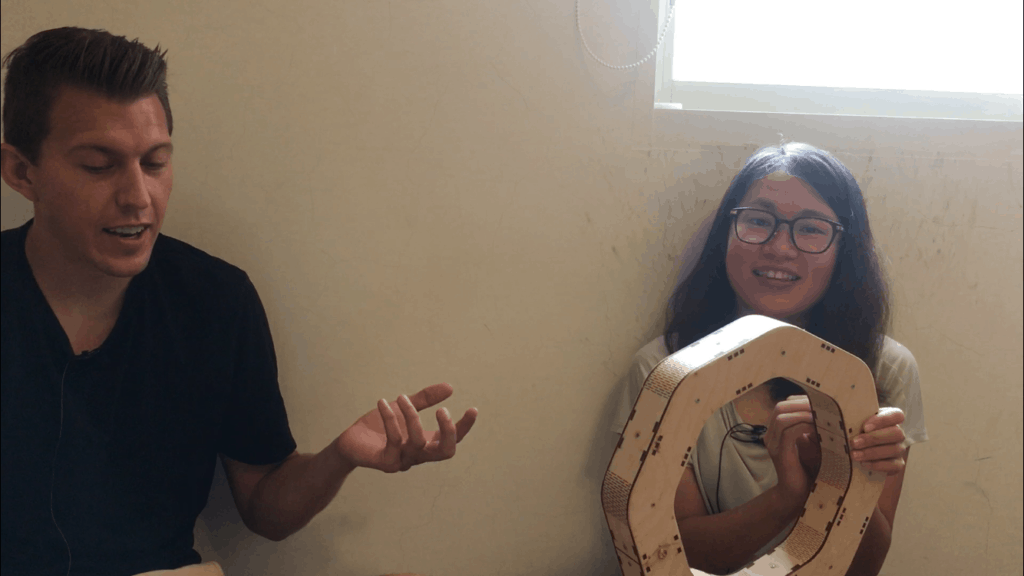
When we first met for coffee, she said to me, “do you want to see the instrument I created?” I’ve never had someone ask this question before and plus, who says no to that question? What she pulled out was an incredible handmade triangle instrument that was her re-invention of an African rainstick, except here was the “infinite” version. She wanted to improve on having to flip over a rainstick every time it stopped making a sound.
Her instrument-making curiosity started when for a project for art school in Chicago, she decided to build a Bacon-themed instrument. We talk about how that got started and how it led to other creative projects such as her Cultural Sound project, where she is trying to map people’s sounds or reactions they used to common occurrences in life. For example, when people see a cute puppy they say “awww” in America, but “ahhhhh” in Taiwan.
Getting grossed out:
In the US, you might say “eww” when you see something gross, but in Taiwan, you’d say:
[/audio]
In addition to her sound projects, we talk a bit about how she expresses her creativity in other ways, through fun and perhaps projects that just don’t make sense. For someone like YuTing, it is hard to imagine her ever using the word “bored.”
Check Out The Video Version:
Check Out Her Projects:
- Soundcloud: @UtingLing
- Cultural Sound Project
Subscribe To The Podcast
Web • Itunes • Stitcher • Google Play • Overcast • Spotify
Transcript
📲Connect + Follow Paul
Read the full transcript
Paul: Welcome to The Pathless Path, exploring the human side of work. I'm your host, Paul Millerd, and I'm fascinated with how we can imagine past the default path to do things that matter. I have conversations with entrepreneurs, freelancers, and thinkers who are questioning the role of work in our lives who are thinking about how we can unlock creative potential in ourselves and organizations and are carving new paths in the world to create a more human future of work. If you want to support the podcast, check out the Patreon link in the show notes. And for more information, go to BoundlessPod.com. Today I am talking with YuTing Chiu, a sound designer and multimedia artist in Taiwan.
Welcome to the podcast.
YuTing Chiu: Thanks for having me, Paul.
Paul: Awesome. So I'm excited to talk to you today, and you're working on a lot of creative projects. You can probably see one of them here. This is my— In the video, there's also a video version of this today, and that's some of the noise the instrument is making. But I'm excited to talk to you about that. You're also working on a global sound project, which we'll dig into.
And building your own instruments, but I'd love to just start with talking about creativity. So you work on a lot of creative projects. Where does that creative energy come from?
YuTing Chiu: It's from my daily life, actually. I'm always curious about a lot of things, and I guess I just try to figure out, so I start those projects.
Paul: You've said to me you think everyone is drawn to work on big creative projects. Well, we'll talk a little bit about some of your creative projects, but can you give me an example of how that plays out for many people? Maybe we should— we could broaden the definition of creativity.
YuTing Chiu: Um, it's just, um, my friends, they are, uh, they're really excited planning about their wedding plan, and I felt that That really inspired me somehow because I felt we always want to exercise our creativity in a certain level. And why I'm inspired is because my friends, they got so excited that sometimes I feel the wedding plan is more important than who they're marrying to. I'm just kidding, but I just felt that Even though we have to follow by certain guideline, I mean the framework, so they give you different options so you can choose what style you want. But I think it's always nice to see how exciting they, they are when they are planning things. So I think exercising our creativity in life is really important for us, but sometimes we didn't really realize it.
Paul: Yeah, that's fascinating. And I think if you're thinking about a creative project that, I mean, if somebody's gone through all the effort of planning their wedding, they can see those really minute details which they put a lot of passion and energy into. Maybe other people don't see it as such, but maybe you're starting to see some of those in some of the weddings you're attending, or—
YuTing Chiu: Yeah, yeah, yeah, that's— I enjoyed it.
Paul: That's awesome. So What drew you to want to go to art school? You've always— or maybe at first a good place to start would be to talk about music and how music has played a role in your life.
YuTing Chiu: Yeah, I'm always found of music. I can feel it in my blood. But the reason why I got into art school is a little funny. I, um, I was trying to choose school between music and art. Actually, music school is supposed to be my priority, but I decided to keep that little wonderland in my mind because if I go to a music school, it's really possible to pursue it as my career, and I don't want to ruin it by doing so. So I choose art school and it turned out it's one of the best choices I could ever make in my life.
Paul: So in a sense, you still were drawn back to music though. So you kind of used the art to express some of the musical things you were doing.
YuTing Chiu: Mm-hmm, yeah.
Paul: Maybe you want to talk about some of the projects you did in art school?
YuTing Chiu: Sure. I made a bagel wind chime one time. And it was just one summer.
Paul: Wait, wait, wait, so let's back up. You don't just make a bacon wind chime. Where did that idea start? Like, what was it? What was the project? What were the goals of the project?
And how did it become something where you're thinking about creating an instrument and then incorporating bacon, which I think most people love.
YuTing Chiu: I know I was vegan at that time, honestly. But it was really funny. Normally my artwork is creating with my computer, and one summer I got so sick of it, so I decided to play with clay. I just want to feel my art in my hand. So I choose the ceramic class and they offer porcelain and red clay in our classroom. And then I'm just playing with the clay and I combine them.
And then I sliced it with my little knife, and then I saw the bacon patterns, and I think, wow, okay, this sounds fun. And then I sliced a few pieces with the real knife, and I decided to just bake it. And it turned out they sound really nice. So I was thinking, what if I created instruments? What if I make it in tune? So I started this project, and then at the end I have 33 notes.
a playable bacon, ceramic strips, and in the key of C. So I can just play it like, ding, ding, ding, ding, ding, ding, ding, ding. Yeah. So that was my work.
Paul: That's great. And what were people's reactions to that?
YuTing Chiu: Oh, they had a lot of fun. And during the opening, I've seen a lot of kids, they're playing with it, and a lot of just people with all ages. This is what I try to create. I don't want people to watch my work and try to figure out what's going on. I just want to be straight and then people, anyone in the world can just enjoy it. That's what my work is about.
Paul: And did you serve bacon as part of your presentation as well?
YuTing Chiu: No.
Paul: Are you still a vegan or did you—
YuTing Chiu: I'm trying to. I'm trying to. Yeah.
Paul: That's amazing. So, were there any other projects or moments in going to art school? And you attended in Chicago, so were there moments of like just being in a different environment? You grew up in Taiwan. What were some of the moments of being in school there?
YuTing Chiu: Hmm, one thing that I really noticed was Whenever we have a critique session, I think a lot of Asian people or East Asian people, or at least the people from Taiwan or China, whenever we got a compliment from other students during the critique, and then we always say, oh, thank you. Thank you. We try to push the things away. And for some reason, I noticed it from by watching other people doing it. Maybe when I was doing it, I didn't really realize it, but I felt that the Westerner culture is more confident about who they are, and then just, they appreciate those comments. And for us, the first thing we did is push it away.
But inside, maybe we're still proud of it. But I just wonder, where did that come from? Why do we try to hide it? And why do we even want to push it away to try to show our humbleness or what, I don't know. Just something that I notice is a little different.
Paul: So have you gotten better? Did you get better during that experience at taking compliments?
YuTing Chiu: Yeah. At the end, they say, I just said, thank you. Yeah. Just like what I do.
Paul: Yeah. I've seen that across many people. I think especially when younger, it's just hard to take compliments. People have this pattern of deflecting. It's like, oh, thank you, but it wasn't that much effort or things like that. Okay, so it's, uh, definitely pretty fascinating.
Uh, so moving back to Taiwan, uh, how were you thinking about some of the creative projects you were doing and like the next chapter as you moved back here?
YuTing Chiu: I'm still working on a lot of art projects, and there's one that I did in front of a metro station. It was, uh, I was holding a sign which written in Chinese and English says "Holding sign for nothing." And that experience was pretty fun, but I have to say I do notice the performance art scene, at least in public, is not that common yet in Taiwan. So I think a lot of people thought I was a weirdo, but it was okay. I was expecting that and it was It was also fun. So that project is really about making a statement. I was inspired by some people, they are trying to buy vinyls.
It was a little trendy a few years ago. I noticed that a lot of people, they buy vinyls and they try to take a photo and hashtag things with it. And a lot of them, they don't even have a vinyl player. Their home. And so I'm just— I think that update, making a statement of your lifestyle, it's become so much important. And that made— that inspired me to just try to making a statement of nothing.
Paul: Well, isn't the statement of nothing such— it's almost stronger than a statement of nothing. It's like an act of rebellion, would you say?
YuTing Chiu: It depends on what you, what you think. Yeah, I'm not trying to make a statement.
Paul: And, and did people come up to you and say anything?
YuTing Chiu: No, I wish, but I think if I did it somewhere, or maybe in the US, people ask what I'm doing, or I will expect a little more interaction with people.
Paul: That's fascinating. So, so talk to me about some of your other let's call them acts of creative expression. Now, you're a member of Couchsurfing, and you've met people from all over the world through that.
YuTing Chiu: Yeah.
Paul: Maybe talk to me about one of your Couchsurfing experiences.
YuTing Chiu: Sure. There's one— I started to be a host this summer, actually, and I was thinking, man, I wanted to be a guest too. Even though I'm living here in Taipei and then in the short term I'm not traveling to anywhere, but I still want to surf somewhere as a guest. Why not? So I decided to make a request and then I found a host and I, I told him about the fact that I'm actually another, also another host in Taipei. And I said, if you don't mind, I would like to stay at your place for a night to see, to check out.
And he's actually totally cool with it. So I said, if you're fine, I'm making a formal request. And in my request, I said, hi, this is, uh, I'm from Neptune, and this is the first time I'm traveling to this tiny planet, and I would like to check out things and Taiwanese street food, and if you don't mind, I would like to spend one day at your place if that's okay. And he said, cool. And yeah, I went after my work. Actually, I still live like a normal person, and because I'm an alien, so I can download any information from this planet, so I can also be in any form that I want, which is a Taiwanese girl's body.
So I went there, but before I went, I bought myself a helium balloon because I know in Neptune it contains a lot of gas, and then 20% of it was helium, and that's how I make myself survive on this planet. So I tied that helium balloon on my wrist the entire time, even the time I slept on his couch and the time I took a shower. So And the next day I still survived.
Paul: So where did that come from? I mean, where did you get the idea to do that? Did it just start as, okay, I want to stay with somebody else in my own city, or was there an impetus for that?
YuTing Chiu: Actually, for that, it's really just the idea came from right before I'm doing what I was trying to do. So, um, I wasn't trying to make— I said I'm going to make a formal request, but I didn't know I was trying to make myself an alien. But just before I decided to type it, I was thinking, why not? And I wasn't planning to buy helium balloon, but before I visit him, and I was thinking, why not? So yeah, it wasn't planned.
Paul: Is that kind of your motto, like, why not?
YuTing Chiu: Yeah, I think so, sometimes.
Paul: And is it something deeper around like curiosity and like going deep on ideas?
YuTing Chiu: Mm-hmm.
Paul: So how does, how does that play out in different aspects of your life?
YuTing Chiu: I'm just thinking of negative space a lot of time. I'm trying to seek for what is the Well, I'm just thinking about possibility most of the time. And if I have one answer, and then what will be my other answer for it? And I'll try to give out my other answer.
Paul: So what— yeah, talk to me a little bit about negative space. So are you talking in like the John Keats sense? Have you read about his his interpretation of like negative space?
YuTing Chiu: No, actually.
Paul: Okay, so I'll definitely share that with you, but he kind of talks about— I don't know, what's your interpretation first of like negative space? I guess it would be in an artistic sense.
YuTing Chiu: Well, I felt that— I'm not sure if this is really related, but I feel what I can perceive things from my angle is only in 2D, but if I can combine other people's perspective, it could be multi-dimensional. And I think the truth is always multi-dimensional. So that encouraged me to think in negative space.
Paul: Yeah, I think his interpretation was thinking about, okay, we have like the rational world and how things can be interpreted. Interpreted, and then there's kind of this negative space that's kind of an unknown territory that we can't really fully ever explain in words. So I mean, I could be getting that wrong, but it's a kind of a different way or lens of thinking of things. But so what was the reaction of this Couchsurfing host that was hosting you?
YuTing Chiu: Surprisingly, he was totally fine with it. He's also a A weirdo. No, I'm just kidding. You're one of the coolest hosts in Taipei.
Paul: That's great.
YuTing Chiu: He has an artist's mind too.
Paul: Yeah. Okay, so what does artist's mind mean to you?
YuTing Chiu: I think it's possibility, seeking for possibility. And there's no just one. Answer. So even being humorous is a creative skill too. You have to be creative. And I think— ah, I don't know.
Paul: I think that's a good answer. Yeah, I mean, thinking about possibility of like what can be, right? And by definition, we don't know. When we start, and it's going deeper in things, and as you're going, you kind of uncover like what to do next.
YuTing Chiu: Yeah.
Paul: Does that kind of resonate with how you work on projects? Mm-hmm. So how do you decide what to do next? Like what project you're working on?
YuTing Chiu: I have a few. I have timeline and Each year I get inspired by a few things, and I notice that if I don't do it this year, next year I'll get inspired by something else. So I have to finish projects maybe seasonally, something like that.
Paul: That's interesting. So you have to— you almost have a pressure on yourself to finish things because you know you're going to get inspired by something else in the future.
YuTing Chiu: Yeah.
Paul: So a lot of people say to me, I'm not creative. And I think we've already talked about this a little, your argument argument would be that we need to broaden the definition of creativity, think about the big projects in our life, maybe it's a wedding you're planning or some other event, but what would you say to people that say, oh, I'm not a creative person? I don't know if people have said this to you.
YuTing Chiu: Yeah, but I felt it's, you have to be able to see if that's an excuse or not. Yeah, it's really easy to answer the question like that, but I feel that it's just like singing. A lot of people, they say they don't know how to sing. I can't sing. And I think as long as you can talk, you can sing. And sometimes people have too much pressure by having higher standard.
But just like what I said, as soon as you can talk, you can definitely singing. So you can be creative anytime, any— just whatever you want, right?
Paul: I've been forced to sing a little as I've tried to learn Chinese. Still learning, but the tone that's like the flat tone, it's kind of like a— it's very like vocal, right? So the neighborhood I'm living in, Songshan, People are saying I'm saying it right, but I feel like I'm like singing a little. Oh, okay. It's kind of fun. I like it.
YuTing Chiu: That's interesting.
Paul: But so building on sound, you started a project called the Cultural Sound Project. Talk to me about like the moment that idea came to you.
YuTing Chiu: Sure.
Paul: You were like, okay, maybe there's something deeper here I want to explore that led to the Cultural Sound Project.
YuTing Chiu: It's just something small, actually. It's just I'm always interested in all kinds of sound as a sound designer, and I'm also curious about how people react to certain things. They have similar emotions but different expression of sound based on their culture, so I just want to collect it and show people. For example, if you see something gross in Taiwan, at least for me, I would say ai yeu. So I think ai yeu might sound fun for other people, but that makes me curious about what would be the ai yeu in Morocco? What would be the ai yeu in Rio?
So I started this project and yeah, I'm working on it and it's been really fun so far.
Paul: Right. Did you know what we said in the US before you went there?
YuTing Chiu: Like, from the movie?
Paul: Yeah, you. And it blew my mind talking the other day with you. Yeah, you're giving some of these examples and it was like, oh my gosh, right? Like even a phrase like that, right? Like, oh my gosh, right? There may be different phrases for like wonder or amazement in different cultures, and there's almost like infinite possibilities, right?
YuTing Chiu: Yeah.
Paul: What are some of the other sounds that stood out for you?
YuTing Chiu: One thing that I find that was funny, so even now I still can't find if I translate it directly back to Chinese sound, I still don't know what that was, which is the "aww." I lost my dog, and then when I was studying in the US, and I heard people, "Aww," and I thought that was a really funny sound.
Paul: Yeah.
YuTing Chiu: It's really interesting, but we don't have that sound. We don't make any sound, and we don't say, "I'm sorry." It's like sympathy, right? Mm-hmm.
Paul: Yeah.
YuTing Chiu: Or something cute. It's the same when people see puppies.
Paul: Oh yeah, like a cute bunny or puppy.
YuTing Chiu: Yeah.
Paul: Or baby.
YuTing Chiu: Mm-hmm.
Paul: You see, you have no equivalent for that reaction at all. No, no, no. No sound, no description of an emotion.
YuTing Chiu: No, I mean because those two are really different. Sometimes it's empathy, sometimes it's something adorable. But we, at least for me, I express in two different sounds. Or different words, it's not even sound sometimes.
Paul: So what would be the sound for a cute puppy?
YuTing Chiu: Huh.
Paul: Oh, wow.
YuTing Chiu: That's strange, right?
Paul: A little bit. But it still works, right? I think if we were walking along this— I think if we were walking along the street and saw a puppy and you made that sound, I'd be like, okay, makes sense.
YuTing Chiu: Yeah, cool.
Paul: And then there's almost another element as we've started using technology that like the text translation of some of these things, because I know in English there might be a different text sound or like the way to type it than you say it in person.
YuTing Chiu: Yeah.
Paul: Have you noticed any of these things as well? Like, I've noticed that in some cultures it's not hahaha, like H-A-H-A, it's like J-A-J-A.
YuTing Chiu: Yeah.
Paul: Or even like 55555 in some different cultures, meaning like hahaha.
YuTing Chiu: Oh, okay.
Paul: Maybe I'm expanding the scope of your project here.
YuTing Chiu: Yeah, this project can be big, can be small. But anyway, let me think. This laughing sound. We have our own typing system. It's called ZhuYin. And we make a lot of sound from that.
And there's one, it's called kk. Kk also means laughing sound. But I don't think people made that in person, right? But it's because it comes from how people texted, and after people texted, and people say cuckoo now.
Paul: Oh wow, so it went from text to now people are making the noise.
YuTing Chiu: Yeah.
Paul: Wow, technology eating the world.
YuTing Chiu: But I feel my parents' generation, they won't be able to understand what it means.
Paul: That's amazing. So what What are you hoping to find at the end of this? Or maybe it's just a fun project to explore.
YuTing Chiu: Well, I am trying to collect that sound, and then at the end I wanted to make a sequencer and then chop those samples into the sequencer and hoping to make it interactive. Art, put it in places for people to have fun with it. So people can actually make beats with the sound, so it will sound like a global beatbox. And at the end, I am mapping a ball. And then, so you've seen those disco balls in the dance hall. So I'm mapping the Earth into that disco ball so you can see where those people come from from the lights from my sequencer.
So you're not only hearing the beats but also see where those people come from, and I think it would be fun.
Paul: Wow, that's— so you're gonna have a big party with a bunch of people when you do at the end of this?
YuTing Chiu: Exactly.
Paul: I like it. I hope to attend. So how do you decide what type of projects to work on next? Like you're working on all these things or even on a daily basis, like how do you decide what you're working on today?
YuTing Chiu: I just felt it's about time, like I mentioned. So I know I'll be only inspired by certain things at this period of time. So I just have the feeling that I have to do this this week, next month, before this year, something like that.
Paul: So you've built a series of instruments, and we can— I'll definitely post pictures of these, but maybe you can show a couple of them for the video camera.
YuTing Chiu: Sure.
Paul: So you have— this is like an octagon.
YuTing Chiu: Uh-huh.
Paul: We're making some of—
YuTing Chiu: So—
Paul: Awesome.
YuTing Chiu: There is the instrument.
Paul: We have the audio of that coming through, so—
YuTing Chiu: There is an instrument called rainstick. It's an instrument in Africa, and they used to find those cactus to make the rainstick. But so it's a long stick shape, and so the rain would drop and it sounds— it makes raining sound. But whenever the beans are falling down, you need to do this to make it rain again. So I was thinking if I make a triangular one or octagon one, the rain would never stop. So that's why I started this project.
I started this project in college actually, and now I am just trying to encourage people to find, to enjoy the little things in life. So I make it, um, so now You can open it and then you can replace what you want to put inside so you can explore and discover things like daily little things. You can also crush the pine cone, or you can try to find something from your office desk and just put it inside and then to see what it sounds like.
Paul: That's awesome. So if you're listening, I would describe this as an octagonal— I don't know if octagonal is a word. So it's kind of an octagon, right? It's made out of wood, uh, it has 4 sides all around, and it's, I guess, what you call an infinite rainstick.
YuTing Chiu: Yeah, you can call it that.
Paul: It's a pretty beautiful instrument. She's made it by hand, and I think she's cut it with, uh, Well, you put it together with hand, right?
YuTing Chiu: Oh yeah.
Paul: And cut it with a laser as well.
YuTing Chiu: Mm-hmm.
Paul: But definitely pretty cool. And you started with a triangle, right?
YuTing Chiu: Yeah.
Paul: And then how did you decide, okay, maybe I'm gonna make this an octagon?
YuTing Chiu: It makes more sense.
Paul: Yeah.
YuTing Chiu: No, actually, because the sound is a lot smoother. But I think the triangular one has different characteristics too. I just want to explore the shapes, so that's why I designed different types.
Paul: That's awesome. And these might be for sale one day?
YuTing Chiu: Yeah, I mean, I want to encourage people to just explore and maybe I'll find something inspiring from other people's work too. Just something that I never thought about I could put in it. Like, maybe now I'm thinking about teeth. Teeth?
Paul: Wow.
YuTing Chiu: Yeah, I need to know where to collect it, but it will sound fun, I think. Just, you can put whatever you want.
Paul: Maybe you could start a part-time job as the tooth fairy. Do you have the tooth fairy here in Taiwan?
YuTing Chiu: No, it's not our thing. Oh.
Paul: Wow, there you go, learning new things as well. Do you have any sort of ritual? I don't know, we're on a tangent of teeth right now, but do you have any sort of ritual when you're a child and you lose a tooth?
YuTing Chiu: No, not about a tooth though. We don't have the tooth one.
Paul: Interesting, maybe you can bring that as a way to collect teeth. But that's great. And it's a pretty cool instrument. Maybe we can show a couple of the other versions.
YuTing Chiu: Oh yeah.
Paul: This is like an earlier version.
YuTing Chiu: It's a little smaller and with, uh, sounds different too. This one has the nails and chicken wire in it. This one is the acrylic sticks, so it sounds a little different.
Paul: Yeah.
YuTing Chiu: And I'm just trying trying to explore the sound and the texture.
Paul: Amazing.
YuTing Chiu: Yeah, I'm having so much fun.
Paul: So with all these creative projects, you're obviously— it seems like you're pretty alive with these projects, pretty energized, challenged. Where do you see all this kind of taking you? Like, how do you incorporate a lot of this creativity in your life as you think about like spending your time?
YuTing Chiu: I felt this is just the exercise of my soul, and I just want to keep it and then to make myself healthy.
Paul: Yeah, it's, uh, it's almost like this inner drive that you have to listen to. Yeah, that's beautiful. Uh, so what would be a message you might want to leave with people, um, for them to think about?
YuTing Chiu: I guess I've mentioned this before. It's just I felt we all have the desire to be creative, and I think people should be more encouraged to be creative and do what they want to do, because I think that really helps us to think outside of the box and to perceive things from different perspective, to seek out possibility. And so I think it's important for everyone to try to explore, and it doesn't have to be a big project like the wedding plan, but it can be just discover and enjoy the little things in life, that could be an art form too.