Why I Turned Down A $200k Publishing Offer
In this episode, I talk about the time a publisher tried to buy my book The Pathless Path.
I shared a thread that seemed to get a lot of attention about turning down a $200k book deal. On the surface, this seems like a HUGE deal but the deal structure made it easy to say no. They offered $70k for ALL lifetime rights to The Pathless Path (a book that has generated ~$40k net profit for me in the last four months) and $135k for a 2nd book deal.
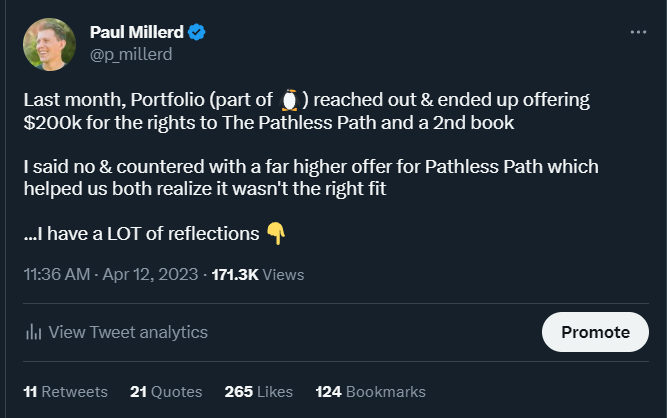
As someone who really enjoyed the self-publishing process and declared my book a complete and total success at 1k copies sold, the prospect of selling my book to a publisher didn’t excite me that much, but I was intrigued. Maybe they had a bold plan to take my book to the next level.
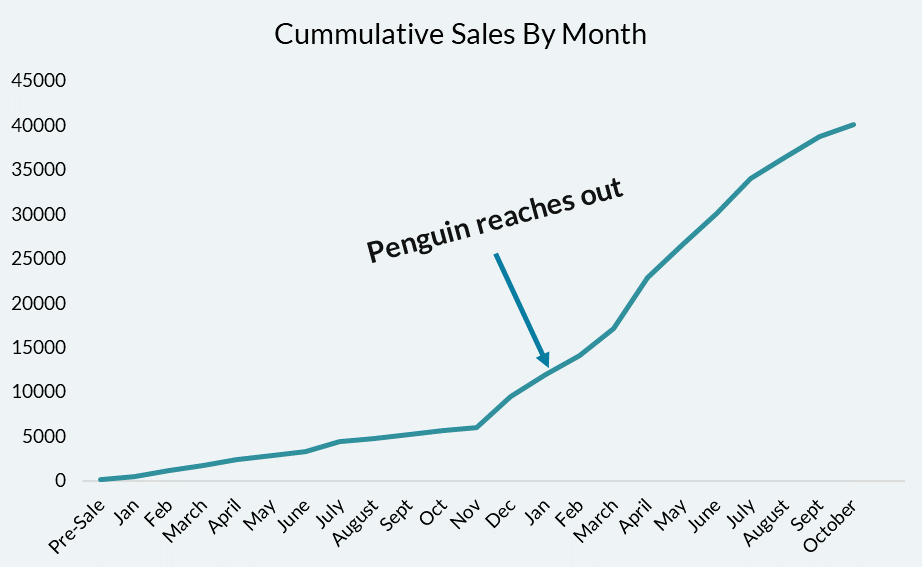
What I found instead was something different. Instead of a plan, they really just pitched me on the fact that other good authors are working with them and the fact that self-publishing is hard (not my experience so far). They also pointed out that I shouldn’t only focus on trying to make money from a book and that other authors make money from speaking gigs and courses. Given that I’ve made about $45k from my book in the last four months, this didn’t feel right for me.
I’ve tried to avoid doing X to get Y to get Z on this path. That’s the career game. Instead, I want to just do Z and enjoy it because I like it. After seeing the high royalty rates from self-publishing and knowing how the costs of running a business are going to decline, I think it’s actually a mistake to think that books need to be a loss leader for other more profitable work.
David Senra was recently expressing a similar confusion, arguing about writers, “You’re not a writer, you’re an entrepreneur and your product just happens to be a book.”
I love that and it aligns with my perspective that the options for people like me to build businesses and capture value are only going to increase over time and I’m not sure I want to partner with a company that doesn’t share that same view of the future.
Advances can be misleading too, especially for future books. For example, here is how a $130k deal pays out: “Payout: $32,500 on signing; $32,500 on delivery and acceptance; $32,500 on pub; $32,500 12 months post-publication.” So an ideal timeline could look something like this:
- May 2023: $32,500
- May 2024: $32,500 (they have to accept it)
- Feb 2025: $32,500 (published 9 months later)
- Feb 2026: $32,500 (final payment)
Laid out like this over three years it doesn’t seem as big, does it?
I ended up telling them that I was not interested in writing a 2nd book, mostly because I’m not feeling called to that right now but that I was open to an offer for The Pathless Path that was higher than $70k. I probably should have just said no and walked away at that point but some degree of greed probably led me to a second call, where the vibes were definitely off and confirmed my hunch that this was not the right fit.
Again they told me the same talking points from the first couple of calls. Self-publishing is hard. We have good authors. We have connections. But there was still no plan. It would have been cool if they were like, “we think this book can sell 500k copies, here’s how we would do it.” It was pretty frustrating.
They asked me what I might accept for The Pathless Path and I gave them a very big number. They weren’t too happy with that and asked how I got the valuation. Looking back it’s a bit weird that they felt like I should be selling them. They were the ones who reached out to me after they noticed my book had accelerating sales in the 2nd year. I’m not sure what I told them but the bottom line for me is that since I’m already on a path I love doing work that matters to me and making enough, the price is going to be really high for me to want to change course.
And I totally understand where they are coming from. I used to work in a company and I understand it’s just business. But I left that world because I didn’t want life to be just business.
And luckily I’ve found many other people that feel the same and want to play a different game. This is the upside of the creator economy. It is a space to play and to show up in a mode of life that is not purely transactional and not purely about money.
Which is beautiful.
Ali Abdaal is a great example of this. He’s read my book, was inspired by it, and has decided over and over again to share it. He’s done this for many others too. I’ve literally never asked him to share my book once. It’s raw generosity and I feel immensely grateful.
He ended up publishing a full review of my book which was totally unexpected.
This is the energy that will win.
They e-mailed me a few days later and told me they would not make an offer which was probably best for everyone. I don’t know what I would have done if they had made me a more significant offer. It would have been harder to say no to something like $300k for The Pathless Path but ultimately, I am more excited than ever to see what is possible with my book.
It made me reflect on something I’ve told other people too: no one will save you. The way I’ve set up my path is perhaps a little more independent and “solo” than most but I think this is the way for me to really do work that matters to me, fully owning all the ups and downs of writing and creating in today’s world. Plus I’m having a ton of fun doing it.
I’m not totally naive and I realize there probably are interesting opportunities worth pursuing with external partners. Because of the thread, I’m now in 3-4 conversations with people who are open to coming up with new ways to work with authors in creator-friendly ways. So I am thankful for them reaching out. It’s inspired me to get creative and pave new paths forward once again. I’ll keep you posted.
Transcript
This is a solo episode of my podcast, inspired by Jenny Blake. I will do more of these if people like them. Let me know! For Video: YouTube
Read the full transcript
Paul: Why did I turn down a $200,000 book deal from a publisher to buy my existing book, The Pathless Path, and for a second future potential book that was not really clear yet? I want to go through that today. I want to walk through this thread over here. I wrote about the experience, but first I want to thank Jenny Blake. Who inspired me to do a solo episode. This is an episode of my podcast, The Pathless Path.
I've done about 150 episodes. I've done a couple episodes where it's just me, but I've more or less just been scared to do this. I, for some reason, the form I think is in words. So doing a newsletter is very easy for me. But podcasts, I've always just had guests and I've never just sat here and tried to unload my thoughts. So that's what I'm trying to do here.
I'm also trying to do this with video. So if you click over to YouTube, you should be able to see that as well. And let's dive in. So I published my book, The Pathless Path. Let's pull this up. And I am looking up stuff live here.
So I published my book, The Pathless Path, on Amazon about, what is it, 15 months ago. This was in January 2022. I spent all of 2021 writing it. And it's been way more successful than I imagined. It has 1,000 ratings, has a pretty good review. And to this point, I've sold about 27,000 books.
17,000 of that has come in the second year, which has vastly outsold the first year. The first year I sold about 10,000 books. In the second year, my sales started increasing. So when my sales started increasing, I think what happens is you start triggering these rankings in publishers' systems, right? And they saw, oh, there's this book. It's getting a lot of attention, more traction, selling more.
People like it. Let's reach out. I think what Portfolio and Penguin is doing is pretty smart, and I think they're trying to scoop up a lot of internet-adjacent writers. Because they can bet on the network effects of those authors working together. For me, though, I'm playing a different game, and that's a lot of what I want to talk about today. Why it was easy to turn down a deal like this and what I'm really trying to do with my book.
So I self-published my book simply because I probably couldn't have gotten anything close to an interesting publishing deal. I had about 3,000 subscribers. When I decided to start writing my book and maybe 2,000 Twitter subscribers. That's not what people look for when they look for publishing deals. So let me go through some of my reflections. Right.
One of my big ones was that it sort of activated this old Paul side of me. So I spent 10 years in the corporate world. Basically trying to tailor myself and my career such that I could fit into what I thought were other people's expectations of me. This is a very normal thing, right? When you're interviewing for a company, you say a lot of things, you put things on your resume to make it look like you would fit well with the company you're trying to join. This is an unavoidable part of the modern career.
And after 10 years of doing that in my career, I didn't feel good about my life. I blew it up, I walked away, and a lot of that story is injected in my book, The Pathless Path. But when they reached out, it activated that side of me. I think part of it was they're an institution. The people that reach out are employees. They're acting as agents of this publisher.
And they're just trying to get a lot of transactions done. I, my whole life and time spent with my work. But to them, I'm just another writer. They have thousands of authors, most of them far more successful than me. And I just felt uncomfortable with that. When I left MyPath, I didn't want to create another job for myself.
And I've done a lot of stuff, probably stayed a little too small early on in my path, but I was scared of creating anything that resembled a job early on my path. And I think this is what was triggered in talking to them, right? And these things are also great. I think as more opportunities emerge, the longer you are on a path like mine, self-employed, doing a lot of creator stuff online, Every opportunity is a test to either choose a different path moving forward or recommit to your values. And this whole experience for me was a good way for me to recommit to my values. So let's go through some of my reflections.
The first one is that prestige is overpriced. And what I mean here is that I think people give up a little too much when they're working with the publishers for the prestige of being selected, being part of this exclusive brand. I have the advantage of having some impressive brands on my resume, and I felt the glow of being selected. When I first got into strategy consulting and worked for one of these amazing firms, I felt really special, right? But that really was a reaction to not feeling good about myself, feeling anxious about my— where I stood in the world. But it never really led to a lasting sense of fulfillment.
It faded away. And I constantly have kept having to, like, feed that need to feel important, feel special. Every job, the longer you're in it, just feels like another job. And so I think one bad pattern I got into in my career was always looking for the next step. And this is very common in today's modern working world. The next step is always how you're thinking about your path.
Number 2, they didn't really have a plan other than we're going to unpublish your book and then republish it, which for me basically meant, okay, in those months it's unpublished, I'm not going to be making money. I'm also going to lose creative control. I don't know what they're going to do with the book, and they didn't really have a plan. Now, I don't think this is their fault. I think they were just trying to get me for the second book, right? They're trying to make an investment, get the first book, which in my mind I think had more upside than they were valuing.
And their game is to launch books that aren't out there yet, right? So a lot of the energy of a publishing company is around that initial launch. It's all around how can we build up hype and momentum such that they either make these bestseller lists or make a splash with tons sold in the first few weeks. There's a good metric in books that if you sell 1,000 in 100 days, you have a good chance of hitting a tipping point of word of mouth. Now that all depends on it being an actually good book that people want to share. And spread.
Right. So I just wasn't all that excited because there was no plan. They just made me an offer. Right. And I think what they were trying to do is get a lot of these internet-adjacent writers and sort of build a network that will grow over the next many years who want to publish books with traditional publishing firms. Finally, they wanted me to write a second book, and I think I sort of overreacted when I had an initial conversation with them and they were like, you should write a second book.
I really hadn't thought of it yet. But to them, that's where the upside is. That's where they can control things. They can guide the story, what I write about, and really shape it into something that will succeed in the markets they know. Right. So I put together a proposal for a sort of book called The Phases of The Pathless Path.
And it was short. It was like 2 pages. I sent them a Word doc and they were like, yes, let's do it. So I can pull up the offer. They offered me $70,000 for the first book. Yeah, so it's not showing perfectly.
They showed— they offered me $70,000 for the first book. And as you can see, they don't pay you that right away. And here's the royalty structure, the royalty structure, which I'll get to later. They basically just pay you, it's probably about, I don't know, anywhere from a quarter to a third of what you're going to make self-publishing on average over time. It's going to vary a lot though. But the payout structures, they give it to you on $17,500 signing, $17,500 delivery acceptance, 17,500 on publishing and 17,500 6 months later.
So this could be over 2 years, right? And then the bigger money was on this second book, $130,000 split up into 4 payments. Now, the problem with this is I sort of laid it out. Here is the payout structure. It's $32,000 for 4 different payments. And potentially, given a traditional publishing timeline, could really be over the next 3 years.
So I could actually get a final payment over in 2026. And this, this is very risky for the path and things I'm optimizing for on my path. This is the thing people don't see, is that this means I'm going to have to continue to work with them. They are essentially going to be my manager. I'm going to be working for them, trying to fit what I'm writing into their framework of what they think they can sell. And there's costs of that.
There's energy costs, there's motivation costs. There's the cost of potentially not working on other things that could have bigger upside or more creative rewards for me. And this is sort of how I think about my path. right? So I quickly realized, like, I don't actually want to commit to this second book. $130,000 sounds like a lot, but it's really spread over 3 years.
Right. And the question to ask is, can I make $32,000 every 9 months over the next 3 years? Right. That's a different question and doesn't sound as crazy as this large number of $200,000. Right. So the, the other thing that was huge for me is this idea of regret minimization.
And this is huge for me, right? The possibilities of carving my own path and inspiring other people and figuring out new ways of using a book, leveraging creative material. This is really exciting for me. So for me to sell that to someone else, that is very costly, right? And money is just not all that important. Reflection number 5, trust your wife.
So Angie noticed in the first couple of days that I was detached and low energy. She says, you aren't, you aren't being yourself, you seem off. I got stuck in this process sort of acting how they wanted me to act. I sent them a mini pitch And I was like, why am I doing this? Right, so my takeaway and a reminder to myself is always trust your wife over trust your gut. Number 6 was the unclear offer, right?
I didn't know what the goal was. They were just making this offer to me and it sounds great, but what's the plan? I wasn't really clear. Number 7, I was annoying to them. This is a little self-reflection. And I'm just not a good rule follower, especially after 6 years of working in solopreneur mode, doing my own thing.
They kept telling me to get an agent. I actually talked to an agent a couple of times during the process. The agent was like, it sounds like you don't want to do this. I was like, well, what if we pitch them a really big number? And I don't know, it just, I was deep in playing a game I shouldn't be playing. Like I said here in this thread, I was probably scared to say no and wanted to hear their offer, but I think I should have trusted my gut and walked away earlier.
I think I was just curious, like, what do they think of my book? What, what is the potential here? If I counter the $70 grand for The Pathless Path, what is the upside? And I told them I am not interested in the second book. I'm open to another offer on the first book. So they said, let's get on a call.
And during that call, like, it was the same thing. There was no plan. They were just like, you should just sign with us. This is the smart thing to do. And there was just too huge of a gap. I didn't really get the sense that they really understood the message of my book, which was really about carving your own path.
So I think it would've just been hard to play their game. They eventually said, we're not actually gonna make a counteroffer. Good luck on your journey, which probably made sense. I wasn't gonna play their game. So they were just, annoyed with me and it wasn't worth it for them. I think reflection number 8, advances are prepayment, right?
People get distracted by this big shiny number, but what you're really doing is you're selling a revenue share of your book's income in perpetuity for an upfront advance, right? This is a prepayment for future book sales. Right. And given that I had already proven in the market that my book was succeeding, it was actually really costly for me to give this up. And I didn't need the money in the present because I've built a lot of my path around building cash reserves and playing the long game. Right.
So you're giving up about 70% of your royalties for them for this upfront sum. And I think another way to think about this is they're paying you for marketing. Right there, the majority owner of the revenue streams of the book, they manage the process and the production. They want you to market the book and they're paying you for that. But there's also a hidden downside of this is that over time, if you don't earn out your advance, you're not going to be motivated to keep selling the book because you're not going to actually see upside for a return on the money. And if you've earned out the advance and you need to sell tons more books, Or if you haven't earned out that advance and you need to sell tons more books, you're just not going to be that motivated because you're going to need to sell tons of books at lower royalties to earn that out.
I think number 9, I sort of looked at the industry and this is Penguin. They're part of a huge conglomerate and I think all these publishers are part of big conglomerates. Right. And publishers did really well during the pandemic. But in the last year from 2021 to 2022, they actually shrunk 3.3%. So for me, this doesn't seem like the industry I want to pair myself to, right?
If I were to partner with somebody, who do I want to partner with? I want to partner with a company that's dreaming big, making big bets, shaping the future, growing 10+% per year. This is probably not the industry to hitch my wagon to. Number 10 is there's always a third option. There's 1, take the deal, 2, walk away, 3, wait and see. Hal Elrod, who wrote this book about "The Miracle Morning," he got several offers.
He had a great podcast on this, on the Self-Publishing School podcast, about how he turned down, I think, like $200,000 and then eventually turned down $1 million for his book from a publishing house. It never made sense for him to give up ownership at any point in the process because, and I think this is similar for my book, it were, it was ideas he was excited about and wanted to keep talking about over and over and over again. This is very unique for me with The Pathless Path. I wrote about ideas I'm fascinated with. I'm going to keep talking about them. I'm talking about them here on this YouTube channel, on my podcast.
Et cetera. It's interesting to me, and my curiosity doesn't seem like it's going to fade. So I think a lot of the things are just going to compound. Now, if a publisher reaches out in a year and offers me $1 million for my book, that's more than my net worth. So at minimum, I'd have to at least consider it, right? But these decisions are complicated.
Number 11 is there's an implicit contract, right? A publisher is a transactional world. The creator, the creator game of giving first without expectation is not their game, right? They want something for what they're giving. They want me to sell my book, right? I was uncomfortable with this sort of implied notion of, hey, you sign with us, then we'll help you, right?
The world I'm playing in and the game I want to play is I want to actually proactively help people without expectation. And Jenny Blake, who inspired this podcast, is a perfect example of this. She went from traditional publishing to hybrid publishing and paying for her own printing because she wanted to do things on her own terms. And she actually sent me her book, Free Time, and it's beautiful. She designed it herself. I'll open up some of the pages.
All the pages are custom here. They're really cool. She has like confetti on the beginning of the chapters. And you can see she just injected her love into it. Not to mention she sent it to me in these custom mailers with stickers on it and swag and buttons saying I'm a book nerd. I love it, right?
She's giving first. And she didn't ask me for anything, but I'm gonna be talking about her book for years now. It's awesome. I love what she's doing. I love the energy she's putting into the world. Back to the thread.
Number 12, my temperament. Over the last 6 years, I've discovered that I thrive when I can make up my own rules and do things on my own. I have a lot of intrinsic motivation. Writing my book was actually a, sort of skiing downhill process for me. It felt natural. It felt in the flow of what I was excited and passionate about, and I felt it was something in the flow of my life.
I think I can keep doing these things and I shouldn't sacrifice things that might zap my energy and the ability to keep doing those. Number 13 is this great quote from, uh, David Senra. He says, you're not a writer, you're an entrepreneur and your product just happens to be a book. I love this. Senra is magic. He's totally right.
The publisher kept saying I could make money on courses, speaking and other things, but why not books? Right? And then for me, what's next? The cool thing about this process is I got creative and ended up reaching out to publishers. I explored a couple other publishers, including people that wanted to print my books overseas. I eventually decided not to pursue those.
But I did end up signing with a foreign rights agent. And this sort of opened my eyes to like translations and things like that. So there's a lot of opportunities with that that I'm going to explore. I'm going to keep sharing if I get translations to put it in Chinese, Spanish, different languages around the world. That's actually very hard to do on your own in self-publishing. So you need help for those things.
Number 15 was I received a bunch of cool messages from people. One of those people was Ramit Sethi. He said, hey, this is really cool what you're up to. Thanks for sharing. It was really cool just to receive that message from someone, someone that was rooting for me, right? Tiago Forte has written some great stuff about the traditional publishing path.
He's perfectly wired for it. Tiago can crush that game. I'm not wired for it. I say the traditional publishing path is about launch energy, putting that effort into a massive launch and event. I don't have that. I have long game energy.
I know I won't quit over time, and it's all about knowing which game you can play. There's more in the thread. Also some royalty information I share. I have it when I hit 20,000 books, and you can see some of the royalties, right? This is just from one of my months. I was making $8 on my hardcover, $7.45 on my paperback, about $4 on my audiobooks, about $4.30 on Kindles, and $7.80 on iBooks.
Yeah, and there's more here. Yeah, this was an experimental solo episode. If you like this one on YouTube or on the podcast, let me know. I'm going to try and do more of these. Thanks for inspiring me, Jenny, if you listen to this. My daughter, who's 3 months old, is crying, so I'm going to go take care of her.
Peace out. Thanks for listening to The Pathless Path. Thanks for listening to The Pathless Path podcast. I really appreciate you listening and spending time with my show. If you want to support my work further, you can do that first and foremost by checking out my books, The Pathless Path and recently published Good Work. Good Work, you can find that at paulmillerd.com/goodwork.
And you can also check out links to my book, Pathless Path, there as well. In addition, if you're somebody that is on a weird path, on a pathless path, or even just wants to meet people outside of your bubble, you might enjoy The Pathless Path community. It's an emerging group of over 300 people from around the world who are sharing ideas about how to fit work into their lives in different ways. You can also find that on pathlesspath.com or in links in my newsletter or in the links in the show notes below. Thank you for listening and have a fantastic day.