Alex Pang on Working Less, Rest, Leisure & The 4-Day Workweek
Pang’s Own Journey To Understanding Rest
I first stumbled upon Alex Pang when my cousin suggested I read his book Rest, which was published in 2016. The book argues that we are ignoring Rest - a key component of a life well lived and more practically (at least in the short-term) a vital component to getting more done while working less.
I’ve also written about Pang’s own experience with a sabbatical and how he discovered a renewed sense of energy for engaging with the world.
As I’ve talked with people that have taken leaves from work - planned or unplanned - I find a similar pattern. I find that people discover or even re-discover hobbies, interests or projects that they are drawn to. Some people write books, some people decide to volunteer.
During Alex’s three-month sabbatical, he had a moment that made it seem like everything he thought about his work was wrong:
It was about a month into it that I had this realization that I was getting incredible amounts of stuff done, I was reading huge numbers of books, I was having all these ideas, great conversations, producing lots of stuff but I didn’t have this sense of being constantly time-pressured and always being half a project behind in my entire life that was just part of normal existence in silicon valley. It was at this point that I realized I had made a significant transition, a mental shift, but also a shift in how I experienced time. It started me thinking about the relationship between work and leisure and rest and creative work.
I asked him if there was a single moment in which all of this came to him.
I had been reading Virginia Woolf’s book A Room Of One’s Own that makes the argument that for in order for women to be creative, but really for anyone to be creative, they needed a certain kind of space and independence that had long been denied to women…That got me thinking about all these issues and their interconnection.
The connection between rest and leisure is something that has bubbled up in the modern consciousness. I’ve written about how we mistake a vacation for leisure, Andrew Taggart writes about how Leisure was once seen as the supreme aim of life and Pang writes about losing touch with the essence of the idea in Rest (my own book notes here).
Of course, I can’t claim any special insight here. The ancient Greeks saw rest as a great gift, as the pinnacle of civilized life. The Roman Stoics argued that you cannot have a good life without good work. Indeed, virtually every ancient society, recognized that both work and rest were necessary for a good life: one provided the means to live, the other gave meaning to life. Today, we’ve lost touch with that wisdom, and our lives are poorer and less fulfilling as a result. It’s time we rediscovered the good that rest can do.
Working Less = Doing More?
In his book Rest, he quotes an example of Academics from the 1950s:
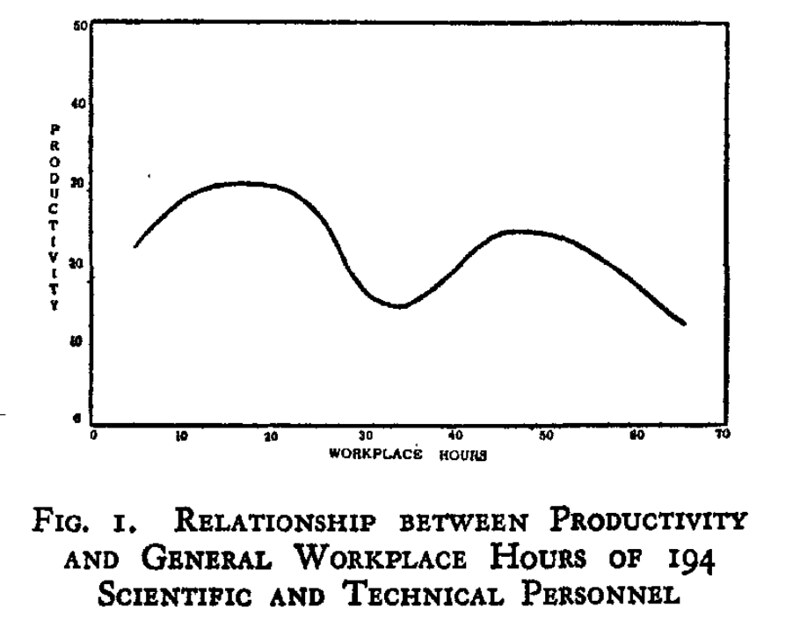
A survey of scientists’ working lives conducted in the early 1950s yielded results in a similar range. Illinois Institute of Technology psychology professors Raymond Van Zelst and Willard Kerr surveyed their colleagues about their work habits and schedules, then graphed the number of hours faculty spent in the office against the number of articles they produced. You might expect that the result would be a straight line showing that the more hours scientists worked, the more articles they published. But it wasn’t. The data revealed an M-shaped curve. The curve rose steeply at first and peaked at between ten to twenty hours per week. The curve then turned downward. Scientists who spent twenty-five hours in the workplace were no more productive than those who spent five. Scientists working thirty-five hours a week were half as productive as their twenty-hours-a-week colleagues.
The surprising chart of results looked like this:
What he found over and over again was a theme of people that do great creative work for about four hours per day:
Toulouse noted that Poincaré kept very regular hours. He did his hardest thinking between 10 a.m. and noon, and again between five and seven in the afternoon. The nineteenth century’s most towering mathematical genius worked just enough to get his mind around a problem—about four hours a day.
But this does not mean they work 4 hours a day and then just lounge around for the rest of the day. Pang has found that people are very deliberate about their rest.
They often have hobbies that are almost as absorbing as their work - sometimes being time-consuming or physically challenging.
Can the 4-day workweek be a bait & switch for doing better work and finding more rest?
As Alex says in our conversation, overwork has become the norm, even a “badge of honor” in the Western world for knowledge work:
Overwork is now seen as a badge of honor rather than a symptom of a problem and this is a relatively new things. Its so common now, its easy to see it as a natural and inevitable thing. However, its actually very new. If you’re a knowledge work, you naturally work harder than others is really a reversal of practice in the past.
His book Rest led him to find companies that were experimenting with the 4-day workweek and finding that much of what Alex has written about in Rest is coming true - that they are able to do the same or more in less time. This is something I talked about with Tash Walker, who moved her company to a 4-day week in 2019 and found many of the benefits that Pang predicted.
He is launching a new book in 2020 and sharing more stories about the 4-day week - sign up to get a notification when the book is on sale below.
Connect With Alex
You can find Alex on Twitter, Instagram (with his dogs), or on his blog Deliberate Rest
Support Boundless & Alex
amzn_assoc_tracking_id = “carewithpau01-20”; amzn_assoc_ad_mode = “manual”; amzn_assoc_ad_type = “smart”; amzn_assoc_marketplace = “amazon”; amzn_assoc_region = “US”; amzn_assoc_design = “enhanced_links”; amzn_assoc_asins = “0465074871”; amzn_assoc_placement = “adunit”; amzn_assoc_linkid = “f56bf2a2ed827c0db8c4711413230488”; amzn_assoc_tracking_id = “carewithpau01-20”; amzn_assoc_ad_mode = “manual”; amzn_assoc_ad_type = “smart”; amzn_assoc_marketplace = “amazon”; amzn_assoc_region = “US”; amzn_assoc_design = “enhanced_links”; amzn_assoc_asins = “0241406781”; amzn_assoc_placement = “adunit”; amzn_assoc_linkid = “e7390e81f46995c1fc372470422838e3”; amzn_assoc_tracking_id = “carewithpau01-20”; amzn_assoc_ad_mode = “manual”; amzn_assoc_ad_type = “smart”; amzn_assoc_marketplace = “amazon”; amzn_assoc_region = “US”; amzn_assoc_design = “enhanced_links”; amzn_assoc_asins = “144747919X”; amzn_assoc_placement = “adunit”; amzn_assoc_linkid = “04e8b18737d12b53e97afc8fcb8a6bba”;
Transcript
Alex Pang is the author of Rest about how you can do more while working less and is author of the forthcoming Shorter, which shares stories of companies that have shifted to a four day workweek. Hear about Alex's own sabbatical, how he changed his relationship to rest and what he's learning now.
Read the full transcript
Paul: Today I'm having a conversation with Alex Pang, the author of multiple books including one of my favorites, Rest, which questions the conventional wisdom that More Work Equals Better Work. He's also working on a forthcoming book called Shorter to be published in 2020, where he will explore new approaches to work with shorter workdays and workweeks. Welcome to the podcast, Alex.
Day Workweek: Thanks, Paul. It's great to be with you.
Paul: Excited to dive into some of your personal experiences with taking a sabbatical, your books, and just what you've learned. But I'd love to start out with your earlier life, which was taking a very academic path and studying history. I'd love to dive into what were you most curious about on that original journey?
Day Workweek: Well, in my kind of previous life as an academic, my focus was in history of science, and I wrote a dissertation about 19th century Victorian astronomy, so it's one of these subjects that was of passionate interest to about half a dozen people or so. And however, the thing for me about the field and about that discipline is that it provided a really good grounding for thinking about issues around the place of technology in our lives or the way in which How do we go about assessing claims about knowledge? And I think also a kind of sensibility that it's really worth asking very often what look like stupidly basic questions, because if you do that and you take them seriously and kind of push on them, you can often end up learning some really interesting things.
And part of the— I think part of what was most exciting about history of science was that I came into it at a time when people were starting to go from a more philosophical or abstract approach to the field to one that said, okay, so what happens And what can we learn if we go into laboratories, kind of like anthropologists, and observe how scientists actually work, how they make arguments, how they decide whether a particular experiment is successful, when it actually has ended, when we've gathered enough evidence to prove what we set out to prove or learn what we set out to learn.
And I think that that You know, that combination of questioning really basic things about the way that the field works combined with that interest in how work actually gets done is something that has continued to be a hallmark of the work I've done since then, whether it's as a futurist or whether it is in books like Rest and Shorter. So I think I'm one of the few people who had a serious academic training in history of science who then kind of put it to use in the business world. So— but that's my background and how it's turned out to continue to influence my work today.
Paul: Yeah, and it seems like that basic question of asking why at the core seems to be at the center of your work and books to this day. Yeah. I ask people often, why do you work? And people can give you a surface-level answer, but as you found in your extensive writing, there's so much more to that question, right?
Day Workweek: Yes, absolutely. And I think it's, you know, that work is, work is an especially rich subject that you can, you can approach from a lot of different angles. In a way that the 3 books that I've written about technology and distraction, the book about rest, and now the latest book, Shorter, are in different kinds of ways, different examinations of what makes work good. What constitutes good work and how do we actually practice it and what rewards do we get from it as individuals? As communities and as organizations.
Paul: In your career, you said you first discovered what the corporate world was when you took a job with Britannica. So you may have to educate some of our younger listeners what that means. But it's also a pretty interesting time for somebody that's studying the history of technology and going into an encyclopedia that's being digitized. How did— what was that experience like at that moment?
Day Workweek: You know, for me, joining at that time was a bit like joining a publishing house in, you know, 1600 when it was making the transition from being a, you know, a place that farmed out manuscripts to copyists and illustrators to being a place that, you know, stamped out stamped out thousands of books on a printing press. It was as momentous a change in the industry as that. And so, you know, for me, working there raised all kinds of questions that we had to deal with about how people, you know, read an encyclopedia once it moved from being a print product to being an electronic product. You know, how you, you know, change in how you went about editing something with the assumption that people would be able to jump around between articles a lot more, or questions about how quickly you had to update it now that you no longer had to obey an annual printing schedule.
But so, you know, all that stuff was really cool, and it was interesting to see how these, you know, what seemed often in the seminar room to be very abstract issues turned out to be incredibly practical ones, right, when you're actually the managing editor of this thing as I was. For me, the other real revelation going in there was how diverse the corporate world is. We had people who were University of Chicago-trained philosophers who could argue about the ontology of printed texts all day long. Then you had production guys who had been linebackers in high school who didn't see the encyclopedia as this incredible cultural treasure, but rather as X number of pounds of paper and leather binding or cloth binding that had to be turned out by the hundreds of thousands. And so the legal team saw it as 44 million words, each of which was a potential lawsuit.
And so the fact that people looked at the same artifact in these very, very different kinds of ways, but that those differences were all really important for making this product as good as it was, was for me a real revelation, having come from an academic world that assumed that business was just this kind of flat expanse where people were concerned about nothing but making as much money as possible. So my time there proved to be a much more illuminating education about business and about technical change and disruption than I ever would have guessed when I started.
Paul: So you worked in the corporate world. A while longer and ended up working in a number of different roles. You ended up taking a sabbatical, and during that sabbatical you started writing the book The Distraction Addiction. So I've been talking to a lot of people that have taken sabbaticals, taken breaks, uh, taken rest in their life, and there always seems to be this unexpected explosion of creative ideas reconnection with hobbies from childhood or other things they're interested in. Did you experience some sort of shift and how long did this take upon taking the sabbatical for some of these things to emerge?
Day Workweek: Well, this was 3 months at Microsoft Research in Cambridge, England. So, it was going from Silicon Valley to one of oldest universities in the world, going to the UK. All of this was made for just personally a really rich and remarkable experience. For me, I think that it was about a month into it that I had this realization that I was getting incredible amounts of stuff done. I was, you know, reading huge amounts, huge numbers of books. I was having all these ideas, great conversations, producing lots of stuff.
But I didn't have that sense of being constantly time-pressured and always sort of half a project behind in my entire life. That was just part of normal existence in Silicon Valley. And I think it was at that point that I realized I had really made a significant transition, a kind of, you know, mental shift, but also a shift in just how I experienced time. And that was significant not just for the work that I did that became The Distraction Addiction, but it started me thinking about the relationship between work and leisure, between rest and creative work that eventually forms the basis of my third book about rest and its role in the lives of really creative people. And it was that experience that started me thinking that maybe our assumptions about kind of success being a race against time and a race against burnout, that in order to do really good work, you have to work constantly.
That these, and that being overworked and time pressured is just a natural consequence of ambition and drive and a desire for success. Maybe these ideas actually are wrong. Maybe in fact they are backwards, and that in order to do world-class work, it's necessary to rethink our relationships, between time and work and creativity and rest. And to see work and rest not as opposites, but rather as partners, each of which turn out to be able to contribute to our very best work and to help us be our very best selves. And so, you know, that was, you know, that was when I started started a line of thinking that eventually yielded Rest and has kind of carried momentum into my latest book as well.
Paul: So I've explored a lot of these similar questions, and once you start peeling back a couple of the layers, you realize that these kind of questions touch everything, right? You alluded to it. You talked about time, rest, energy, our work beliefs. When was the— was there a moment for you that you realized, "Oh wow, this is a big question"?
Day Workweek: You know, I think that certainly there was one particular evening when my wife and I were at a café where I was, you know, I had been reading Virginia Woolf's book, A Room of Her Own, you know, that makes the argument for that in order for women to be creative, and indeed for anyone to be creative, but women in particular, that they needed a certain kind of space and a certain degree of independence that had long been denied to women. And I've been reading a couple other things as well, and sort of all of those together had got me thinking about these issues and in a way thinking about their interconnection, maybe in ways that I hadn't previously.
And so I do— and I think this is something that has carried through into— that I actually see the people that I write about in my latest book about the 4-day week, sort of realizing for themselves that in a sense, One of the great stories of companies that make a shift to 4-day work weeks or to 6-hour days, who move to 32 or 30-hour work weeks without sacrificing productivity, without cutting salaries, without alienating customers, is that they come to see that time reduction, that reduction in the work week, as connecting to a whole bunch of different things, right, about technology adoption within companies, about work-life balance, about the need to, to encourage or enforce collaboration between different groups, about the role that simply being with other people in the same space at the same time plays in making organizations successful.
And One of the remarkable things about the 4-day week is that it's almost like, you know, these internet ads about, you know, this one crazy trick that lets you, I don't know, you know, lose weight or sort of get great grades or something. The 4-day week in a sense is somewhat like that in that it turns out to be a way to solve a whole bunch of problems that we usually approach separately but which really turn out to be very interconnected. And so I think that being able to see that and being able to see, you know, being able to see that not just as a source of complexity or something that paralyzes us, but rather as something that can then stimulate a desire for solutions or search for solutions. Is a really challenging thing, but it's something that the people I talk about in the book managed to do.
And it's something that I hope in, you know, my own work, I kind of managed to do myself.
Paul: I'd love to dive into the idea of leisure. And I think this is a fascinating one because it's something we've almost lost touch to. And maybe I'll start with a quote you wrote in Rest. And you say, when we treat workaholics as heroes, we express a belief that labor rather than contemplation is the wellspring of great ideas, and that the success of individuals and companies is a measure of their long hours. So I think the interesting word in there is contemplation. So maybe talk to me about what contemplation has to do with work.
Day Workweek: Hmm. So, you know, I think that the— where they intersect is that both work or active efforts at problem solving and contemplation or mind wandering or passive, more passive time spent not trying to solve problems but more sort of casually reflecting upon them, letting ideas play out kind of in the back of your mind while your attention is drawn to other things. That both of these turn out to be really important for solving really difficult problems. You know, there's a number of models of creative thinking or problem solving that identify several different and quite different stages in the kind of problem-solving process, right? There's that formal phase where you're working on a problem and maybe you solve part of it, but some of it gets, you know, is just, is too difficult for, sort of, and eludes your conscious efforts at solution.
And then, you know, you kind of put it down, you go do something else, you have this kind of period of incubation where your kind of subconscious takes over and plays around with sort of ideas. And then out of that emerges a kind of that sort of moment of inspiration or insight where the kind of answer to the final piece of the puzzle emerges and everything kind of falls into place.
And I think that, you know, we that the fact that we tend, you know, we see success as a matter of conscious hard work has had the unintended consequence of making us more suspicious of those more reflective contemplative phases, even while our scientific understanding of what's going on under the hood or what's going on in our minds and in our brains when we allow ourselves to mind wander, when we allow ourselves to kind of ruminate over these problems rather than trying to attack them directly, our understanding of those things has become far clearer in the last 20 or so years thanks to technologies like, you know, magnetic resonance imaging and sort of a bunch of really creative experiments that psychologists of creativity have done.
And so I think that the, you know, that Part of what I try to do in Rest is to make the argument that we should see that kind of active work and that kind of contemplative leisure as equally valuable and as equally important and necessary in doing really great work and solving really significant problems. That's where that comes from. That's what animates that quote.
Paul: Yeah. And in our modern world, we've lost touch with this more ancient tradition of leisure, which used to be kind of the aim, right? And now leisure is often thought of as something you do once you've worked enough and gotten enough money to leisure or vacation. And I think people swap those two words interchangeably, whereas kind of the more ancient idea of leisure is both an active and a passive.
Day Workweek: Yeah, now, and I think we're in this weird situation, especially in the States but in other countries to some degree, where, you know, overwork is now seen as a badge of honor rather than a symptom of a problem. And this is actually a relatively new thing. I mean, it's so common now. It's easy to, or easy to see it as a kind of natural and inevitable thing. But it's really very, very new. And the idea, particularly that if you are a professional, if you're a knowledge worker, if you're in a position of authority, that you naturally work a lot harder than somebody else.
Than people in blue-collar jobs is, in particular, a real reversal over practice in the past. When we talk about bankers' hours today, that's like up at 6:00 AM seeing what's going on in the markets in Frankfurt, and then you finally quit at 9:00 PM and you sleep with your phone under the pillow. So, if something happens in Tokyo, at 2 AM your time, you know, you can, you know, you can move on that opportunity. A generation ago, banker's hours meant like roll into the office at 9:30 and you're out of there by 3. It was a very, very different kind of life lived at a very different sort of pace. And I think that, you know, at an everyday level, we have moved away from an idea that that success correlates with the freedom to work less as opposed to the necessity to work even more.
And that our assumptions about the relationship between work and success and leisure are now almost completely different than they were in the past. And so I think that it's It's an understanding that I think is really worth trying to revive or turn the dial back on. I think that some of our ancestors had a much better understanding of the relationship between work and leisure and work time and free time than we do, and I think that there is a lot of science and a lot of work that helps explain why it is that their approach to, you know, to the workday and to work and rest deserve, you know, deserve a new look today.
Paul: Yeah. So reflecting on the science, I was fascinated by this study you highlighted in Rest, and I looked up the study and there's this cool graph, I can link to it in the show notes, but it's an, it's basically, it makes an M, right? And it slopes down. I'll try to describe it best for audio, but it showed these academics that number of hours worked and their output or contributions, right? And there was a peak around 10 to 25 hours of work, and then there was a drop, and then it went up, but not equivalent to the 10 to 25 hours. People that work 40 to 60 hours, and then it peaked again.
So I love this example. I'd love to hear if you have more around this or if you found other examples in different industries of this trend. But it kind of showed that this 10 to 25 hours a week was kind of a sweet spot for contribution.
Day Workweek: Yeah. And, you know, this is, this is from a study that was done at Illinois Institute of Technology in the 1950s, or of looking at hours worked and output by different faculty members. And essentially, there were two high points. One among people who worked like 3 or 4 hours a day, and then one among people who worked 10 hours a day. And the amazing thing is that the people who worked less were more productive than the people who really like tried to grind it out. And so that's, you know, that for me was one of the first empirical pieces of evidence that illustrated that there is this kind of clustering around or of working about 4 hours a day, particularly, that seems to be special.
And it's a number that you see in lots of people's descriptions of how they work, in, you know, sort of workout routines and in studies of things like students at conservatory. So there's a wonderful study, you know, if you're familiar with Malcolm Gladwell's 10,000 hours rule, right? I think this is in his book, What the Tipping Point, where, you know, you need 10,000 hours to become world-class at something. That number comes from a study of violin students at a conservatory in Berlin. And what the authors were interested in was what is it that sets really great students apart from just ordinary ones? Is it genetics?
Is it the number of hours they practice? Is it something else? And what they found was that the really top students, the ones who are going to be first chairs, who are going to be Deutsche Grammophon, you know, artists, that they actually didn't practice that much more than the ordinary students. Yes, they practiced 10,000 hours or so, but this is over the course of 10 years. But, you know, they didn't just— but what was more striking to them was that they practiced very deliberately. And, you know, they practiced with an eye toward improving very specific parts of their performance.
They got a lot of feedback from their teachers. And so they weren't just putting in long hours. They were working in a much more focused kind of way. What struck me about that study was two other things. One was that 10,000 hours over 10 years is about 1,000 hours a year. If you assume people take weekends off and a couple weeks during the summer, and this is after all Europe, so that's highly likely, you figure they're practicing about 250 days a year.
1,000 hours into 250 days works out to about 4 hours a day. Again, a number like that one in the study of scientists in Illinois. It's also a number that Charles Darwin worked per day when he was writing The Origin of Species and The Descent of Man and a dozen other books. 4 hours is about the number of hours that Stephen King, Toni Morrison, Ernest Hemingway, Salman Rushdie, innumerable other authors, composers, painters, mathematicians worked per day. And like the conservatory students, they tend to, they work in a very focused kind of manner and then they're done.
The second thing is from the conservatory study, which again you see replicated in lots of other places, is that the students didn't spend enormous amounts of time in, or as much time as the ordinary students in leisure, but the really elite students were very good at explaining how they chose to spend their time and why they chose particular hobbies. And so they were in a sense resting as deliberately as they practiced. And you see a similar kind of thing with very creative folks, right, that they often have hobbies that are, as for them, almost as absorbing as their work. They're often time-consuming or physically challenging. And, you know, for people who are often described as obsessed with their work or, you know, in super competitive areas, it kind of doesn't make sense that they would engage in these time-consuming often dangerous activities.
But it turns out that those kinds of activities both provide a real kind of intensive restoration from their normal work, but also give time for their creative minds to sort of explore ideas even when their conscious attention is turned elsewhere. And so all of this together, I think, points to a fact that there does seem to be something almost kind of physiological about working 4 hours intensively. Doing that on a daily basis and combining it with generous portions of leisure and rest allow you to do a lot of really significant work and to do it for a very, very long time.
So, you know, so all— so that combination of things, the Berlin Conservatory study, the study of the Illinois scientists, and then biographies and autobiographies of creative people, all to me pointed in the same direction, a kind of common pattern of daily schedules of work, but also a relationship that gets built into those schedules between intensive periods of work and periods of deliberate rest.
Paul: Yeah, I've experienced a lot of these things shifting to working on my own. And one of the things I realized is I work a lot less and create a lot more suddenly because I have control over my time. And I kind of reflect back and there's just a crazy amount of meetings and movement around to different rooms and I just never really focused on the work I was doing. And you kind of just throw yourself into the wind of the corporate machinery.
Day Workweek: Mm-hmm. Now, there were, you know, there are these studies that suggest that between time lost to multitasking and task switching, getting interrupted by, you know, people who have just one quick question or phone calls or a new email, the time spent getting back on task, the time lost in meetings, the time spent in all that other kind of friction can easily amount to 2 or 3 or even 4 hours of productive time every single day. And I think that, you know, lots, lots of people have your experience of discovering when they go out on their own how much more productive they actually can be when they don't have to deal with all of that. And also companies are discovering that one of the keys to moving to a 4-day week successfully is attacking all of that stuff, right?
Getting rid of that kind of rubble of overly long meetings and interruptions and bad planning that turn out to be amazingly time-consuming and which if you're able to deal with it, make it possible to make it possible for companies, whether they be factories or creative agencies or even restaurants, to do really great work in far less time than we normally imagine is necessary. Yeah.
Paul: So I'd love to dive into the 4-day workweek now, which I've been fascinated with as almost a sort of bait and switch to kind of address some surface-level issues, but then what I've seen is people seem to start questioning deeper things around, okay, how do I spend my day? What am I actually working on? And then now I have this extra day, like, what do I actually want to do with it? What's my relationship between life and work? I interviewed Tash Walker, who implemented a 4-day workweek at her company in London, and she experienced a lot of these things and also just experienced a profound shift in her personal life of just more engagement in her life and energy at home. What have you seen in some of the companies and some of the unexpected benefits they've experienced from these shifts?
Day Workweek: Well, I think, you know, Tash and The Mix are a great illustration of the kinds of changes that you see in, you know, in companies that move to shorter work weeks. So I've looked at about 100 companies all over the world, right? Europe, US, Japan, Australia, Korea. Korea in fact turns out to be like one of the epicenters in which this movement is taking hold, which is like kind of surprising given that Koreans are like number 2 in the world in average number of hours worked per year. But you know, that just shows that they really need this. But you know, I think that the— or that what I see in all of these companies is, first of all, someone in charge, very often a founder or someone in a very senior role, who has the kind of epiphany that you had, right?
That the way that we normally work is super inefficient and is costly both for organizations and people it burns people out, it's not necessary, and that we can figure out how to do it better. And then at the organizational level, I think that I see them going through a couple phases. I mean, one of them is just a kind of managerial phase or sort of, or sort of self-managing phase of figuring out, okay, how can we make meetings shorter? How can we make this process more efficient? How can we automate this thing, how do we use technology more effectively, which then leads to kind of a phase of thinking about cultural and social norms in an organization. And I think that the really big discovery that they make is a recognition that these efficiencies and increases in productivity and savings in time are fundamentally social things.
By which I mean, we are so— we are very, very accustomed to thinking of productivity as an individual personal thing, right? It's something that each of us, you know, each of us can achieve usually in competition with other people through Pomodoro or tips and tricks or some other, you know, or, you know, or of eating Soylent or some other set of, you know, life hacks. And What these companies come to realize is that an enormous amount of time can be saved if you respect other people's time. You know, my ability to focus and get work done depends upon your ability to respect my time and my need to pay attention to what is most important. Like, and that if you do this, You know, my ability to leave at the end of the day Thursday and to not come into the office on Friday depends on you being able to get your work done.
So there is this— I think that there is this shift from seeing productivity as essentially a personal thing to being a social thing. And likewise, seeing efficiency, productivity, and time savings as being social phenomena. That also means that these companies develop cultural norms that help support that. So, you know, one of the— so a couple important ones are, you know, I think respect for people's time that plays out in stuff like no longer asking people, making a conscious effort not to interrupt people with those, you know, one quick question type things that turn into 20 minutes, with setting aside particular times of day when people can work on their most important stuff at a really high level and not have to answer the phone and ignore other people, ignore questions, ignore everything.
And also, and finally, a kind of understanding that when you automate processes, when you use and introduce some new technology that makes your work more effective, you get to keep the time savings. It's not that the company then, you know, turns that into profit that can be, you know, that gets absorbed by the CEO so that they can, you know, buy a third Mercedes. It gets translated into you being able to go home earlier. And so I think that those, you know, those cultural things turn out to be almost like even bigger revelations for people. And they finally, I think, culminate in a changed attitude toward the relationship between work and time. You know, we think now that spending long hours at the office is a sign of how passionate you are, how devoted you are to, you know, to your bosses or your business or, you know, how, you know, how like intellectually engaged you are in the work.
And what these companies do is they flip that around and they say, first of all, that, you know, in a— that what we really ought to respect is an ability to think hard enough about your work so that you can get it done in less time rather than more. Anybody can sit in a chair for 12 hours a day. Anybody can do that. The really impressive person is the person who's able to get that work done in 6 hours or 5 or 4. I think the second thing that, that reflects is the sensibility that being passionate about your work does not mean working every single moment of the day. What it means is being deeply, passionately engaged in your work at a high level for as long as you can sustain that, which is, you know, a shorter— which is a few hours a day, not an enormous number of hours.
And so I think that these are— it's a really interesting set of shifts. And I think it's one that makes people happier at their work. It means it allows them to do better work. It allows leaders to be better at their jobs. And I think it makes company— the evidence is it makes companies more profitable, more sustainable, more resilient during difficult times. And it allows them to do better work at a higher level of quality that satisfies, satisfies clients and customers.
So, it's a win for everybody.
Paul: I've discovered very diverse reactions to the idea that we work less, shorter work weeks, shorter workdays from around the world. And the one that stands out is Americans. When you suggest to people from the US that you work less, there's almost like this horrified reaction, like, how could you do such a thing? Right?
Day Workweek: Right.
Paul: What is so special about us as we're Americans and what is the deal with the US?
Day Workweek: Yeah, we're particularly crazy for one thing. This is actually, seriously, like William James more than 100 years ago was talking about how Americans, you know, Americans work themselves to death in contrast to sort of, you know, civilized people in other countries. And so I think this is something that's been part of American culture for a long time. But it's definitely something that I have seen here in Silicon Valley, right? You can talk to people about all kinds of crazy stuff like global networks of balloons delivering 5G internet access seamlessly everywhere in the world with zero latency. And the reaction is like, yeah, that's just like a technical problem.
And yeah, it's an optimization issue. Or providing water for everyone in the world. Or cryptocurrency, stable cryptocurrencies on the blockchain that provide total anonymity. You could do that tomorrow. But mention a 4-day week and it's like all of a sudden you're spouting, you're like a sorcerer giving some sort of incantation to raise up the dead. And so it is the idea that we can do so many things in the world, but we can't work less.
It's a very interesting thing to see. I mean, I think that we are beginning to see some shift in this. We are seeing, particularly in the UK and to a lesser extent in the US, more discussion of companies that have made this shift and classified not just in like news of the weird, but rather being treated a little bit more respectfully as examples of companies that are doing something really interesting that maybe you can learn something from. You might not go all out yourself and try this, but at least, you know, there are these interesting places that are doing this.
You know, and as for why, you know, I think that, or, you know, as for why we have this kind of reaction, I think we've had a generation of, you know, being told that, you know, what success looks like no longer is, you know, it's not like steadily starting at the bottom and working your way up to the top of the company, waiting your turn, paying your dues, and eventually reaching the top, right? You know, like the way that it was in the days of, you know, Mad Men or, you know, or of earlier. There was a time in the 1950s when both— when the two most valuable companies in the United States General Motors and General Electric were both run by guys named Charlie Wilson, both of whom had started in the mailrooms of their companies, you know, when they were teenagers. And that kind of model of success seems almost inconceivable now.
But I think, you know, and what has replaced it is a model of success from Silicon Valley and from Wall Street that says that success is achieved by working titanic numbers of hours when you're young before your technical skills become obsolete or before the next downturn in the market wipes out your net worth. And so success is something that happens very quickly through putting in incredibly long hours. Once that becomes the model for everybody, then that becomes a kind of— you can then kind of detach that vision of what success looks like and apply it to people who will never become rich or to Uber drivers or to teachers and to other professions. It ceases to become something that has a certain logic to it in places like the Valley or Goldman Sachs and simply becomes a kind of ideology that we all question with that, that we all simply live under and very rarely get to question.
Paul: Yeah, so I'm interested what you're finding across the globe. So I'm in East Asia in Taiwan and East Asia is known for long work hours as well.
Day Workweek: Oh, heck yeah.
Paul: I think Europe is always the one that has this natural kind of anti-labor sentiment, but I'm curious to hear what you're seeing in Korea. I'm really intrigued by that and why the 4-day workweek seems to be resonating there.
Day Workweek: Yeah. So I think the two things to be said about Korea are, Number 1, work hours there are the second longest in the world by country. And then, number 2, Korea is one of the few countries in the world whose language has a specific word for working yourself to death. So, that gives you a sense of generally what it's like there. But the companies are making the shift for Actually, largely the same reasons that they are everywhere. It starts out as a kind of rational economic choice.
The companies that have been doing it are ones that are trying to recruit talent that are competing with giant companies like Samsung or LG for engineering talent. They can't pay the sorts of big salaries that you get at those places. And so the 4-day week or, you know, a 35-hour workweek is something that you can offer instead of more money. And I think for, you know, you also see this in the cosmetics industry, which, you know, and for the cosmetics industry there, it's a very innovative, it's a very innovative space. It's one that's all about health and wellness, and it's— and the products are ones that are sold as part of a kind of quest for beauty and balance.
And so that's an industry where, you know, changing around the way that you work in order to help achieve those same kinds of things is, yeah, there's a kind of internal logic there that aligns the practices of the company with the aims of the product. For the software industry, it's mainly about sustainability of people and recruitment and retention. So, and the, you know, the key insight that they have there is that well-run projects and people and, you know, well-run projects staffed by people who are not perpetually exhausted will turn out far better products than ones where you've got people sleeping under their desks most of the year.
Also, when times, you know, when times get tough or when, you know, something happens and a schedule crashes and people have to like work 50% more time for order for a month, If your baseline is a 30-hour week, that means you go to a 45-hour week, you know, and which is a vastly, vastly different thing than if your baseline is already set at 50 hours a week and then you've got to go to 75, right? That's the sort of shift that just destroys people, whereas, you know, a month of 45-hour weeks is, you know, that's kind of a challenge, but you already have in place practices and sort of managerial procedures that make that something that is, that has, you know, clear boundaries and is going to be more productive. And just at a physical level, it is work at a pace or of a duration that people are better able to handle.
You know, and then you see in in Japan, likewise, several software or e-commerce companies that are doing it. And then one of my favorite examples from Japan is a ryokan, you know, one of those traditional Japanese inns with the tatami mats and the picturesque garden and the sliding, the shoji screens. And this was one that's owned by the Miyazaki family, the same family that the owners actually are cousins of the famous animator, Miyazaki, who did, yeah, My Neighbor Totoro and stuff. Actually, if you know My Neighbor Totoro, there's that wonderful dream sequence with the gigantic camphor tree, right? And that tree in the movie is actually based on a tree at this inn. But a few years ago, they inherited the inn, and, you know, traditionally inns run 7 days a week, just like, you know, hotels in the United States.
And they tried doing that for a while, and it was really tough, and they decided to move to a 5-day week and eventually a 4-day week. What they found, first of all, was that this made it that you didn't lose that much in revenues because there always are some really slow days in the week anyway. Most people aren't— The weekends are always busy. Monday and Tuesday, they're almost always empty. There's a kind of rise and fall, a kind of rhythm in the revenues that allows you to shorten the work week. But it also meant that they were able to do, it gave them time to do things like develop side businesses in catering and in build up the wedding business, which is a significant thing in Japan.
But also to experiment with like automation and to introduce things like automated license plate readers in the parking lot that would send a message to the front desk that that this guest has arrived so that, you know, as they're getting out of the car, someone can go down and greet them by name and take their bags and get them checked in on a tablet rather than having to go to a front desk. And to do all— and, you know, basically to build a kind of wireless Internet of Things layer on top of a traditional Japanese inn that had been on a site that has existed since something like the 1200s. And moving to a 4-day week made it possible for them to do those kinds of experiments.
And so I think it's a, you know, it's a wonderful example of how having that kind of extra time, that time to experiment, to tinker, to play around with things, turns out to offer not just time for recovery, but for amazing creative activity and innovation that has turned this place into, first of all, a highly profitable inn, but also one that is now seen as a real innovator in the industry. So those are my favorite Asian examples.
Paul: You've been talking about rest, shorter work weeks for several years now.
Day Workweek: Mm-hmm.
Paul: What— have you noticed a shift in kind of the zeitgeist around this? What are the general sentiments and are you optimistic about these things changing?
Day Workweek: Yes, I am. I think that the— as someone who looks at technology trends and other future trends, I see a lot of really bleak stuff, but the shift to a 4-day week is one of the things that actually makes me optimistic about the future. But I think that the, you know, what I am seeing is at least the beginnings of a recognition that, or of perpetual overwork is, I think the idea that You know, that's bad and unsustainable and not— and bad both for individuals and for companies that people pretty much, I think, buy that argument. The question is, what do you do then, right? How do you deal with it? And I think that we are— what I am seeing is You know, first of all, greater attention to this as a serious problem.
You know, not just as something that afflicts like, you know, people who just don't know how to manage their time, but rather as something that is effectively a public health crisis, first of all. Second, that it's something— pardon me. That has more kind of structural sources than merely personal ones, that it's not just a set of problems that arise from, you know, my bad time management or someone else's poor project management, but this really reflects problems with the way that capitalism and companies operate today. And then I think the third critical thing is a recognition from that, that the solution to these problems isn't just individual, but rather collective and organizational.
And that's where things like the effort to move to 4-day weeks comes in, that the most effective way to solve all of these problems with work-life balance, with productivity, with making careers more sustainable is for us to all work on them together and to work on the structures that have created these problems and can be redesigned to help us solve them. So that stuff makes me optimistic. You know, having said that, you still see a lot of people who are, you know, basically in a race to like be successful before they burn themselves out. So we still got work to do.
Paul: Yeah, I share the mixed takeaway, but I have seen a lot more interest in these ideas. So I think the work you're doing is just very meaningful and looks at things that may seem obvious, but I think you go deeper in a way that kind of makes people think and think about these in a different way. So I appreciate the work you're doing. Is there anything you want to leave people with or point them to find out more about your work, your books?
Day Workweek: People who want to learn more about, um, about this stuff can either, you know, follow me on Twitter or Instagram, um, where I am, um, AskPang, A-S-K-P-A-N-G. I'm, I'm that on both of them. Um, and then though Instagram is more pictures of my dog than, um, anything. And then I also write about issues about work and rest on my website, Deliberate Rest, deliberate.rest. Rest, blessedly, is a top-level domain these days. So, but I've continued the story of, or of deliberate rest there.
And also been writing some about companies that have been moving to 4-day weeks and other kinds of shorter work weeks. So, that's where people should go.
Paul: Fantastic. Well, thank you for the conversation today, Alex, and looking forward to the launch of your book next year as well.
Day Workweek: Oh, thanks very much. I am too.