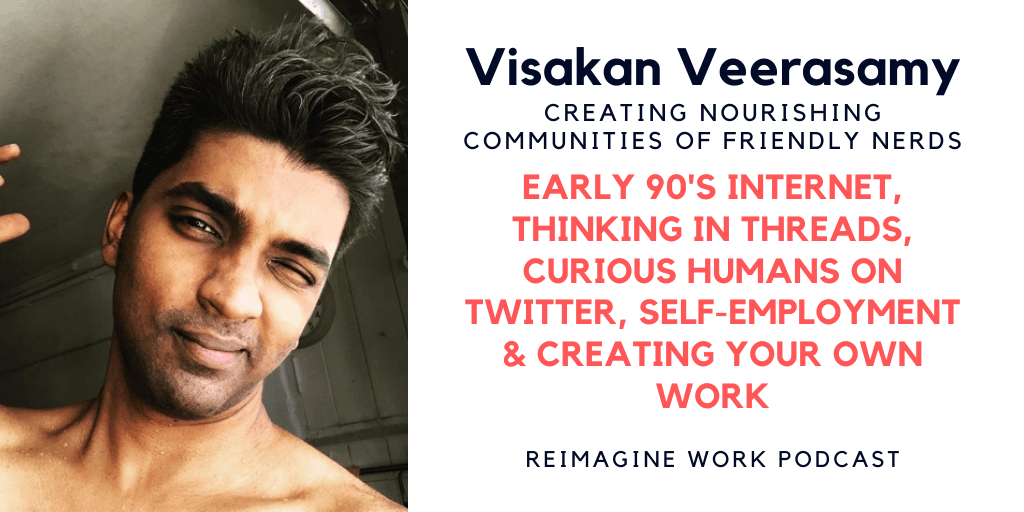
Visakan Veerasamy On The Curious Humans Of Twitter & Creating His Own Work
I connected with Visa on Twitter, where he’s made many friends over the past several years. I wanted to interview Visa to talk about his leap to self-employment over the past couple of years, but we talked about so much more. We talk about:
- What the word “nourish” means to him
- His evolution on procrastination and getting started
- How to find like-hearted humans on twitter
- The “asshole problem”
- The curious humans of twitter
- How he creates his own work
Thinking On Twitter
Visa has gained a reputation on Twitter for being someone who’s building a transparent “second brain” (h/t Tiago Forte), sharing whatever he finds with his followers.
He says he does this mostly to keep track of what he’s learning and finding, but it also seems to be something that many people find value from.
- Link To All His Threads: Visa’s Threads
I asked him for his most overrated thread:
https://twitter.com/visakanv/status/990570131238473728?s=20
…and his most underrated thread:
https://twitter.com/visakanv/status/591230884449124353
His tips for getting started on Twitter
Many people worry about attracting the attention of influential people. Instead, he suggests you just focus on building genuine connections. Here are the five steps he recommends for anyone who wants to dive in:
- Don’t follow institutions - if its interesting, people will retweet it
- Don’t follow people that won’t reply (+3,000 followers):
- Follow people with max of 1,000-ish followers
- Have conversations with people
- Make friends with their friends
Taking the leap to self-employment
I love his own tips on self-employment. The following tweet summarizes how he’s thought about his own leap (he say’s he us currently on step 4!)
https://twitter.com/visakanv/status/1015469196300337153?s=20
He thinks people should be bolder in creating their own work and using their curiosity as a guide
you can do unpaid work for yourself. I suggest do anything you find interesting
He gives the example of a mean girls essay he wrote that (Power & Social Dynamics In Mean Girls) got a lot of attention from people who were “above his pay grade:
The trap some people fall into is they think they need to do what they think other people will be interested in…that;s like guesswork…and your guesswork is probably off by some degree that you don’t realize.
I love that model. Check out the episode and let me know what you think!
Transcript
I connected with Visa on twitter, where he’s made many friends over the past several years. I wanted to interview Visa to talk about his leap to self-employment over the past couple of years, but we talked about so much more.
Read the full transcript
Paul: Today I am getting nerdy with Visakan Veerasamy, a Twitter friend with a mission to find friendly nerds around the world, introduce them to each other, and build robust, nourishing communities. Welcome to the podcast, Visa.
Visakan Veerasamy: Hi, Paul. Thanks for having me.
Paul: It seems the internet was a huge channel for you early in your life.
Visakan Veerasamy: Yes.
Paul: And you were writing about not fitting into that default path of success, the education system, and sharing your thoughts. Mm-hmm. When was the first moment you kind of thought about the internet as a thing?
Visakan Veerasamy: I mean, so I was exposed to it directly before I started theorizing about it or whatever. So it kind of, you know, it was a very get your feet wet, get your hands dirty kind of thing for me. So the story I sometimes tell people is that— let me kind of try and retrace my early internet steps, which was, you know, so the first thing I did as a child was to look for video games and look for I think like video game cheat codes and stuff like that. And I found a forum for a very niche game that I was playing. It's called— the game is called Darkstone. It's like a— it's made by a very small company.
It's like a Diablo 1.5 kind of clone. And none of my friends played it, but I found the forum of the company and I found the forum— like Google wasn't even popular then, so I found it through the booklet in the CD case, and they said, oh, this is our website. So I went to their website and there's a forum there, and on the forum there were like dozens of people who also played the game. And I'm like, wow. So, you know, like, because the internet isn't really a thing yet, it's kind of a novelty, like a fax machine or whatever. And here I was, I was spending hours on this game on my own, nobody to talk to about it.
And then, you know, there's a bunch of— there's a string of text which is like http://delphine-software blah blah blah, and I typed that into my browser browser. I think I was using like Netscape Navigator at the time. And here there were other people who would talk to me about the game that I was playing. So it was like, whoa, it's a string of— it's like a magic incantation, right? Like you type in this thing and now you can talk to people from around the world. And that just very early on, that was like a, you know, so it's difficult to accurately recreate your younger states because the language that you had at the time was not so precise.
So I don't— so now when I talk about it, I'm like, oh, it opened up a whole new world. And it just seemed exciting, I guess. So as a child, I was like, you know, I have my, my life outside of the screen, which is, you know, I, and I do have friends and, you know, we, we, we play— how old was I? 7, 8? Yeah, we play in the playground, running around and stuff. But then I could come to this magical hyperspace cyberspace thing which just seemed like an entire different universe and I just wanted to experience more of that as much as I could.
I wanted— I knew very early on that I wanted my own website so I had like a personal homepage with like a guestbook and like a list of jokes.
Paul: I love that.
Visakan Veerasamy: Yeah, like just— it's just I wanted to have a space on the web that was mine. And you know, another kind of riff that I do is like, I think, I'm not sure if it was Richard Feynman or, I can't remember, somebody wrote something about, I think it might have been Steve Wozniak who wrote about fiddling with a ham radio as a child. And again, it's kind of the same thing where, you know, you have this device and you tinker with it. And then you can go and you can just broadcast, you can find a frequency and you'd be like, hi, I am call sign whatever on this frequency. And then you might get like a captain of a ship from the Navy or from a merchant ship, and they're like, hello, call sign, we are— this is Admiral so-and-so, like, we read you. And you're like, holy shit, I'm a child and an admiral is talking to me.
And then you just— that just opens up your concept of what is possible, and you want to spend more time doing it. I think even like Jim Carrey once, he just— he saw a talk show on TV and he just wrote a fan letter and he got a kind of a—
Paul: this is a crazy story.
Visakan Veerasamy: Yeah, right. He gets like a cookie-cutter response and it's like with the talk shows, um, like their letterhead. And then it's like, oh, thank you, Mr. Jim, for writing in. Stay in school, study hard, maybe you'll have a good future, that kind of thing. But he was ecstatic.
He was like, I wrote to Hollywood and Hollywood wrote back. And like, I mean, I mean, I'm— this is I'm gonna do more of this, right? And then now he's— so it's very interesting how all these origins tend to— it tends to start out really small, like just some little interaction, but that little interaction is like the call to adventure. It's like, oh, I can explore this.
Paul: That resonates. I explored on the internet. I think it was this product of the '90s, right? And you're kind of exploring solo, but there are other people it's not fully developed yet. And in the US, we had AOL, so people were operating in these chat rooms. There was early gaming.
And I think a lot of people our generation kind of disappeared or disconnected from that, might have gotten serious, quote unquote, about work. And I find a lot of people are reconnecting with that now, either through Twitter, um, getting into coding and kind of reconnecting and remembering Oh, I used to love kind of coding up random websites at GeoCities or Tripod or all these early internet sites. Yeah. It seems that the internet helped you kind of overcome something you were facing in your life, which was a lot of friction to actually do stuff. So the number 2 tag thing you've written about is procrastination.
Visakan Veerasamy: Right.
Paul: And you wrote a lot about how there was just all these things you should be doing but you didn't do when you were little, right? But it seems digitally you were able to kind of overcome that and just do a lot of stuff. What do you think was the difference between those two operating modes?
Visakan Veerasamy: Right, it's interesting to hear this from someone else because, I mean, you're talking about my word vomits, right, that you're looking at, the tech log. And I was— so I never set out to write so much about procrastination, but I mean, so that was just— that project was just me wanting to write as much as I could about anything and kind of really just, you know, I think Ed Sheeran has a quote that he was— so some guy in the audience asked Ed Sheeran, like, I'm a songwriter as well, how do I get good? And Ed Sheeran used like this tap water metaphor. He talks about how if there's like an old tap and you first turn it on, it kind of trickles a little bit and then it's dirty water because it hasn't been used in a long time. And you kind of have to like open the tap and let the terrible stuff come out for a while before it eventually gets the good stuff.
And that's kind of my— that resonated with me. That's kind of the same attitude I have towards writing. I'm like, if you want to become a writer or an artist or a painter, whatever it is you want to do, You're gonna make a whole bunch of shitty stuff first before you get to the stuff that you really want to do. I mean, and you're— even your idea of what you want to do is itself a work in progress that you will modify as you develop more experience. And I'm not answering your question. Your question is about procrastination.
Paul: I procrastinating the question.
Visakan Veerasamy: I was trying to see if that would be useful context. It's context, but well, I was, I was really shitty in school. So I did really well in school early on, and then later on, not so much. And then I couldn't get myself to study. And when I started work, my work— so I used to think that, oh, the reason I'm not doing well in school is probably because, you know, at some level school is bullshit. I mean, that's one narrative that I had.
At some level school is bullshit, and I'm not going to be able to force myself to do things that I don't want to do. Then I started work and I was really blessed. I got hired to work in a startup where the work environment was great, the work was interesting, I wanted to do well at it, and yet I was constantly kind of getting distracted and not doing the work that I wanted to do. And my boss was great. He was like my therapist. At our meetings, he'd be like, no, so why didn't you do the thing that you're going to do?
And I'm like, oh, it's because I'm a bad person. He's like, no, don't give me that. What, like, talk me through it step by step. Like, why didn't you do— I was like, well, I was planning to do it at this time, but then, you know, there's an argument on Facebook, that kind of thing. And I just wanted to really understand that. I guess I kind of caught that bug from my boss.
So what my boss was really great at was he was more curious about me at the time than I was about myself. Like, I had already at some point internalized, you know, so my teachers would say, oh, you know, you're a smart kid, but you're lazy. I'm like, yeah, I guess. Sure, that sounds true. And I had kind of internalized this I'm lazy, I'm distracted label for myself. And my boss didn't buy into that.
He was like, no, I'm sure there's something else. I'm sure, like, let's dig deeper. And just kind of, you know, I felt a sense of The obligation is a bit of a loaded term. It sounds a bit negative, but I felt like a positive obligation to— here's the guy who took a chance on me and he hired me and he's paying me, and I feel like— and he's genuinely interested in me, so I feel like I should, you know, kind of rise to meet him at the level of his interest. And so I'm like, okay, I'm gonna understand myself as well as I can so that our conversations can be better and I can be a productive colleague. And Yeah, so I just wanted to be done with it.
And I mean, I'm not, I'm not done with it per se. I think it's one of those lifelong things. I think even like Leonardo da Vinci said in his journal, like, I have wasted my days. And you know, if someone, if someone like da Vinci feels that he procrastinated, I don't think any of us will ever be free of it entirely. But again, I think there's like stages to your relationship with, with the work that you're doing and your feelings about the work that you're doing and If you're not doing what you want to be doing, how do you feel about that? Are you in denial?
Are you honest about it? And so I think the reason I have so much writing on procrastination, which I don't really do anymore, by the way, I think that was like a 2013 to 2016, maybe that was like the top. I think by 2015 I was pretty much done. So I basically read everything I could find on the subject. I read like hundreds of blog posts. I would read books, I would watch videos.
I wanted to kind of understand the whole space. And I mean, this is kind of how I approach learning anything, but yeah, so I wanted to understand the whole idea space. What are like the recurring things people talk about? What are, who has solved this problem and how have they solved it? Is it solvable at all? Is it like unsolvable for some people?
Is it, you know, is it psychological? Is it contextual? Is it the environment? Is it the the mindset, and spoiler, it's everything. But like, yeah, I just, I, it occurred to me and my boss made it clear to me that, you know, I had, I think I developed some kind of avoidance mechanisms as a way of kind of surviving with my psyche intact in school. So like in school, I would rebel against the curriculum by reading books under the table.
And so at some level, to try to preserve my freedom or to preserve my autonomy, I would reject whatever was, um, whatever instructions or directives I was given because most of them seem like bullshit. But the problem with that is when you make that a habit, it becomes like a, like a subconscious habit. And so you just reject all directives and instructions. And so I even reject my own instructions. So if I write down, I'm going to study today, I don't because like, fuck instructions, right? —So in my earlier life, the impulse that— I would say it served me.
It served me to preserve kind of my sense of self and my sense of what I'm interested in, all that. But like, I was overcorrecting, I guess, and I needed to dig into it and inspect element and like unpack whatever was not helping me anymore. And so I spent a lot of time doing that. I wouldn't say I'm done with it, but I've made a lot of progress and it's, it is what it is.
Paul: Well, it seems like a lot of what drives you is almost making the complex visible. Yes. So you can say, here's what it looks like. It's way more complex than you think. And I imagine having that in the corporate world, in school, where there's a right answer or a right metric or one process. That's such a, such a tension.
And I imagine probably what's driven you to kind of explore working on your own as well. Yeah, true, true.
Visakan Veerasamy: I think something I felt pretty early on was that if there is a problem that has already— that already has a very, very clear solution, I'm not very interested in working on it because— and I think intuitively I know that I'm not kind of suited for it. Like, my disposition and personality is not right for it. So like, And I have met people who are really good at that. And like, you, so you give them, you give them kind of a puzzle that's like a closed puzzle. And there's like an algorithm, like, you know, Rubik's Cube kind of thing where you follow the algorithm and you get it. And the game is to get as good as possible at following the algorithm.
So you get it. I, so I used to kind of overcorrect against that as well. I'm like, oh, that's bullshit and totally nonsense. But now I'm like, okay, okay. There is that, you know, it's a, it's a way of, you know, it's, it's a field, it's a class of fields, and some people are good at that. Like, you know, accountants and all those people, they're good at that.
And, you know, the world needs people who are good at that, and I respect that now. And, um, but I also know that I will never be— even if I work my absolute hardest, I will never be as good an accountant as someone, even let's say like my wife. Like, my wife is— I would say she's more like me than the average person, but she's also more kind of, um, technical, like, um, meticulous, I guess. And I will never be able to be in the top 10% of like meticulous people. I just can't do that. And so if I try to play that game, I will lose.
And it's like, why would I work so hard and get so miserable to play a game that I'm not going to win? Right? Like, I might as well try to go to the frontier. And there, you know, at the frontier, um, my lack of meticulousness doesn't hurt me. And my ability to kind of, explore and change frames and change context, it serves me. And people who are kind of good accounting, rulebook-following types, they struggle there.
So it's just, it's about finding the kind of the space in the spectrum where my strengths are good and my weaknesses are not bad. And so, yeah, so it's like frontier work, I guess.
Paul: It seems like a big theme for you centers around the word nourish, which I see in when you're talking about nourishing ideas, nourishing friendships, what does that word mean to you?
Visakan Veerasamy: That's a great question. So, and I would say that even the concept of nourishment, I think it's a very recent one for me. I mean, I can trace it, you can always trace back the like kind of little glimmers of it from early on. But I would say before I started work, And maybe like when I was a teenager, I was a very disagreeable teenager. Again, like, you know, I despise the system and then the media and convention. And so I was— I would end up— so I never set out to be a disagreeable person, but like when you care about that set of things, you will find that you're surrounded by other disagreeable people.
And then that's kind of the game that there's this sphere Some people will say like, oh, most of Twitter is like this. And maybe that's true. But like, and disagreeableness is not bad in of itself, but there is this environment or this context where people are so disagreeable to the point where it becomes combative or vindictive or just cruel and hurtful. And I, you know, I actually got pretty good at I wouldn't say thriving, but like, I got pretty good at being in that space and playing those games. So I used to spend time on many different forums, and I've been in forums where, you know, there are smart people, and the dominant way of operating in those forums is to just dunk on each other and insult each other. And I get it.
It's like, it's like, those are kind of the agreed or socially agreed-upon rules, and everyone's just Everyone's mean to each other, but everyone knows to expect everyone else to be mean, and there's almost a certain camaraderie to it. And I can actually get in there and be a member of that and be okay with it. But I found that it didn't satisfy me on some level. Like, I think I have— before all of that, I was probably kind of a little bit sold on ideas from, I would say, you know, really old stories, even like Star Wars and Lord of the Rings and, you know, all these great stories. Stories, they all have, I think, some element of nourishment. This idea of like friendship and kinship and taking care of each other, and you pick up the guy who's down, and, you know, I want to be— I would rather be in that kind of mode or sphere.
And I have so many stories about this sort of thing. Like, I've seen cases where people are having a disagreement that looks like it's going to be interesting, and then it gets personal somewhere along the way, and then people start fighting with each other, insulting each other. And it's not that I have a problem with people fighting, but like when they start getting personal, they deviate from what was originally interesting. There was like this Hacker News exchange in like 2013 about finance and economics, and it was like, I was like really interested, like, oh, like how interest rates are affected by so-and-so. Then one guy was like, oh, read a newspaper, you dweeb, or something. And then someone, and I'm like, I want to read the rest of that.
But now I have to see you guys insulting in such a sad frame. And I just, I feel like, yeah, we could— it isn't necessary to be that way. And you know, so here we get into kind of a— there's like this false dichotomy that either you have like this bar fight, street fight, everything all no-holds-barred, everything goes, vicious thing, or you have like this really coddling, precious place where like everyone's feelings must be protected and you can't say anything. You know, and I didn't realize how bad this can be as well, because like where I'm from, I don't have that kind of environment. But I have discovered that there's like this overly coddlesome safe space idea where, you know, no one's allowed to hurt anyone's feelings and no one's allowed to say anything contentious. So that's also bad.
But like, I feel like there's this middle ground where, you know, like a dojo where like, you know, you train each other and you challenge each other and then you pick each other up when you're down and then The point is so that you can keep going, right? It's not that I want to be— it's not that I'm against, um, bar fight kind of street fight scenes, and I'm for like, you know, nursery coddlesome. Like, I don't like either. I just want to see progress. And like, it feels obvious to me that to have progress, you need— it's like strength training, right? You need to lift hard and then you need to rest.
You can't not rest and you can't not lift. You have to do both. And so I— and when I kind of step step back and look at the big picture, I feel like, you know, like we already kind of fetishize strength and we fetishize intelligence, but I think sensitivity and kind of like emotional resonance, that's still kind of framed as weakness. And so I'm kind of throwing my weight behind that. I feel like that's the kind of the hole in the boat, right? That is the leak that we We don't get to have conversations as long as we would otherwise because people get tired because we aren't sufficiently nourishing.
I love that and I think it's something I've thought a lot about.
Paul: I mean, I think especially for men, there's a tendency to kind of be a little more combative when you're younger and kind of compete over ideas and be right. I was always a little more analytical so when somebody would say something, it's like obviously not true. No, you're wrong. But then, yeah, I think over time you realize, well, you actually have to keep hanging out with this person, and there's like a deeper, hard-to-name aspect of that. And I think that's where I love the word nourish. It kind of evokes a more emotional, like, oh, that's kind of nice.
And I experience it with podcasts. I think having these kind of conversations, I walk away and say, oh wow, that was kind of fulfilling to kind of do that. And you wrote a little about this. I was reading one of your posts about the tension between intellect and kindness, right? Yeah. And there's tremendous benefits to being intellectual.
However, the dark side to that is the drive to like have to be right, right? It's like placing the rightness over the value of the relationship, which it's easy to measure who's right, but it's harder to measure nourishment in that connection.
Visakan Veerasamy: Right. And I, one way that I kind of synthesize this is, um, I still want to be right. It's not like I've given up, given up like, oh, logic, you know, it's out the window. I think how I'm framing it now is again, I've accumulated so many kind of, um, unfortunate and sad experiences where, you know, I had a friend and then we had a difficult conversation and I was, I came on too strongly and then like, we're not really close anymore. And like, ah, like if I had just known when to quit in that one particular conversation, for example, then we could keep talking and then like I would make progress. So it's about, it's really about kind of expanding your frame of how, so I still want to be right, but I don't need to be right right now.
I need to kind of win people over, over a long term. So if you're willing to, it's really, you know, if you need to see, if you need to get the person to see your point of view today, that limits your options. But if you're willing to, you know what, you're not going to get this this month, this year, because, you know, you have your context and your background and I have mine. And like, for you to see my perspective, you need to understand where I'm coming from. I need to understand where you're coming from. And that's going to take, you know, years.
I have, there are people I have been following for years who, you know, we don't entirely see eye to eye on everything, but like, And it's nice, it's nice to— when you say I'm willing to have this conversation for years, which sounds crazy to some people, but once you've experienced it, it sounds crazy to me that you don't do this, which is, yeah, it's just, you know, kind of this open-ended long-term conversation. And maybe in like a couple of years I might change my mind about my position, you know. So it's just by willing to kind of pull out the timeframe longer, everything becomes kind of more flexible, more interesting, less combative.
Paul: Yeah, I've been fascinated with how this has evolved on Twitter. It seems to be just this, or at least a certain subgroup of people. I think Anna Gott has called it the inter-intellect, right? And it's this group of curious humans who I think you're probably a really good reflection of this group. And it's just somebody that is not most excited about right versus left, right versus wrong. It's, uh, let's dance with some interesting complex ideas and see what it spurs in us, right?
It's, uh, what do you make of this group?
Visakan Veerasamy: I mean, so I actually met Anna in like, uh, in April to May, we both went to San Francisco at the same time. We coordinated our trips. And yeah, it was a wonderful experience. So I was living in a house with Mason, who's web dev Mason, and Anna, who's— and it was just, you know, Anna's from Budapest, I'm from Singapore, and Mason's from the States, and we're all just kind of in the same room. And, you know, we're so different. Like, we all grew up in different parts of the planet, but like, we all had the same kind of nerdy philosophy adjacent curiosities.
You know, I think one thing we all have in common is a kind of— I mean, I'm projecting when I say we all have a long view, but I think it's true. I think it's— we all have— again, I think people get caught up in like superficial differences when you're kind of face-to-face with each other and you don't have common interests. I'm spiraling. Like, but like, uh, so I know that, okay, well, a thing that I remember thinking when I was there was like, oh wow, this, this is a little taste of what it must have been like in a coffee shop in Vienna during like the Freud era. So that's, are you familiar with this? Like in the 1600s, I think, like all the, like the Western intellectual world would congregate around like Vienna coffee shops.
And like you could go into a coffee shop and there's like, like the several people who are the best in their fields on different, in different spheres are all at the same coffee shop. And how wonderful that atmosphere must have been. And I feel like we got a taste of it. Like, you know, like Mason's passionate about education. I am passionate about everything. And it just felt like it would be so nice to have more, like a more diverse group of people with that same kind of spirit.
And I think we're doing it. I think we knew that we test— we kind of— our experience showed us that it's possible to have people like that from around the world come together. And I think so. I think it's all— there has always been that group of people. You know, so I very recently tweeted about this, this kind of mental picture I have, which is libraries as kind of the church to the light of human consciousness, where, you know, so there are libraries around the world with books written by people over hundreds of years, and, you know, from Seneca and Socrates and just all these generations, like there's this there's this line of people who have been interested in kind of the cultural and philosophical and— however you want to frame it, just kind of people who feel like they have a responsibility to kind of take the species forward.
Like not just to think about, oh, you know, I have bills to pay, I have, you know, I need to make sure my kids go to school. Like there's that, and then there's also kind of, you know, what is our species What is our place in the world, right? What is the future of humanity? What can we be excited about? What— like that kind of big picture thinking. I think there have always been people who do that.
And the moment I learned that there were people like that, even in the past, I knew that I wanted to be a part of that myself. And I think when I met Anna and Mason, I saw it in them that they want to be a part of that as well. And I don't know if there are many people that I've met before that who I felt shared that same feeling with that degree of intensity. I think there are a lot of, there are a lot of people who are kind of like tourists in the space of, in this space, right? Which isn't a bad thing. Like, you know, sometimes people are at different stages of their journey and they might, some people might want to just get a sense of it and then go back to their lives.
Or some people want to try it for a while and they need to try it for a few years before they're like, okay, this is what my life is gonna be about. And some of us, we re-architect our entire lives to say, we're gonna do this, ride or die, right? And yeah, for me, just having witnessed this and participated in it, I wanna help as much as I can. I wanna find everyone else. You know, I tell people like, my job, so I remember like in the last couple of days together, we were like, Okay, we got to make sure this, this still happens. Like, Anna's like, okay, I'm gonna make a website and gather people.
And Mason's like, I'm gonna have a chapel and host events. And I'm like, okay, I'm gonna find all the really obscure, like, people in South America and Africa and, like, you know, find those people and bring them together. And so there's this sense of urgency and mission, which is really exciting. It's, like, purposeful. And yeah, I mean, so you asked, what do I think about it? It's just, I love it.
I think that it's It makes me, you know, it sounds dramatic to say, but it makes me happier to be alive even, right? Just knowing that people are doing this. Because if nobody is doing it, then it's like, what is life, right? Like, we're just paying the bills and eating food and watching a bit of Netflix, and then we die. It's just kind of— there should be something to be excited about, to make the struggle worthwhile.
Paul: Yeah, it's a fascinating space. And I like what you said too about like there's almost like digital tourists who will pop into these communities online, check it out, and then go back to their venture raising life or something. Yeah, right. And it's been amazing to see like, oh, there are other people like me. I sense this too. I tell people, people ask me my goals and I say, well, my goals are to make a lot of friends.
So when I'm older, I have people to hang out with. Yeah. And people are like, no, like, I mean, how much money are you trying to make the next quarter? It's like, no, like everything I do is geared around friendship. And then if I find stuff, I can make money along the way. Fantastic.
And for me, a big influence is this. Book you read when you're younger, Tuesdays with Maury. Oh, I read that. Yeah. And he's basically a guy who has all friends just visiting him as he's older. And it was like, I always just had this idea of, wouldn't that be kind of cool?
So maybe we can live on the same street or same digital street. Who knows what the world will look like? Yeah.
Visakan Veerasamy: And you know, another thing is I often— so I have riffs for utilitarians. So, I mean, so there's this, there's this very narrow utilitarianism, which is like, how can we maximize profit this quarter? Right? Or how can we be, you know, what's the greatest amount of value I can create now? And what I always, I like to play with these people. I like to remind them that, you know, so what's like, what's the most valuable company in the world right now?
Like Apple, probably, you know, like almost a trillion dollar company. And, you know, Steve Jobs and Steve Wozniak, they didn't, meet and say, let's start the most valuable company in the world, right? So they were pranksters. They were clowning around. And Steve Jobs said that, you know, they used to do this thing called blue boxing. Are you familiar?
So what they would do is they would like, there was a way to kind of hack telephone systems back then, right? And the thing, they weren't doing that to make a profit. They were doing that to screw around, right? They were like, oh, let's just, you know, it'll be fun. Let's call the Pope. You know, let's have fun.
Steve Jobs said if it was the experience of being able to kind of leverage billions of dollars of telephone infrastructure that made them realize that they could play with that, and then they made Apple. And it's just, you know, I feel like a lot of people are saying let's start Apple, but they aren't saying let's fuck around and make and call the Pope, right? And you have to do the fucking around to make the apple. That's the thing that, you know, I feel that people miss. It's the screwing around and having fun. And so like Richard Feynman has a quote about how— so he was trying, he was like being paid to solve some problem that he didn't find very interesting, and he was like in a rut.
And then he was like at a cafeteria and he was just sitting around like, ah, I love physics, but why am I so bored? And then he sees some guy spinning a tray in the cafeteria and he's like, hmm, why is it that when the tray is spinning, the outside seems like it's spinning faster than the inside. And then he's like, hmm, let's think about it. That sounds interesting. And he starts writing equations and everything. And he eventually wins the Nobel Prize for like the consequences of the equations that he was doing then.
And you know, he showed it to his colleagues. They're like, okay, well, what's the point? Like, what's the point of this? And he's like, I don't know, it's interesting. Let's just see where it goes. Right.
And so I think what a bunch of us do is almost give people permission by example to just explore the crazy stuff. And again, it's all— penicillin was discovered by accident. Like, these people are so— so my criticism of utilitarianism is not what you're doing is wrong, but like the way you are doing what you're doing is not the way to get what you want. Like, the way to get what you want is to go and explore unknown territory and find interesting things, and that's how you make a— and yeah, the point is not I won a Nobel Prize, therefore I'm gonna— the point is to just get yourself alert to whatever it is that's interesting around you.
Paul: I love that. Another thing you write is about friendship. It's dangerous to go it alone. So why is it dangerous to go alone?
Visakan Veerasamy: Well, I mean, that's a quote from Zelda. Have you played Zelda? Yeah. So early on it says it's dangerous to go alone and take the sword. But you know, Humans are extremely social creatures to a degree that I think modern society has almost hidden from us. So I would recommend anybody who's curious about this to read Tribe by Sebastian Junger.
I have a thread about it. And basically, you know, so the thing about modern capitalism is that it makes, you know, it's so cheap to get food. So you can, so it used to be that If you want to eat, you got to go and find the food, and you can't really do it alone. You need to go hunting with a group or whatever, and you share the spoils of your— you hunt the deer and you can't do it alone. And like today, you might not get a deer and your friend might get a deer. And so you kind of, you invariably depend on each other to survive.
And that's just like one tiny fragment of the way in which people are social. And you know, what else? There's just so many things about people who are tightly knit. So like, there's a bunch of stuff that Sebastian Junger talks about. It's like, you would expect disasters to be like miserable experiences, but like repeatedly when people study what happens after natural disasters, like people get closer to each other because they need to depend on each other. There's like no electricity, there's like no— I need to share food and people need to really pay attention to each other and care for each other.
And everybody tends to say like, oh wow, I miss— you know, there are people from like London who are saying that I miss the bombings because we were so close to each other back then.
Paul: It's the same thing with 9/11 in the US. Yeah, yeah.
Visakan Veerasamy: It's so sad that we need all these threats and external things to bring us together because, you know, ultimately we're all gonna die, right? So we are also like— there's this study about LSD for like using LSD as therapy for terminal cancer patients. And then the doctor was like, you know, we're all terminal. Those guys are closer to it than the rest of us, but we're all terminal. So, you know, we all need it in a sense. We all need that.
That's why we have art and why we have— the point of art is to give people a common thing to share their emotional resonance. And it's just, to me, it's become obvious that this is just a very fundamental human need that we have almost screwed ourselves a little bit by In the age of abundance, we have— everything is so— I think one of the quotes from Sebastian is, men do not mind hardship. In fact, they thrive on it. What they might— what they struggle with is not being needed. And modern society has perfected the art of making people not be needed, right? Because again, like, you can— if you are hungry, you can just buy some cheap stuff from wherever.
So you don't need to cooperate with someone else to whatever. And then just loneliness is kind of the— so the grand irony is that we are more connected than ever and we are lonelier than ever, which is so sad because, you know, there's so many people, there's so many people who are lonely, and just all the beautiful things come out of social connection and kinship. And so what was your question again about loneliness? Yeah, I just—
Paul: I feel that why it's dangerous to go it alone.
Visakan Veerasamy: Well, yeah, so we know that loneliness kills people, like, lonely, and you know, It's just not only kill— and a person shouldn't have to kill themselves for us to say that being lonely is terrible, right? It's just, you know, right now there are millions of like elderly people around the world who are like living alone in their houses and they haven't seen anybody in months. It's really sad. And they're also, you know, teenagers. Like there's something about modern civilization that atomizes people. It's— and even in school, right, like you're trained to study for standardized tests.
And like nobody does standardized tests in life. Like, the first thing you do is you collaborate to build stuff together, whether it's a company or you're gonna make a band or whatever it is you're gonna do. All the interesting stuff that you can do is stuff that you collaborate with other people because then you go beyond your mind into somebody else's mind. And all the great partnerships like Lennon-McCartney and Axl and Slash, whatever, it's just partnerships and peers and scenes. These are all obviously the beautiful things about humanity. But we raise, we have nuclear families and we raise kids to study for standardized tests and just people have come to think of themselves in atomized ways, which is clearly not good for health, right?
It clearly makes people neurotic and upset. And so it is dangerous to go alone. You lose a sense of proportion, I think. Like, so even like I pointed out at some point, like the danger of a very, very nuclear family, for example, so it's just mom and dad and child and there's no grandpa, there's no aunt, there's no cousins, is you then in that relationship like all of the parents' anxieties are projected onto the child, and all the child's like rebellious stuff is projected against the parents. And just, there's no context for like, if one party is being unreasonable, you can't resolve it within that context. You need an aunt or a sister or somebody else to say, hey, like, you know, like parents are being unreasonable, or the child is being unreasonable.
Like you need a village, right, to mediate everything.
Paul: Yeah, there's a great Vonnegut quote about that where he says, you're not enough people. Exactly. Exactly that. Yeah. He's like, people are just screaming. It's basically because there's not enough people.
And he talks about this family that has like 100 cousins. Like, how cool would it be to be that baby growing up in that family? Exactly. But, um, yeah, it's, uh, it's interesting too, coming from the US where so much for like my idea of success growing up. All had to do with independence, right? Like success is literally having a huge house and nobody says like, well, you have a bunch of empty rooms.
Isn't that sad? Right? Right. Yeah. I've always thought about this. It's like so many people have empty rooms, like, and that's kind of one of my goals is if I have rooms, I'd like to fill them or leave them open.
Right. That's great. That's beautiful. To people to have. I only have a one-bedroom apartment right now, but I have a lovely couch. But yeah, it's— and I was listening to a Hidden Brain episode today about the loneliness challenges, and they were doing this experiment where they were saying, what do you think will give you the most joy?
Sitting on a train in solitude, doing an activity, or talking to somebody, right? People were like, well, I don't want to talk to strangers. And the funny thing was, like 100% of people are like, yeah, I'd talk to somebody on the train. And then when you judge people's like enjoyment level of that, they all enjoy the conversation the most afterwards. So it's this disconnect of thinking nobody wants to talk to us. And I almost think like our scales are too big.
So I'd love to bring that back to digital communities in which like I've seen the friction to connecting with somebody is really low. Like, it didn't take much for us to jump on a podcast. I've jumped on the phone with people after 10 minutes, just like jamming about an idea. Do you think there's a shadow side to this of being connected digitally and the fact that we're all at our computers instead of in person?
Visakan Veerasamy: No. So I actually have a, I have a whole bunch of stuff to say about this. Well, so first of all, I— so one of my other themes— so I don't include this in my mission because that's a bit antagonistic, but like one of the major themes of my life's work, I think, is what I call how do we coordinate to address the asshole problem. It's connected, right? Because I love it. Yeah, like there's a bunch of studies and there's a bunch of— and just, just letting— talking to people about this, everyone's like, oh yeah, that's true.
Which is 1% of people cause like 70 to 80% of all social problems. And like, you know, so they're the disagreeable people, they're the people that are like unreasonable customers, you know, angry, traumatized people. Like, I'm not trying to— I'm not judging people for behaving badly, but the point is that like 1% of people behave in ways that are damaging to society, to communities, or to spaces. And like the mere existence of bad actors makes good actors suspicious of each other. Because if we passed each other on the street, if we passed each other in the street and we don't know anything about each other, each of us is going to have to worry that, oh, that's like a couple of percent chance that this guy might be an asshole, right? So as long as there are some bad actors in a market, everybody else has to worry that everybody else might be a bad actor.
And the reason that, you know, we can kind of hop on podcasts and stuff very easily with each other is because we can verify each other's background. We can look at each other's tweets or blog posts or whatever, and like, oh, this guy cares about these things, and you now can sense. So what might be cool is if in the future you could kind of have like an AR something floating around you that, you know, if you go into like a train or whatever, and you can see each person's kind of mission floating above your head, it's much easier to strike up random conversation, right? So the worry again, like with random stranger talking is that you worry that, oh, this person's going to sell me something, or this person's creep and he's gonna waste my time, or he's gonna ask me for money, or he's gonna— all those things.
And which is why I find— I've asked a bunch of friends and everyone says this is true. If you travel, like, the odds of people randomly being nice to you when you're visibly a traveler is much higher. Everyone's nice to travelers because you know that you can see that that guy is, oh, he's a visitor, he doesn't know what's going on, and he comes to you for help. You're like, oh, let me help you, right? Like, there's because you're pretty convinced that this person is unlikely to be a bad actor. Right.
And so, like, people underestimate how much damage a few bad actors cause because it's not just what they do. It's like the potential of what they might do. And okay, circling to your question about is it bad that we are on our computers and phones all the time? I don't think it's that bad, actually. But I'm speaking from my frame where I'm very intentional about what I want. And, you know, I'm looking for friends.
I'm willing to I know how I'm going to handle angry or disagreeable people. So as long as I'm always looking for friends, every conversation— you know, so now I feel like after this, either of us knows that if either of us visits, if you come to Singapore, if I come to Taipei, we have a friend. And that's like such an amazing use of time. It's like you're creating— it's real wealth. Wealth is options, is possibilities, is being able to go to— I can actually say now that I'm not rich or anything, but like, I can go to most major cities and there will be people who want to show me around, which is amazing. It's like, you know, you have people way wealthier than me don't have that option because, you know, they don't have friends there, so they have to pay a tour guide.
And again, you pay a tour guide, he'll show you around, but he's not your friend, you know, he's not gonna— it's not the same. You can't cheat this. And so for me, I I don't personally see the downsides, but again, when people talk to me about it, I'm like, oh, you know, so like we're both guys and like, you know, women tend to endure a whole lot more bullshit from internet strangers than we do. So that's a whole other thing that, you know, it's not in this conversation, but it's a thing that exists that people have to work on. And again, it's, you know, I feel like it's all related to the asshole problem that needs addressing.
Paul: Yeah, I think the asshole problem is probably the synthesis of why I ended up leaving the corporate world. And it's just, it's a lot of, you're always carrying around this like on guard personality, right? Because I knew who some of those people were, but you don't know if everyone is, right? And who's gonna—
Visakan Veerasamy: Right, and once there are a few bad actors and they seem to always win, —like then everyone else is like, I want to be a good actor, but I can't trust— —they're always one. Right, yeah, I can't trust that being a good actor will not be taken advantage of. So people who want to be good actors end up kind of, you know, unhappily becoming slightly bad actors in a kind of, you know, like, if I don't kind of COVID my ass, someone else is going to take my pie or whatever. And yeah, so that's the great thing about kind of striking it out and going into the wilderness. 'Cause everywhere that is kind of a— so yesterday I was watching a Netflix show about like avocados, and like there's like an avocado cartel and like organized crime around. So basically anywhere there's like something becomes extremely profitable, whether it's drugs or avocados or whatever, maple syrup in Canada and whatnot.
When something becomes very, very profitable, it attracts, you know, like rent seekers and organized crime and people who decide unethical people who decide that they don't care what happens as long as they can extract value. And so if you care about kind of having— I mean, this is a huge thing to talk about, but I guess what I'm saying is if you don't want to hang out with that kind of people, one of the fastest ways to do it is to just kind of go— I describe it as going away from that and Examples I would give is like anything that's difficult to do without immediate and obvious rewards has some of the best people around. So like I witnessed this when I went like scuba diving in Thailand. I can't— I can barely swim and I can't scuba dive, but I went on a scuba diving kind of like a, like an intro beginner's course kind of thing.
And at some point, like, you know, so you got to take this small little boat out to the big boat and then you get the big boat and you go out to sea. Sea. And then like halfway while I'm at sea, I realized, oh shit, I'm like in the oceans of Thailand. My phone doesn't work. If there's an emergency, like I don't even know if like what's going to happen. Like if someone has like a heart attack, right?
How are you going to get back to like, you know, you suddenly realize it's like 20 people on the boat, like instructors and like whatever. And like you suddenly feel like, oh, we're all really dependent on each other now. Like there's a limited amount of food, limited amount of water. Everyone has to take care of everyone else. And it feels great. It feels very intimate.
And also you realize that like, and you just feel like everyone here is nice. Like no one here, no one came here to take advantage of other people. Like there's nothing to be taken advantage of. So anybody who made this perilous journey all the way out there, and I'm sure the same is true for, so I, in Singapore, you have to serve. If you're a Singaporean citizen, you have to serve in the military. And so I was like a support staff to like special forces for a while.
So I wasn't in special forces, but I was like their water boy, right? And I got to witness how the special forces operate. And it's beautiful. It's like, it's just, there's amazing camaraderie. It's a very, very high trust environment. Everyone takes care of each other.
Like, um, people have ranks, but they don't care about the rank. Like a lower ranking guy can kind of tell a higher ranking guy, hey, I think we should do this. And they would like, listen. And again, the reason there's such a high trust environment, I think is because first of all, it's so difficult to get into the special forces. So like anybody who went, who is in there, like they spent like a decade of their life working towards getting in there, right? So it's a, you can trust that no one is there to like make a quick buck or like no one is there to try and be a career politician kind of guy.
And yeah, I'm always curious to see this dynamic play out in kind of high trust environments versus low trust environments. How can we make our immediate environments higher trust, you know, what can we do to— so, and again, like, so I think to both of us it's obvious that we both like to operate, you know, in where we can trust the other person. I guess for some people that's not true. I guess for some people they're like just, I don't know, maybe they grew up Machiavellian. I don't know. It's just, I don't know how curious I am about understanding the minds of people who don't relate.
Because it's a full-time job just finding the other people who relate, right? So you'll have to build this idea out.
Paul: Mm-hmm. Um, so Buster from Twitter asks, yeah, he wanted you to perform your top 5 tweet threads as a rap or dance.
Visakan Veerasamy: Uh, I don't think I can do that, but this might be a good, uh, transition.
Paul: I was going to shoot you some like rapid fire questions about some of your threads. Sure. So maybe similar to like what Tyler Cowen does with his guests. So most overrated thread.
Visakan Veerasamy: Ah, hmm.
Paul: You could pass. No, I like to try and answer.
Visakan Veerasamy: I think probably my most overrated thread. This, I mean, so my most popular thread of all time is just a series of screenshots I took from a subreddit called Boring Dystopia. And you know, so sometimes I make threads of screenshots and it's just for my own reference. And this is one of those. I just wanted a reference of screenshot ideas. And it has like, I think, 50,000 retweets or something.
And so I, it's a little bit humbling that, you know, like people care so much about. I mean, it's funny because I didn't take those pictures. I just copy-pasted them. So it's not mine. It's not my work. I just did it.
And, you know, but is it overrated? I mean, it helped a lot of people see things that they might not have seen before. So, you know, it went more viral than it— I don't know. It's messy.
Paul: It depends on how you face it.
Visakan Veerasamy: Yeah. What about most underrated thread? Hmm, I have a bunch, but the slightly sad thing is that if a thread doesn't get much attention, it's easy to forget it after a while. But I think I have some old threads where I kind of talk about— I have some really old threads from like, I mean, not like a couple of years old threads about like just my feelings and Thinking about— so I think I have some threads from earlier on where I was very intimate about my feelings of uncertainty and things like that, and no one really noticed at the time. So I may retweet some of those things. So I think I did have a thread about masculinity in 2017 when I had fewer followers and nobody really saw that.
So that's pretty underrated.
Paul: What about weirdest thread?
Visakan Veerasamy: Oh, I have so many weird threads. I have one where I just, like, so I do a search for myself with like, ha, and like, haha, and hahaha, and just to see all of the instances in which I have done that. That's just weird. Why did I do that? I don't know. I just felt like doing it.
And it's a weird collection of the amount of hahas I type out. And I learned nothing from it. It's just one of those things that I do because the idea came into my head and I did it. And I'm glad that I do weird things like that, but there's nothing that comes out of it except the willingness to just do pointless things.
Paul: Best Twitter tip you'd have for somebody that's maybe using it passively, maybe lurking, or wants to get more into using Twitter?
Visakan Veerasamy: Right, so the first thing I would say is don't bother following like institutions. Don't bother following like, you know, CNN or any— like, like, you should use Twitter to follow other people because if you're following it for like news, even celebrity news or whatever, if it's really interesting, like regular people will retweet it as well and it'll come on your feed. So don't bother following institutions and companies and stuff. And then I would also say don't bother following anybody who isn't likely to reply to your replies. So I would not bother following anybody with like over a couple of thousand followers. And when you're starting out, when you're starting out, I would only follow people who have like 1,000-ish followers, 2,000-ish followers, because then they're likelier to reply.
And ideally they're not following too many people so that you want to optimize for replies. You want to have conversations as much as you can and as quickly as you can. And then once you have a few conversations with people and they like you and they follow you back, then you want to make friends with their friends, right? So it's really, it's really this very relationship-driven model of Twitter. So you're not there to post, I mean, you're not there to read the news or to be up to date on gossip or whatever, but really just to say hi, like make friends with people.
Paul: So we did a whole podcast about work and somehow didn't talk about work. Maybe talk to me about your self-employment journey and leaping in the past year or so, right?
Visakan Veerasamy: So I mean, so I want to mention a thread that I have that I thought was pretty good, which is, uh, I say step 1 is to do unpaid work for yourself, and then step 2 is to use those assets to negotiate paid work for someone else that, you know, gets the bills paid. And then step 3 is you save up as much as you can so that you then have the leeway, the freedom to do higher quality unpaid work for yourself. And then after that, you kind of— in my tweet I said step 4, we'll see, but I'm kind of in step 4 right now, which is, you know, so this is kind of about a kind of sideways look at the whole should you do unpaid work question. So I would, you know, I don't like— so I personally I have always paid anybody who's done work for me because I can't respect myself or respect anybody else who demands free work from people.
So that's kind of a, you know, but like, so if you're going to do unpaid work, like, and so that's kind of the divide, right? Like, should you do unpaid work for other people? Like, if you're going to do unpaid work, you should do it for yourself because you are the person who will benefit. You are like, it's like, it's like, you know, You're doing the labor of writing a blog post or whatever, and it creates capital, and that capital should be yours, right? So that you can use that to get better work subsequently. So that's what I've been doing.
So like when I started out, I was just kind of blogging for myself, and I got a job to do marketing because my boss saw my blog and he believed correctly that this guy can probably like be pivoted into a software marketing role. And then, yeah, and so when I left my job, I spent like a year tweeting aggressively, and that was like my unpaid work for myself. And then through that, I find all these interesting opportunities that will then get me the next work. So I think, yeah, I think that's the thought I would like to leave people with, which is that you can work for yourself, like you can do unpaid work for yourself. And I suggest doing anything that you find interesting. So even, you know, one of my most popular essays of all time is an essay I wrote about Mean Girls, the movie.
I watched the movie, I was like, holy shit, this reminds me of this shitty friend that I used to have who was really smart but really manipulative. And anyway, I wrote an essay called the Power and Social Dynamics in Mean Girls, and it went super viral. And like, it's funny because, you know, it got the attention of people kind of like layers above my pay grade, like I think Ev Williams retweeted it and like a bunch of people who I would not have met otherwise retweeted it. And even so, I was working in tech and like if I had sent those people an email about like, hey, check out this tech thing, they'll be like, ah, I don't care, right? But because it's an essay about a movie and that they cared about, they read it. And then now I have like this, I wouldn't say I have a relationship with them, but I have like this opening thing like, hey, remember you shared that essay?
I wrote it. And like, I want to chat about something. And so again, and this goes back also to like the Apple thing with the hacking of the telephones and stuff, like do the telephone hacking work that you want to do, like whatever it is that, you know, like sometimes people say things like, oh, nobody wants to read that. But you are a person, you are a body, right? So if you want to read it, if you want to read it, then somebody else wants to read it. That's because you're not, you're not so special that nobody else cares what you care about.
So find the thing that you really care about. And write the essay, or make the video, or do the podcast, or whatever that you think is— you have to think that it's exciting. And in fact, the trap some people fall into is they think that they need to do what they think other people will be interested in, and that's like guesswork, right? You're guessing that someone else will care about this, and your guesswork is probably off by some degree that you don't realize. Whereas if you do something that you care about, and you personally laugh at your own joke— you have to laugh at your own joke, you have to make the joke that you think is funny— Once you do that, then you're guaranteed that someone else will also find it funny, and you have to share that.
And if you do that in your spare time, then that— and the amazing thing about the internet is if you publish stuff on your website or whatever, people can find it in the future, and you can reshare it in the future. Like, so the thing that I'm known for is I keep sharing old threads, whatever. And it's just, yeah, it's like I did the work in the past, and I can share it now. And like, people are like, oh, it's amazing how you do that. Anybody can do that. It's just And the trick is you have to care about it, right?
So if I wrote stuff that I don't care about, then I won't remember it. But if it's something that I care about, then I'm like, oh, I remember having strong feelings about this and I wrote about it. So here's the relevant thing. And you just keep doing that and like opportunities come, like it's amazing.
Paul: Yeah, I love that framing. It's very much the approach I've happened into. It's nice. I basically just always had stuff I wanted to create. And then after enough time you start meeting people like, hey, this stuff you're creating is cool. Yeah.
They then basically tell you what to create next. Right. Yes. With their questions. And then it's like, well, I don't really think about what I'm doing. I just know I'm going to get enough signs or questions or inquiries or, so it have this kind of loop and you can't really tell someone here are the 10 steps to get there.
Though I do love your 4 steps. The 4th step could be that meme from South Park, like get underpants, question mark, profit. Yeah, yeah.
Visakan Veerasamy: There is an element of faith, right? And the way I get, I'm personally dramatic about it, which is kind of like a, again, when I was in school, I remember thinking, there must be people like me. The world is too big for there to not be people like me. And so there must be, you know, like, there must be like a dozen wealthy Visas out there, right? Who, if they saw me— so they don't see me right now, but if they saw me, they would be like, hey, that's one of me, and I'm gonna help that kid because he's like me, right? And because that's what I would do in their shoes.
Like, if I see a kid that's like me, I would want to help that kid. And so I made a leap of faith basically with the belief that those people must exist. And like, to be dramatic about it, if they don't exist, then I'll just die. If there are no people out there who care about me the way I am, then like, why bother, right? And wonderfully, you know, there's billions of people in the world, so there are thousands of people who care about you.
Paul: Yeah, that's so I think it's deeper than people may realize. That idea around faith is people frame the decision I've made in terms of, oh, well, what do you do without a paycheck? Right? And for me, it's the same thing. It's about finding the other people that want to go on a weird journey with me. Yeah.
Right? Yeah. And you can't quantify that. You can't convince somebody that's quantifying it. That it can be something you can believe in. But it really is about faith.
And when it comes down to it, I don't really know what my future looks like. I just know it feels— I have faith, right? That's the word. I have faith that it's headed towards something.
Visakan Veerasamy: Yeah. And I mean, I've done the reading, right? So if you've read about pioneers and, you know, voyagers and whatever. Like, people have been doing this for millennia, right? And you know, sometimes people say things like, oh, you know, the stars— like, I was born too late to sail the oceans and too early to explore the stars. And I'm like, sure, but like, your everyday life is something that can be an exploration, right?
You can just try crazy shit in your own life.
Paul: Yeah, I pulled up a quote because It reminded me of something from Alan Watts. He says, belief clings, but faith lets go. Nice. I love Alan Watts.
Visakan Veerasamy: So like around 2014, 2015, I was like depressed and I was depressed because I was, you know, I had everything that I dreamed of as a child that, you know, like, so when I was a child, I was like, oh, I hope someday somebody will pay me for what I do. And like, I had it, like in 2013, I was married to my wife who I love very much. I had my own place away from my family, which was like a precious space. Like everything about my life was on paper great, but I was just miserable anyway because I think it felt, it felt like existence itself was like a jail sentence somehow. Like, uh, you know, I was going to work every month, waking up every morning, taking the bus and then the train and going to work. And, you know, I love my colleagues, but, you know, we have our weekly meetings and just everything just felt monotonous.
And I'm like, is this as good as it gets? And is this what my life is going to be like for the next 50 years? And am I— and I'm one of the lucky ones, right, to be, you know, born in the developed world and to have my health and to have all those things. And yet it seemed like the prospect of my life was just a jail sentence in a way. And that I just felt so miserable. And then I ended up listening to a bunch of Alan Watts on YouTube.
And he— I feel like what he showed me was that it can be funny. I was taking things too seriously and I was kind of all tensed up and anxious and worried. But he kind of helped me see that if you let go and kind of laugh about it and see the humor in it and look for the light in the cracks. So Leonard Cohen has a quote that's like, "There's a crack in everything, that's how the light gets in." If you don't be so tense, if you let yourself be playful, if you let go of like this anxious need to make everything perfect or whatever, then you can kind of find the laughter and the light in the spaces. And then you realize, ah, it's all right. I don't have to agonize and I don't have to worry about, oh, I can't predict the future.
And like, you know, And I remember I used to, because I was good every day, I would go home after work and I would be, you know, it's kind of like I would take the same commute for 5 and a half years. So every day I would, not every day, but like every once in a while I'll be like, this is me doing the same, putting on my headphones, listening to music, walking to the train station. I'm like, this feels relentless, but one day will be the last day I do this, right? And then I will look back on it and be like, huh, You know, those were the days, right?
And just kind of that— there's something Alan Watts-y about that realization, and it made me kind of— it gave me a lightness, you know, which isn't like— it's not like I don't have bills to pay anymore, or I don't have— so right now, so it's funny because sometimes in my current kind of free agent life, I sometimes think, oh man, I'm worried about, you know, the bills or like my clients or whatever. And like, there was a time where I was living a paycheck life and feeling kind of unfulfilled or kind of, you know, like, I mean, I wouldn't say unfulfilled, but like, I remember feeling kind of lethargic and restless at the same time. Like, I'm kind of tired of that. And I wish I had— I would yearn then for what I have now.
And now that I'm here, you know, it's like, I mean, I don't yearn for back there anymore, but like, it's just funny to realize that there's struggle in every kind of context. So I was struggling in a certain way when I was at work, and now I'm struggling a certain different way when I'm here. And the challenge is to, you know, like Alan Watts says, you know, like the magic of life is not that it's work, but that it's play, right? That kind of thing. So it is still painful, like it is still stressful to have, oh my God, I got another appointment later or whatever, but like you have to find the humor in it and you have to find the lightness in it, not take yourself too seriously.
Paul: Yeah, I love that. It reminds me of a Bertrand Russell quote too, where he's writing in praise of idleness and he just wishes, he's like, there was once a time of more play and lightheartedness, right? And that might be a good point to end. But I appreciate the time today. Where can people find you if they search Visa KANV? They should find you.
That's the best way to find you. Yeah. And you're easy to find on Twitter, I would say.
Visakan Veerasamy: Yes, very much so. Yeah.
Paul: Fantastic. Anything else you want to say in terms of like the work you're doing or clients you're trying to find, or—
Visakan Veerasamy: All right, yeah, so I am available for marketing consulting. I do a bunch of things, so I can— so my specialty was to help kind of early-stage SaaS companies flesh out their content strategy and build out their content team and stuff. I'm good at that. Not a huge— like, it's not what I want to do in my life, but I'm good at it. And so if I can help people with it, I like to help people with it. But my favorite thing to do recently has actually been to help individuals figure out kind of their personal positioning.
So I've done this for a couple of people where I've helped this lady who's like a semi-academic essayist kind of person, and she's kind of working in isolation, and she's been, how do I connect with other people like myself? So I'm like, I help people with that and, you know, figuring out like, you know, messaging, your positioning, how to frame things so that people can find you. I mean, so I spent a lot of trial and error, spent a lot of time doing trial and error to do that. And I realized that, you know, initially I felt like, should I touch— is that cheating? Like, is that a real job or whatever?
But I realized that I actually do have a lot of experience with this, and I can kind of speedrun people through this process by helping them think about how they want to frame their Twitter bio, what kind of content they should be putting out, to be— to know what you want people to find and how they're going to find you. I can help you with that. And, um, or just any general kind of marketing, um, sparring, riffing. I do like an hour brainstorm. So what I think I do is like, um, you tell me about what your challenges are, I'll go and look it up, and I'll let you know if whether or not I can help. And if I can help, I'll kind of do some reading and research and put together like an hour's worth of talk to, you know, like brainstorm some proposals, stuff like that.
Paul: Well, thanks again, Visa. Looking forward to staying in touch with you and hopefully meeting in person one day.
Visakan Veerasamy: Yeah, I think that will happen shortly at some point.