How Wesley & Tanya Are Co-Creating a Life and An "Actually Slim" Dress Shirt Company
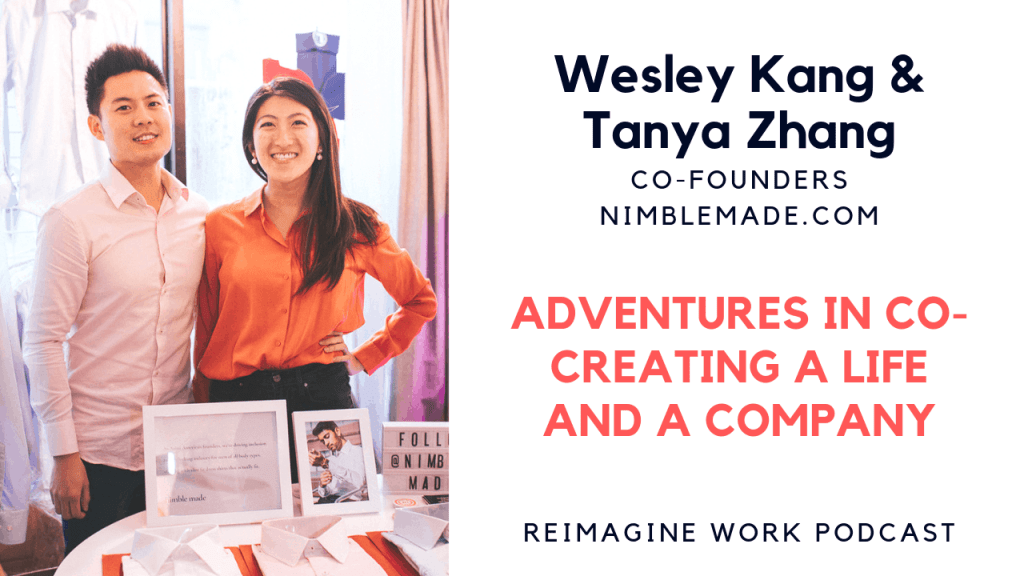
Wesley Kang and Tanya Zhang are the co-founders of Nimble Made, an e-commerce clothing brand that makes “actually slim” dress shirts.
Before taking the leap to work full-time on their business, they worked in the corporate world in New York City. As first-generation Asian-Americans, they had achieved “success” - good jobs, and good salaries. They were on their way. However, deep down both wanted something a little more. Some of Tanya’s challenges working as a freelance graphic designer on the side convinced them they should try to think a little deeper about building a brand and a business, instead of just helping other people.
Wesley never felt right in the corporate world and knew he had to make a change:
After 3 years of working there, I realized there wasn’t much more I could learn and I grew tired of the put-your-ass-in-a-chair-and-get-promoted-every-2-or-3-years environment. It felt like a constant race to see who could sit the longest. We weren’t particularly smart or had particularly unique skills, despite what people may think about banking and finance. I felt a strong desire for change that grew day by day.
Tanya always had that “entrepreneurial spirit” but never really thought it was a “valid” career path for her. While moving to a number of jobs early in her career she continued to find out that perhaps her path wasn’t the corporate world. “Yearning for a bit more and searching for something bigger”
As they found themselves thinking about the business all day at their full-time jobs and coming home ready to work on it, they realized they finally had to go all-in. Over the past year they have worked on the business and are starting to find some traction. As they’ve dealt with the challenges of running a business, they have also had to constantly reflect on how to manage a relationship both as committed partners and co-founders.
What we talked about:
- Expectations on them as Asian-Americans
- What “success” means in today’s world
- Taking the leap to entrepreneurship
- How they handle being in a relationship as well as co-founders
- How Tanya’s freelance work led them to think about starting a brand
- What convinced them to leave their corporate jobs
- How their lives are different now compared to working full-time
- The uncertainty and challenges of entrepreneurship
- Fostering a dog and reclaiming their “daytime”
- How they are thinking about building a life around their work
- How they created a new sizing system for their shirts
- How “average” sizing and approaches to live don’t work for anyone
Interested in their shirts? Check out more at Nimble Made. For their past reflections check out Wesley’s guest post on entrepreneurship and Tanya’s post on how her father inspired her to start the company.
Transcript
Wesley Kang and Tanya Zhang are the co-founders of Nimble Made, an e-commerce clothing brand that makes “actually slim” dress shirts. Before taking the leap to work full-time on their business, they worked in the corporate world in New York City.
Read the full transcript
Paul: Today I am talking with Wesley Kang and Tanya Zhang, the co-founders of Nimble Made, an e-commerce clothing site that makes actually slim dress shirts. Welcome to the podcast, guys.
Tanya & Wesley: Hey, thank you so much. It's great to be here.
Paul: Thanks, Paul. I want to dig into your stories. I also want to dig into the fact that you guys are also in a relationship as you're running a business. But first, just wanted to start with digging into what your conceptions of success growing up were in terms of thinking about going into the business world, getting jobs, things like that. What were some of your earliest reflections on what, what that meant? Either of you feel free to jump in.
This is my first, uh, two-person podcast, so we'll, we'll learn as we go, but, uh, excited to see how this goes. Between Tanya and myself, I think Tanya has the more traditional, stricter parents, so I think she's faced more obstacles around what it means to be successful, especially as Asian Americans, like growing up here. You know, she was on the West Coast, I was on the East Coast, but you know, cultures are really similar. For myself, I think that because my parents came to the US really, really late, they had no real idea of what success meant or like what the American dream was. They just knew that, you know, from a very high level that coming here would be good. And so when they came, they didn't really define for me, like, you know, where I needed to go and like what job I needed to land to find success for myself.
But I ended up like kind of learning that as I went through the system, because I think in the US, you know, education is like such a primary focus, and I think who you're surrounded by, like, that really influences like what you think success is. And then, you know, my parents really, their influence was very broad, and they just basically just wanted me to like find a high-paying job that was like steady and I was able to like support myself and then like make more money than they were able to make, essentially. And I think that's You'll hear that from a lot of immigrant parents because they basically sacrificed everything so that we had this one opportunity.
So what success meant for me always was just study something that was really useful in college, graduate, find a really good job that pays well, and not have to bother my parents for financial troubles or anything, and then hopefully pay them back. And kind of reward them later on in life, you know, by either like buying them something really nice or have enough money to just like retire and spend time with them. And that was like kind of my original definition of success for myself, and it was very straightforward.
Tanya & Wesley: Yeah, I think Wesley's right. We do have kind of different upbringings in that our parents kind of had different I guess, standards that they wanted us to uphold too. But again, very much with the similar themes of like being very hardworking and getting a good job someplace that paid a lot and had a good reputation. For me, my parents immigrated to the States in their mid to late 20s. So they were definitely coming here with the intention of Hey, we're gonna start a family in a better place where they have like an American dream they can fulfill. And so I have very, very clear, very clear kind of moments in my mind from my childhood.
I remember coming home with having gotten like 100 on a test or like a piece of homework, showing it to my dad. And then of course being very like, oh my God, Dad, like look what I got, like 100%, isn't that great? And remember him looking at it and kind of like laughing it off, saying like, "Oh, but that's what you're supposed to get." So it was very tough, very, very tough growing up because I felt like everything I did, I kind of had to build kind of a business case around. If I wanted the new Game Boy SP, I had to kind of build up the rationale as to why my parents should buy it for me. And so it was tough, but it all comes from a place of love only because they've, my parents have both struggled so hard and like brought us to the States or like came over to the States to have us here only just to make our lives much easier.
Paul: Well, I think one thing that jumps out too is You touched on it, Wesley, that expectation of taking care of your parents. It's often not a suggestion, right? It's often quite explicit for people. Has that come up as you've entered into this period of more uncertainty? Tanya's parents came when she was like, when they were like in their 20s. My parents came when they were like mid-40s.
And so they don't like speak really a word of English. And that's kind of influenced a lot in who I am today because I've had to learn how to deal with a lot of different types of scenarios where a young person would not have to help them call the utilities company to figure out why the electricity bill was higher that month because they can't speak English. And I had gone through and I knew English, and so as a 12-year-old, I had to do that. And so for me, I mention that because my parents are less traditional in that sense because they don't know what it means to come here and pursue the American dream, so they're very casual in that sense, so they actually only joke about, oh, when I retire, you're gonna have to give me X amount of money every month. But haven't really like always meant that because they're not that traditional.
Whereas I think in the, in the very traditional mindset, it is like absolutely expected and critical for you to be like giving back to your family and then being like putting that, you know, before anything else in your life. And I think Tanya can maybe chime in on what her parents' thoughts are on, on giving back.
Tanya & Wesley: Yeah, I mean, I think more or less It's around kind of the same, the whole expectation with kind of like a Chinese American family is that you provide for like the generation after you, just give and you give and you give and you give. And with that means that you pay respect to the generation before you. And so yeah, it is very much about expecting that you take your parents in when they're like older and that you can take care of them. Give them grandchildren, etc.
Paul: I'd love to touch on some of the experiences in the corporate world. You both worked in New York for a few years. Wesley, you were more in the banking and finance. Tanya, you worked in advertising, fintech, and consulting. But perhaps we start with Wesley. You, you wrote a reflection on my blog, which I'll, I'll link up in I'd say you were a little bit scorched earth in terms of some of your reflections on the corporate world.
But you said something, we weren't particularly smart or had any particularly unique skills despite what people may think about banking and finance. What's that about? I thought people in banking and finance are highly skilled. I think you know the answer to this one, but You know, when you go through— like, the education system in America is like one that is very systematic. And I think that, you know, we're expected to do certain things, and when we do them, we expect to receive certain things in return. So I think in many ways the system is very like organized.
And so As a result of that, I think everybody has this idea of like, you know, if you go to a good school and you network well, if you go to an Ivy League and you find the right recruiters, then you're going to get into the high finance world doing investment banking or like equity research or, you know, all these like buzzwords in finance. And that means that you're of a certain caliber in intelligence and you studied certain things in school. That might be true to some extent, but when I got to the real world and I got my first job, of course I was super excited and I was really proud of myself because I thought all of those things, right? I thought I was super smart. I thought that I played the game right and networked with the right people, and I thought I had finally got there.
I didn't need to do anything more other than be successful at my job and I'll continue to reap the rewards, so to speak. And after I worked there for like 2, 3 years, I realized that like that wasn't really true. And it's because the very fact that we have this construct, I think, is really the negative thing about it, which is we're kind of siloed in this set of expectations and we're siloed in this set of thinking so that, yeah, people in finance are smart. But they're only smart at using Excel, and they're only smart at doing 5 things, the same 5 things that we do every day for 40 years, right? And to a truly smart person who is intellectually really curious and wants to learn about everything and wants to be involved in everything and is curious, that's not smart at all because you're really only good at one thing.
You know, after working there for like 2, 3 years, I realized that like, you know, you're constantly surrounded by people who think they're really smart and we're all really good at one thing. And so we're in this like fantasy world where we tell each other like we're the best. And then I think it's dangerous because you don't really realize like what else is out there in the world and what else there is to know other than like financial modeling, and like, I don't even like saying those words anymore. But so, so that's kind of what I mean. Like, I think there's a, there's a cycle of feeding into this idea that, you know, you are successful if you are in finance because you know, like, these things. Yeah.
And perhaps, Tanya, you could reflect on— you actually moved, it seems like you moved around a little bit more was that driven by a similar kind of urge for learning? I, and I think like this is something I face is I worked in what was seen as like, oh, you've made it right now. You should just like lock down and try to optimize for earnings. And I kept leaving and like sometimes I'd take pay cuts and people would be like, you're making a mistake. But then like looking back, people would be like, oh wow, you were so successful. And it was like, this is not what everyone told me in the moment.
'cause I was trying to prioritize learning. Eventually I ran out of moves and had to do my own thing, but wondering how that resonates with you and what eventually led you to decide to take the leap.
Tanya & Wesley: Yeah, I mean, that's definitely the exact same kind of feeling. I was— I started my career in advertising as an art director, so I was working on big kind of global campaigns, which was really, really fun. There's a whole kind of glamour to advertising as a whole, especially as a creative. And so I had some really, really great experiences, some really bad experiences there as well, but always thinking about, okay, so this is advertising, what's next? Like, what else is there to learn and to do in this world, right? And so you're right, I did switch from then, I switched to like a fintech startup, And then eventually into consulting.
I think it was always just kind of hoping that I would be able to find a company or a brand or a place that would really continue to challenge me on a daily basis, where I would wake up, feel really eager to be working on something. But it's tough because as Wesley says, these corporations and even higher education as a whole is very systematic in a way that kind of applauds people for doing the average things since they're compared to the rest of their peers on kind of an averaging system. And so it's, it's, it's really tough, especially when you've— especially when you know you have the skill set and the potential and the capacity to be some— something much bigger and greater. It's like, okay, where Where can I go that would really, really just make me feel uncomfortable every day when I wake up? And it turns out starting a business is that.
Paul: Yeah, how did you get to that realization? Was it just moving around a few times? And I think one thing I realized in just full-time jobs is that people are typically hiring you for a narrow set of skills, right? And they're And there's a lot of talk about like we prioritize learning and we want you to like really do a lot of different things. But in reality, it's not what the role of like a full-time job, like your main role is just to kind of do what you're expected to do, keep doing it really well. And kind of as, as Wesley says, sit around the longest and hope to get promoted.
Right. So how did you come to that realization in terms of thinking about entrepreneurship?
Tanya & Wesley: Yeah, I think that's a great question. I think I had it in me pretty early on. Even in college, I was kind of like freelancing on the side, just trying to like do some side hustles here and there, selling t-shirts that I like designed and like silkscreened on the side, you know, for fun. And so I think there— I always had that entrepreneur spirit. And I never really thought that that was a valid career path for me. So naturally, after college, I went straight to kind of a Fortune 500 company to start my first job.
And then from there, just, I think, wanting to try something very, very different and try different industries because I was kind of really hoping that I just hadn't found like the right job or I hadn't found the right company or the right industry that was gonna kind of fulfill my ambitions for me. And so I switched like from agency to a startup that was just financial tech and then switched to consulting, which is a whole different kind of business model. And I mean, it's all really, really great experiences, but I think in the end, you're always just like yearning for a little bit more and just itching to kind of create something bigger.
Paul: Yeah. What was the first moment between you two where you sat down and had that first kind of small thought of, hey, let's start a business together? Or it might not even have been that fully formed, but, uh, do you guys remember the first moment? Might be a different memory for each of you. Um, so actually, like, When we were talking about the Nimble Made company, I think that parts of that actually existed prior to the actual formation of Nimble Made, and it existed in Tanya's design business where, as she mentioned, she did a lot of freelance work in high school, even high school and college, and that business continued to grow until we met. I think in 2017, like March of 2017, we had said like, hey, like, you know, you've been doing this for a while, but you've never really had the opportunity to like try and actually grow it and make it your thing.
And let's try that. And I think we tried that for like half a year and we realized that like the services industry is like, the graphic design services industry was like pretty competitive and we weren't particularly like good or didn't particularly feel compelled to be like aggressive salesmen to try and like pitch clients. And because ultimately like you have to do that in a really, really competitive market. And so we, you know, we were finding ourselves in this kind of like unstable lull where we weren't really sure if we were going to get a client on one month, and then the next month we would get like 3 clients. And it was hard to like project our success and, and maintain it because, you know, I think in graphic design sometimes it can be very like one-off.
And so our idea was like, let's create a product and see if we can like establish some kind of consistency and sell this product and grow it, and then we'll be able to like project it, we'll be able to like work on it. And that product idea turned into what Nimblemade is today. And that really came from, as you know, my personal struggle of not being able to find a dress shirt while working in finance, which is kind of funny because basically working in finance inspired me to create this thing. And I never would have created this thing if I didn't work in finance. For us, the inflection points are really, it's really like March 2017 and then like April of 2018 was when we like turned that product idea into Nimble Made and started working on it. And then August of 2018 was when we formally launched the brand Nimble Made.
And then November of 2018 was when we both like left our jobs. And you know, they aren't defined by those particular moments. There's a lot of buildup in between. I think Really between August and November was the biggest buildup, I think. We would really just go to our jobs every day, come home, and just talk about it. And to the point where we were just like, wait, we're talking about this every single day, talking about like, I just can't wait for that one day where we can just work on this.
And then I think at some point we were just like, wait, why aren't we doing that? We weren't at a place in our lives where if we didn't have our full-time jobs, we would be homeless. Yeah, and so like there really is no good reason to not try it at least, right? I mean, arguments can be made that like we're gonna fail, we're not gonna make any money, but like I think what pushed us over the line was just like money can always be made, jobs can always be had, but like we are never going to be the same young age that we are and be able to take on this risk at the same place that we are. We'll never get time back. And so we kind of just made the leap.
That's amazing. How did you pick the date that was the quit date? Yeah. There was not really a set date. I think I was working at my startup job. So after I worked in banking, I left to join a startup, actually pretty similar to Tanya.
I joined a startup doing finance there. And they were an e-commerce company selling used cars. And there I had like, you know, like a really hardcore manager. He's like a great guy. He's like a great mentor. And he like really challenged me in like many ways that I didn't get challenged in the finance world.
And I think because of that, I realized that like, this is like really fucking hard what I was doing in the startup, but like I wasn't passionate about it. So I didn't have the motivation to like push past these obstacles. And so I had like, basically just like started talking to my manager about it like over the course of a month or two and eventually just led up to this, this like breaking point where I was like, look, I like, I'm doing the company, you know, a disservice by like staying here. Like, of course I can just like lie to you and like not do shit or like be an average person for like who knows how long, however long I want actually. But like, I'm not the type of person to like not be 100%. So I basically just told them like, look, I'm gonna leave.
Like, if that means like giving my 2 weeks notice now or like not coming back tomorrow, I'm doing it. And so, you know, that happened really like in October, so I actually left before Tanya.
Tanya & Wesley: Yeah.
Paul: And after I left, I think Tanya felt more inspired to do it as well. And she had her own struggles because she had to convince like her parents and stuff, and I'll let her you know, talk more about that.
Tanya & Wesley: Yeah, I think that's funny that that's how you remembered it. I think, uh, let me see, I vaguely remember I had started to think about leaving my full-time job, and at that time you had just kind of started at your startup. And so I was like, it definitely took me longer to kind of to get around to do it, uh, just naturally being a very like risk-averse person because of my cultural upbringing. But I had been thinking about it for a good like half year, like literally every single day coming home thinking like, why am I still at this job when I can be doing something on my own? And so it took me a little bit longer to kind of break down. I think Wesley was a little bit more kind of spontaneous and quick to execute towards the end of it, where he actually, as he was saying, ended up leaving before I did, just about like a few, just for like a few weeks earlier, I think.
But yeah, I think it was funny because we were thinking, okay, I'm at least freelancing on the side. I can kind of like leave my job, try to start up. If it takes off, then Wesley can kind of like hop on board. And then just by the nature of like the events at his work, Wesley left before I did.
Paul: I was just like, "Okay, me too." Did you guys ever have a conversation about the different skills you guys had? 'Cause it seems like you have a unique combination and collection of skills.
Tanya & Wesley: I think we didn't kind of sit down and have that conversation. We just naturally came to realize it when we were working on my freelance business that we were trying to scale into kind of a design or like a creative agency. Obviously I was doing a lot of kind of like design work using the Adobe Suite, whereas Wesley obviously had a lot of skills in data and like finance and like the books and everything like that. So that, I mean, was like pretty natural to us just from the get-go working on the, when we were trying to scale our design agency. But when we started working on Nimble, we actually realized like, yeah, we have complementary skill sets, but oh my God, there's a lot of stuff we both don't know.
That was really scary because I think with the, with the creative agency that we were working on, it was kind of just like, okay, we design, we send it out, we collect payment, done, repeat. Whereas with Nimble Made e-commerce business, oh my God, the whole, there's so many things like SEO, SEM, digital ads, none of which we really had dabbled in in our corporate careers at all.
Paul: Did you guys sit down and have another conversation around, hey, we're also in a relationship and we're starting a business together?
Tanya & Wesley: Wesley's nodding.
Paul: Yeah, yeah, I know. I think we— that, that combination conversation we definitely had. And I think when we were doing the freelance business, it was like, it was like less serious, I think, because I basically just told her like, look, if it like, if it doesn't work out, like, of course you can like have your freelance business. Like, I would never like take that away from you. And so I think going into it, like Tanya had that safety net to feel like, you know, even if we don't work out, like I wasn't there to like take that away from her. And we were both working towards like the success of this thing.
But as we got more and more involved with like, you know, Nimble Made and stuff, I think like we've encountered a lot of obstacles we did not foresee. And, you know, I wish we had like an explicit conversation to talk about like What do we do when this happens? What do we do when this happens as a couple? Because what we discovered was that, I think that the nature of running a business where it's a startup and you're the only two people involved is an environment where there's a huge, huge lack of resources. Anything that you don't know, you can't just ask the VP or ask your coworker to find out. And so you gotta find out on your own, and 99% of the time it's not just like ask one question, get the answer.
It's like ask one question and get like 15 more questions. And so it causes a lot of tension and a lot of frustration, and every time I feel like I go down a hole, I find like 10 more holes. And so emotionally it's put us in a very kind of short, we're always short-tempered, I feel like. And so that has definitely trickled into our relationship at times. And that's why I mentioned I wish we had these conversations so that we would know, oh, whenever you're feeling frustrated, just remember that we also love each other and that we're more than this working relationship. But recently I think we've really found the rhythm a lot more.
And I think we've been good at reminding ourselves that This is more than just the success of Nimble Made. It's also like other parts of our lives are melded together in this.
Tanya & Wesley: Yeah, and I think a lot of that is, it's hard to have a conversation around it if you don't really know what to expect or what to really talk about. A lot of the times it's like we are working, something comes up and we're like, oh, okay, this is kind of interesting for both the business and us as a couple. And then that's kind of the moment that we'll talk about it, right? Like for example, we're always working. When do we stop working and just talk as if we aren't business partners? So we kind of chat about that and then we're like, okay, let's try to, after 7:00 PM, we'll stop talking about work and start watching TV or talking about pop culture and stuff like that.
But then really we just end up finding ourselves like 8 PM, 9 PM, at like a late, like late dinner out and just like having the conversation just slide back into work. But also in a good way because it's that we then realize that we actually both like talking about work too. So why does it need to have, why does it need to be that clearly defined and like so black and white? But we're learning a lot.
Paul: Yeah. Yeah, it sounds like you're both excited about it, right? So it's— I think we often get tied to this idea that we should kind of separate work and life, and I think sometimes that's almost why people feel a bit alienated, is because they have this separate work life and it's not really who they are. And I think entrepreneurship— I mean, you've written about this— both of you, the uncertainty of it is, it can be paralyzing, but it can also on the flip side bring you alive, right? It's pairing that uncertainty with responsibility and like the ownership that I know for me, like creating my own things, it just gives me so much energy because there's no one I can complain, there's no boss I can complain about, or there's no like excuse other than like I just didn't have the courage to do it. And I've kind of seen that as a feature, like the uncertainty and vulnerability of it.
How have you guys, uh, felt about that? And definitely in respect to comparing it to full-time work.
Tanya & Wesley: Like I said earlier, I'm more of the kind of risk-averse person. Um, I'm like always very planned out and like organized, like my Google Calendar is like planned to the minute because I'm crazy like that. It is very, very uncertain at all times, every single day. But like you said, Paul, that's just what makes it as exciting as it is. It's really awesome to be able to see the results of like our labor kind of like become fruitful. We've just like recently seen some success in like some of our ads that we've been like pushing out for like months after spending hundreds of dollars, you get like one sale, we're like, oh my God, this is amazing.
Like, just like a wave of like relief. And so yeah, it is very, very scary. I personally haven't really coped with it or found a way to kind of like reassure myself that it's going to be okay. So kind of just living on the edge every day. But it's great to have a co-founder who's also my lover to be able to talk to and like talk things through with.
Paul: Yeah, I think in many ways our relationship has actually made our business relationship stronger as well because like there's just more to it than strictly business. And I think when times are tough, like we can support each other and reassure each other in a personal way that like business partners can't really do. And And I won't say that this would work for everyone because I definitely don't think it would. I think Tanya and I are like really lucky to have this dynamic work between us. I can see how this could like destroy friendships, destroy relationships for sure. So, and for me dealing with the vulnerability and the uncertainty, I usually just like trap myself in like an extreme logic kind of proposition, and I just basically tell myself, like, what is the worst thing that could possibly happen?
And to me, the answer is always like, I spend a bunch of money, the company goes nowhere, we make $0, and I have to find a job again. I have to cash out my 401k, and I have to make money again like everyone else. And to me, if I have to do that after having learned all the things that I've learned, met all the people that I've met, and gained all the skills that I've gained from failing, then that's not really failure at all. And so, you know, there really is no option for me. People often have this fear of, I can't leave my job, I'll never be able to come back again, right? And they're only looking at the negative side of it.
People, when they actually take the leap and they learn all these new things and they're experimenting, the challenge is often not how do I get a job again. It shifts to, oh crap, I've learned all these things. There's now 50 other things I'm actually interested in anyway. And I think people have a hard time anticipating some of the positive shifts that happen from doing something like this, especially early, earlier in, in your 20s like you guys are?
Tanya & Wesley: Yeah, I think that's a really good point. I think it's tough for people because there's not enough entrepreneurs doing it, so they don't have people in their immediate circles where they see that, oh wow, like he or she is doing it, that means I can do it too. And that's something that was especially hard for Wesley and me as Asian American founders. It's like there's not too many of us kind of breaking away from this like conventional career path just due to our kind of cultural upbringing, right? We don't see a lot of Asian or Asian American or even AAPI or people of color entrepreneurs who are kind of like paving the way and showing us that there are like, that you can do it, right? And so it's It is very, very hard to, and I think that like Wesley and I like pride ourselves in being Asian American founders and being very like prideful and saying that we are trying to do this.
And so everyone that we talked to in our communities, we're like, hey, like we're doing this, like you can do it too. You don't have to be stuck at an office job at a 9 to 5 because you think that's the only way to do it.
Paul: How have you found staying in New York? I worked in New York for 2 years and I was working full-time there, but the— when I left, I was still in New York. I was working on my own as a freelancer, basically not really landing any projects and just sticking around in New York. I did the calculation that I was just basically lighting money on fire and I should move somewhere else immediately, but One thing I found was that all my social circle in life was oriented around a Monday to Friday, everyone works 9 to 7 type life, right? And I kind of wanted to do stuff during the day and people would be like, all right, come to happy hour. And it's like, that's not really what I wanted to do anymore.
How, how have you found the social dynamic of all these things? Yeah, I think the most direct answer to that and the biggest change we've had recently is that we started fostering a dog and thinking about adopting, which is funny because you mentioned things you want to do in the daytime that you couldn't really do in the past. And so we've had basically these experiences taking in these beautiful animals and really seeing how their personality changed and I think it's helped us shape our perspectives and seeing something like that makes us just remember that there's so much more to life than a 9 to 7. And that's what these people are missing out on when they have a 9 to 7, right?
So I think staying in New York has been beneficial for us personally and I think in the interest of full transparency, I think we're fortunate that like Tanya and I have a place that, you know, Tanya, like Tanya owns her place. So it's not like we're, we're critically burdened by like rent and stuff. And now that we're living together, we can kind of like cushion, cushion that financial burden in a very large sense. So that's, that's kind of like the majority of our expenditures. Um, so from a financial perspective, like we're pretty okay. And you know, because we've had years in, in the corporate job, like we do have like a decent amount of savings that we could kind of use to live in for the foreseeable future.
So financially, like, that's been fine in terms of staying in New York. But I think the other aspect, which is the positive, is that I, on a personal level, I don't like how ridiculously crazy New York is all the time and how monotoned the working force is. But I think professionally, like, it's good that we're surrounded by this fast-paced environment and that we've been able to really, like, you know, meet so many people so quickly. You know, like, you talk about the density of New York City, like, I think that's been a really huge asset for us because if we go to one event in New York City, we can talk to, like, 200 people, whereas if we go to, like, one event in, like, San Diego, there'll be, like, 30 people.
And so efficiency-wise, and if we bring that to numbers, let's say every 100 people you meet, there's one person that's really important for the growth of your business, whether it's a client or a partner, then meeting 200 people is a hell of a lot faster than meeting 30 people at a time. And so for us, it's kind of efficient for us to be here. And so that's kind of my response to it.
Tanya & Wesley: Yeah, I think definitely to Wesley's point, like we can set up a photo shoot for one of our new shirts and maybe like a few days, if not like a few hours, right? We'll find the model, we'll find the photographer. Everyone's hungry. Everyone's like hustling. They're like, yes, I'll do it. Let's like do it tomorrow.
Or like, so yeah, awesome. So that's really been like helping us expedite our startup. Many people who come across our website or come across us as we're like sharing our brand, they think that we've been around a lot, a lot longer than we have. Again, it's only been about 6 months since we left, but everyone's like, wait, you haven't been doing it for like a few years? Like, no, but thank you. So yeah, it's been— Yeah, I know, thank God.
It's, yeah, it's been really, really great. I mean, I think we both kind of also talked about we'll be in New York for a little while longer. I think it depends on how quickly we can get the business to scale to a to a place where we can basically just work remotely anywhere. Ideally go abroad, maybe meet you in Taiwan. That'd be awesome.
Paul: Basically as soon as we hit critical mass, we're getting the fuck out. Yeah, so let's talk about that. How did you guys ever sit down and say, okay, here's the life we're building around or building towards? I think one of the unique features of working on your own is that it often flips the frame from designing your life around a job to, oh crap, we can do whatever we want. And then you, you have the extra burden of having to design a life that's not centered around a job. But have you guys talked about that or gone through any exercises to figure out what that looks like?
That's both the most exciting and the hardest part because like we've talked about it, but that doesn't necessarily mean it'll happen. We're like, here's what we want to do. We want to get Nimble Made to this level. And it doesn't have to be a multi-million dollar business. Let's say we just scale it to a business that brings in $100,000, $200,000 in revenues a year. That would be enough for us to just go abroad and basically live indefinitely, right?
So we can talk about scenarios like that. And that's not super far-fetched for an e-commerce business. There's plenty of people. Doing stupid dropshipping that does that much in revenues. So we've certainly talked about it, but it's one thing to talk about it and then actually execute the things needed to get us there, right? I think every day we have some idea of like, okay, here's what we need to do today to be one step closer to what we said we were going to be a year from now.
And the problem is we only think that, and it's really hard to know for sure. Whether, you know, it actually moves the needle. Because a lot of times, like, there is no direct feedback system when you, like, start a business. Like, it's like when you're at a corporate job, like, even if you do something that was, like, wasted work, at least you're moving, like, the needle of time, which is, like, if you spend enough time in corporate, like, you're gonna get promoted, you're gonna get a pay raise, right? So it's like just by putting your ass in the seat, like, you're getting somewhere. But in entrepreneurship, that needle does not exist.
It's like if we just sit in front of a computer and do things that we think are working and don't move the needle, then it really goes nowhere because it's all on you and everyone you work with. And for us, that's just Tanya. And for Tanya, that's just me. So that's both the exciting and the challenging part. And we have talked about it, but we're it's hard to align it completely on like a steady track to see if we're ever gonna get there. And the other thing is like, we can like, we can go 364 days like thinking that we're never gonna get there, but then on the 365th day, like everything that needs to happen like happens.
That can also like totally, totally happen on any day. So that's the thing. What have you seen as some of the challenges of, or even some of the interesting things and opportunities that have emerged in terms of of how you can actually start and run an e-commerce business today. I think people don't realize how easy some of these things are to actually pull together. I think the tools, the, the e-commerce sites, the infrastructure in the backend has gotten so much easier that I don't think people realize that this is possible. And I think for me, seeing all this, I've experimented with a lot of different things.
I've come up with like so many ideas just because I'm like, oh my God, I didn't even realize what was possible. Two things, like one, I'm like, oh my God, like the corporate world was using so little of this. And then like two, it's like, oh, there's so many things I could do. What have it been your reactions to what you've seen in terms of the tools and technology out there?
Tanya & Wesley: Yeah, I mean, that's, that's, that's true. I would agree with that. There are a lot much kind of easier, like, user-friendly interfaces and software out there where people can easily click and drag and just create a website, right? I think while the tools exist, definitely just need a lot of perseverance to make sure that you commit yourself to to it because as Wesley and I have made our own website through like Shopify, while it's easy to create the page, creating the whole site is, it definitely takes some effort, right? So it's not to discount the fact that things take time. And so having that patience is really, really great.
But we've, yeah, I mean, we've used Shopify as our e-commerce kind of website host. We use Mailchimp for email marketing. I mean, Instagram obviously is going crazy and there's so many things you can do now with influencers spreading the word of your brand and what you do. And also the easiest I think is just the word of mouth and the amount of, the amount of kind of support that you can get from just your immediate community has been probably the most overwhelming for us, especially since Wesley and I with building Nimblemade were completely bootstrapped, we're self-funded, and so everything that goes into the business is coming out of our personal savings, right? And so naturally we're very much kind of conscious, very aware of where we're spending money. And so being able to kind of reach out to our community and be like, hey, is anyone like willing to help us out with this?
Like give us your feedback on this like dress shirt that we kind of just like hacked together at the very beginning. Like that's like you'd be surprised how many people are willing to help you out, and that's kind of been really helpful for us.
Paul: Yeah, and I think one thing I'll add to that is to like aspiring entrepreneurs and current entrepreneurs, I think like nowadays because there's so much information and so many tools that make like what used to be difficult really easy, it actually creates this facade that like, you know, all entrepreneurs are successful and all people who like try to do something, we'll learn it. And everything is very easy because there's these tools out there to help you do it. But I think it's actually made the landscape more difficult, right? Because it's so easy to create an e-commerce store, everybody's doing e-commerce. So it's like, you now— the difficult part is now not to launch an e-commerce store, but launching an e-commerce store that's differentiated enough so that you can convince people to buy what you're selling.
And that's a hell of a lot harder than, like you said, signing up for Shopify and clicking and dragging a few things. 'Cause you're right, anyone can literally do that nowadays. But because of that, everyone is doing that, and so it's harder to stand out. And for me, the challenge has been figuring out what those things are that we have to do to convince people that we are different and that when you buy from us, you know, it's something else and it's not any other store. And because we've not really done anything like this, like we don't know what those things are. And so the only way we know is by finding out the things that aren't those things and trying something else until like the needle moves, so to speak.
Yeah, so maybe we can close with a little bit about what you're building. I found it fascinating as somebody that was— I am not an Asian American, but maybe I have an Asian American body. Like, I've just never had— I've never had a dress shirt that fit me. Yeah, I don't wear dress shirts anymore, and I'm very happy about that. But talk to me about how you came up with the new sizing system. Yeah, our brand is not like exclusively for Asian Americans.
I think it's simply just like inspired by, you know, kind of my personal struggles. And how I came up with it honestly was just I was never really able to find a dress shirt, and so when we first started this company, I was just like, let me just start by making a dress shirt that fits me, and then we'll kind of just like figure it out from there. And so I literally just like measured myself and then like made a sample of a shirt that like fit me really well. And then I basically bought like tons of dress shirts from like all kinds of competitors, brands that were too big on me, Brands that exclusively sell to smaller men or shorter men. Brands that I already shop at that I know kind of fit me well. And I just measured all of those shirts and I put all of those measurements into an Excel and I kind of just figured something out from there.
And there's no, I literally have no methodology, there's no algorithm behind sizing at all. It's literally just like, hey, instead of increasing the sleeves by like, an inch for every size, let's just do like less than that. And that way, like, people who find the sleeves too long but everywhere else on the body fits like okay will find our dress shirt like better. And it's like finding the medium between like all of these brands so that it's no longer just catering to like the average American male, which, you know, in our community like tends to be larger than our average person. Where can people find out more about what you guys are doing? I'll link up to the couple guest blogs you guys wrote for my site which I thought were pretty fascinating perspective on your leaps.
But where can people find out more if they haven't found a dress shirt that fits them? Yeah, so I think our two biggest assets because we're an e-commerce brand is just basically going to be our website and also our Instagram. So the Instagram is for like just a closer look of like what we're doing day to day, and all of the mediums are just managed by like me and Tanya. So literally like when someone emails us or like DMs us or like talks to us on the chat on the website, it's all me and Tanya. So they can go on our website which is just nimblemade.com, they can go to our Instagram which is just @nimblemade, and then we also have a Facebook page but that is like a little less interactive. I don't particularly like the layout of it, but those, those two are the two our biggest assets.
And then if they want to get in touch, you know, they can email us obviously at hello@nimble-made.com, which is also accessible through the website or Instagram. So those two things are probably the easiest.
Tanya & Wesley: Yeah, and our site also has a sizing calculator, so for someone like yourself who hasn't found a dresser that fits them perfectly, you can go to the fit guide on our website where Wesley worked with a developer to kind of code in a calculator where you input your height, your weight, and then outputs—